Showing posts with label Joseph of Arimathea. Show all posts

Saturday, July 23, 2011

Changes

From the beginning, I have blogged under my long-time on-line alias Roland. In fact, I originally planned to name my blog Oliphant: The Horn of Roland. I was pretty upset when I found the name Oliphant was already taken. The resulting frustration launched me into a small crisis in which I questioned the purpose and content of my intended blog. I realized it would have a primarily religious/theological focus, and I came up with a more fitting title. But it did not then occur to me to switch to a different alias.

I first used the name Roland my first summer in grad school. It was a hot summer, with frequent record-breaking, triple-digit temperatures, and I was living in a cheap room without air conditioning. So I spent my afternoons studying in the comfort of a lounge in the student union. Every once in a while, for a break, I would go the basement and play the video game Tutankham. When I got a high score and had to come up with a name, I spontaneously chose Roland, inspired by the Warren Zevon song, “Roland the Headless Thompson Gunner”. Years later, I revived the name for my high scores in Tetris on a friend’s computer and subsequently began using it in various on-line contexts.

About a decade ago, not long after 9/11, I read The Song of Roland, the medieval French epic poem based loosely on the 778 Battle of Roncesvalles, and I began to assimilate my on-line persona more to this older Roland by choosing appropriately medieval-looking avatars, or by using the name Roland778 when Roland was already taken.

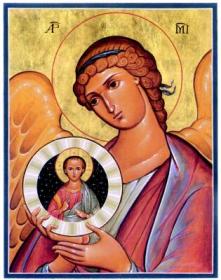
At the same time, in other on-line contexts I was using the alias Arimathean. Long before my chrismation, when Joseph of Arimathea formally became my patron saint, I had considered him my patron. Within a year of starting my blog, I realized this would have been a more appropriate alias (thus my avatar, which is a mosaic image of Joseph of Arimathea), but I had already begun to establish myself in the blogosphere as Roland. So I decided to wait for a more opportune time to make the switch.

For the past two years while I have been studying theology, I haven’t had much time for blogging (or recreational reading or TV or movies . . .). In the few forums where I have been active, I have mostly been using Arimathean, so Roland is now less likely to be missed. So, as of today, my handle in the blogosphere is changing to Arimathean (though I will continue to go by Roland in some non-blogging contexts).

Speaking of recreational reading . . . My first post-seminary novel brought together both of my on-line personae. The hero of Judith Tarr’s Kingdom of the Grail is Roland, who is a descendant of Merlin and Nimue. Nimue, in turn, is the sister of Parsifal, the Grail King, whom one can infer to be descended from . . . Joseph of Arimathea (though he is not mentioned by name in the book). The novel’s execution was not as good as the concept – it too often followed the conventions of the romance genre rather than historical fantasy.

I am also adopting another change. I recently read a Slate article about “logical punctuation”. Until now, for my whole literate life I have slavishly followed the convention of placing commas and periods inside quotation marks. Unlike nearly all other grammar and punctuation rules, this one never made sense to me, and I was always ready to disparage it whenever the opportunity arose, even while following it scrupulously and enforcing it as an editor. In the Slate article, I learned that this is not the universal English language rule my teachers would have me believe. Rather, it is a peculiarly American rule. The rest of the English-speaking world follows the more logical convention of placing commas and periods after the closing quotation mark (unless the punctuation is logically a part of the quote). On-line, it appears that most Americans are now punctuating like Brits. Wikipedia and other sites have adopted logical punctuation as their standard. And even the old guard has conceded that when quotes enclose a URL any following punctuation should be placed outside the closing quote so that no one tries to paste it into the address bar of his browser as if it were part of the address. For now the conflict continues, but it is already clear that the prescriptivist-traditionalist American copy editors are doomed. I’m happy to join the winning side.

Friday, July 16, 2010

Summer Reading

While shopping for souvenirs in the kitschy tourist block of Kruja, Albania, I spotted a book with a title in English, Faith and Fairies: Tales Based on Albanian Legends and Ballads, by Mustafa Tukaj. I didn’t know I was supposed to haggle, so I overpaid for my used, water-damaged copy. The English translation is quite new – it just appeared last year. Perhaps it should have been delayed to allow an actual English speaker to proofread it before publication – some of the translations are unintentionally hilarious. Of the ten tales in the volume, the last five concern the heroes of Jutbina, Gjeto Basho Muj and his brother Halil. The book begins with a scholarly essay summarizing the main themes and motifs that run through Albanian folk tales. The primary virtue exalted in these tales is faith (besa, in Albanian) – keeping one’s sworn pledge of honor.

Before I found Faith and Fairies, I was reading Arabian Fairy Tales by Amina Shah, who comes from “an ancient Afghan family of writers and savants.” The Arabian stories feel, somehow, more familiar and less austere than the Albanian tales. Perhaps living in Britain has taught the author what an English-speaking audience expects. Or perhaps The Thousand and One Nights has become so much a part of the English canon that tales from that culture no longer seem particularly exotic.

At St. Vlad’s, returning students can check out books for the whole summer. After I learned about this privilege, every time I found a book I thought I might want to read over the summer, I filled out a check-out slip for the book. On the second-to-last day of the semester, I took my pile of slips to the stacks, located all my books, and checked them out.

First on my list was Edessa ‘The Blessed City’ by J.B. Segal, a thorough, detailed history of this city, which was central to Syrian Christianity. Here was where Greek, Semitic, Persian, and Armenian cultures met and mixed. Originally home to Antiochene theologians who followed Theodore of Mopsuestia, Edessa’s theological school later switched sides and adopted the theology of Cyril of Alexandria. The city was also home to King Abgar and the famed Edessa icon, known as the mandylion.

Continuing that last theme is Veronica and Her Cloth: History, Symbolism, and Structure of a “True” Image by Polish artist Ewa Kuryluk, an examination of the veronica, the mandylion, and other “true images” of Christ from a postmodern feminist perspective.

Tangentially related to these is Image and Liturgy: The History and Meaning of the Epitaphion, the 2008 M.Div. thesis of St. Vlad’s staff member Tatiana Penkrat. The epitaphion is an embroidered icon of the burial of Christ that is used in Byzantine services of Holy Friday and Saturday, particularly the Lamentation service. I am eager to read this work for multiple reasons:
  • The Lamentation service has always been my favorite Byzantine service.
  • Many recensions of the epitaphion display the Troparion of St. Joseph of Arimathea in the border and place St. Joseph himself at the feet of Christ, making this my patronal icon.
  • Penkrat considers the possibility that the epitaphion is a recension of the True Shroud of Jesus, which some equate to the mandylion translated from Edessa to Constantinople in 944.
Finally, a book that has nothing to do with Edessa and its icon: Religion and the Politics of Identity in Kosovo, by Ger Duijzings. Identity politics in the Balkans has interested me since my 1992 stint on a joint military intelligence task force that followed the Balkans. Since then I have followed Kosovo with special interest; Slobodan Milosevic made the province a particular focus of Serbian identity politics, and the Kosovar Albanians responded creatively to his provocations. Duijzings questions the assumption that ethnic and religious identities in the Balkans are clear-cut and fixed. Indeed, I have long been aware that Balkan villages have historically changed their language and ethnic identity when it was expedient to do so, much as they converted to Islam under pressure from the Ottomans. The whole idea of nationalism, as we understand it, is an invention of the 19th century, and it is even more inappropriate to project it further into the past than it is to maintain it in the present.

Saturday, August 8, 2009

Joseph, the Grail, and the Shroud

Those who know me will understand why I was excited last year when I came across an article whose title promised to tie together three of my favorite subjects: "Joseph of Arimathea, the Holy Grail, and the Edessa Icon," by Daniel Scavone. Those unfamiliar with the third item might find the title of an earlier presentation of the same material more eye-opening: "Joseph of Arimathea, the Holy Grail, and the Turin Shroud." On the one hand, Scavone's literary research undermines the popular understanding of the Grail as the chalice of the Last Supper, as well as the association of Joseph and the Grail with Britain. On the other hand, he gives us as much as he takes when he ties Joseph to Christ's burial shroud, the shroud to Edessa and its icon, and, ultimately, the Grail to the shroud. He concludes that the Grail as chalice is a garbled medieval Western interpretation of mysterious Byzantine descriptions of Jesus' burial cloth.

In his article, originally published in Arthuriana (Winter 1999), Scavone pieces together his hypothesis from numerous ancient and medieval texts, carefully laying the foundation before revealing his conclusions. His paper is thoroughly documented and referenced (the lists of texts, endnotes, and bibliography take up more pages than the main text of the article). For those of you who are into that kind of thing as much as I am (and I know some of you are), just click on the first link above and download the PDF. Here I will just try to summarize his more interesting conclusions.

Joseph and the shroud both make their first appearance in the Gospels. Mark (15:46) tells us that Joseph "bought a linen shroud, and taking [Jesus] down, wrapped him in the linen shroud, and laid him in a tomb which had been hewn out of the rock." And John (ch. 20) reports that when Simon Peter and the Beloved Disciple came to the tomb on the first day of the week, they "saw the linen cloths lying there." The pseudepigraphal Acts of Pilate picks up the story from there, telling us that Joseph was seized by the Jewish leaders and imprisoned. But Jesus came to him in prison and freed him. In describing that encounter later, Joseph recalled, "And I said to him that was speaking to me, 'Show me the place where I laid thee.' And he carried me away, and showed me the place where I laid him; and the linen cloth was lying in it, and the napkin for his face. And I knew that it was Jesus."

According to a Georgian text from the 5th-8th century, St. Joseph's subsequent missionary activity was associated with that of St. Philip, and the two built a church together in Lydda, directly west of Jerusalem. The NT book of Acts names two Philips, who are associated, respectively, with Samaria/Caesarea in Palestine and Phrygia/Galatia in Asia Minor.

Abgar VIII (r. 177-212), King of Edessa, became a Christian sometime before the year 200. He had a close relationship with Rome, and like many Roman client kings, he took a Roman name: Lucius Aurelius Septimius Megas Abgarus VIII, partially taken from the name of the emperor, Septimius Severus. He was well received on a visit to Rome around 202, and he might very well have corresponded with Pope Eleutherius. In 205 he built a citadel called Birtha in Syriac and Britium in Latin.

It may have been during Abgar's reign that the shroud, known as the Mandylion, came to Edessa. In any case, its presence in Edessa is documented from the fourth century. It was transferred to Constantinople in 944. When it was not kept entirely hidden, it was usually displayed folded, so that only the face appeared. This is probably the source of the acheiropoietos, the "icon not made by human hands," usually known in the West as the veronica, a slight corruption of vera eikon, or "true image." But on special occasions the Mandylion, with elaborate ceremony, would be unfolded in stages to full length, over the course of a day. Worshipers were kept at a distance, so the nature of the unfolding ceremony - and of the Mandylion itself - was not clear to the crowds who witnessed it. But the accounts of those who saw it up close, describing the bloodstained image, make it sound like the object we now know as the Shroud of Turin.

It was around this same time that some new icons of Christ appeared, depicting him in death. Scavone suggests that these were inspired by the Mandylion in its partially and fully unfolded forms. Scavone further speculates that it was reported that Constantinople possessed a mysterious relic associated with Christ, which had collected his blood at the Passion, and which appeared in different forms. When these stories passed to the West, they took the form of the no less mysterious Holy Grail.

The Mandylion disappeared from Constantinople when the city was sacked by Western crusaders in 1204. According to a recent Vatican announcement, the burial cloth now known as the Shroud of Turin was hidden and venerated by the Knights Templar from this point until about a century later, when the Templars were suppressed. Not long after that, the Shroud enters the historical record in the West.

St. Joseph of Arimathea is first associated with Britain in a revision of William of Malmesbury's De Antiquitate Glastoniensis (Enquiry into the Antiquity of the Church of Glastonbury), published in 1247 by the monks of Glastonbury Abbey. According to this revised history, St. Philip, who was operating in Gaul, sent a delegation to Britain headed by his mission partner, St. Joseph. But William's original text, written about 1125, had mentioned Philip only in the most speculative way and had not mentioned Joseph at all! The monks apparently revised their history in an effort to claim an apostolic foundation, which would let them trump rival monasteries.

Moreover, William's speculation regarding Philip's presence in Gaul was based on a misunderstanding of his source, which actually related the traditional story that Philip preached in Galatia. The whole idea that Philip and Joseph preached in the West unravels under scrutiny. There is no reason to believe they ever left the Middle East.

The earlier origin story of the Church in Britain, related by the Venerable Bede, was that the 2nd-century British king Lucius had sent a letter to Pope Eleutherius asking to be made a Christian. Bede was apparently drawing from a line from the Liber Pontificalis (Book of the Popes). But it has been recognized for some time that this King Lucius was probably not a British king, but was the Edessan king, Lucius Abgar, whose citadel was known as Britium.

So the connections of Joseph and the Grail to Britain fall apart. Scavone leaves us, instead, with a connection between Joseph, the Mandylion, and Edessa. He sums up his conclusions thus:

In the apocryphal tradition about Joseph of Arimathea, then, before Joseph's Holy Grail as cup of Jesus' blood, there was Joseph's cloth in which he had captured the blood of Golgotha. Britium's face icon (Mandylion) was over time identified as a burial shroud icon of the body of crucified Jesus. The mysterious tenth-century ritual in Britium/Edessa and the new twelfth-century Byzantine Melismos service, inspired respectively by the presence of this reputed burial wrap, portrayed the infant Jesus becoming the adult Jesus, sacrificial victim of the Last Supper and Passion. The romance Holy Grail also revealed the mystery of the infant Jesus changing to the body of crucified Jesus.

Saturday, August 1, 2009

Hymns of the Arimathean

On Thursday evening, the eve of my name day, I attended Vespers at Holy Cross, hoping to hear a few hymns of my patron saint, and I was not disappointed. He shares his feast day with St. Germanus of Auxerre and the Forefeast of the Procession of the Precious Cross, so not all the hymns were about St. Joseph. After the service, I made copies of most of the hymns of St. Joseph of Arimathea for myself, with the exception of the canon (yes, he even has his own canon!). These all come from the appendix to the July Menaion, as published by Holy Transfiguration Monastery. I will share a few of my new favorite hymns.


Doxastikon of Saint Joseph. Plagal of Second Tone.
All generations call thee blessed, O Noble Counsellor; for thou wast deemed worthy to minister to the divine dispensation of the universal salvation of our race. Thou didst pluck that ever-living Flower of Forgiveness that burst into bloom on the trellis of the Cross, and hast delighted the whole world with the sweet fragrance of our restoration to God. Since thou art glorified by Christ as his disciple and friend, O Joseph, intercede with him to save them that keep thy memorial with faith and love.

Another Apolytikion of Saint Joseph. Plagal of First Tone.
Let us honour the man that gave burial to God and showed compassion to him by whose mercy all things exist: Christ the Angel of Great Counsel's Noble Counsellor: who gave his narrow grave to Christ and received as recompense the vast spaciousness of Heaven, where he entreateth the Saviour to show his mercy to those praising him.

Exapostilarion of Saint Joseph. Third Tone.
When the Apostles faltered, the Noble Counsellor valiantly went in, obtaining of Pilate that Body which shook all the world. Now he obtaineth forgiveness for all who keep his remembrance.

Fourth Sticheron of Saint Joseph at the Praises. Plagal of Fourth Tone.
Blessed are thine eyes, which looked on Christ; O Joseph, blest are thy hands, which conveyed him from off the Cross to that quickening Sepulchre where our race was reborn to God. Blest is thy heart, which was rended at his death, wherein he dwelt always, filling it with grace. O Noble Counsellor, as we honour thee with songs of hearfelt joy, intercede unceasingly with God to save us all.

Theotokion. Grave Tone.
A virgin womb, conceiving thee, revealed thee; a virgin tomb, receiving thee, concealed thee. We glorify her from whom thou didst receive a beginning in time, and we honour him that ministered to the end of thine earthly life for our sakes, asking that through their prayers, O merciful Saviour, we might be deemed worthy of thy Kingdom of the Heavens.

Saturday, April 11, 2009

Give Me This Stranger

Today, which is Good Friday on the Gregorian calendar, my Byzantine Catholic e-friend Dan sent me this YouTube video of the hymn “Give me this stranger.” It is Byzantine chant sung in Arabic, and it’s about 10 minutes long. It’s not very impressive visually – just a series of very slow pans over icons of Christ’s burial – but the music is otherworldly.

This hymn is sung on the night of Great and Holy Friday at the end of the Lamentation service, which commemorates Christ’s burial. It is sung from the point of view of my patron saint, Joseph of Arimathea. Many of the hymns on Holy Friday mention St. Joseph, but this is one of only two that are sung from his point of view. (Interestingly, both of these are in tone 5, as opposed to the hymns about him, which tend to be in tones 2 and 6.) An English translation of the hymn follows.


Seeing that the sun had hidden its rays and the veil of the Temple had been rent at the death of the Saviour, Joseph did approach Pilate and did plead with him crying and saying,

Give me this stranger, who from his youth hath wandered like a stranger.

Give me this stranger, whom his kinsmen killed in hatred like a stranger.

Give me this stranger at whom I wonder, beholding him as a guest of death.

Give me this stranger who knoweth how to take in the poor and strangers.

Give me this stranger whom the Jews in envy estranged from the world.

Give me this stranger that I may bury him in a tomb, who being a stranger hath no place whereon to lay his head.

Give me this stranger, to whom his Mother, beholding him dead, shouted crying, “O my Son and my God, even though my vitals be wounded, and my heart burns, as I behold thee dead, yet trusting in thy Resurrection, I magnify thee.”

In these words the honorable Joseph pleaded with Pilate, took the Saviour’s body, and with fear wrapped it in linen and balm, placing thee in a new tomb, O thou who grantest to all everlasting life and the great mercy.

Thursday, August 7, 2008

The Transfiguration and the Cross


When the days drew near for him to be received up, he set his face to go to Jerusalem. – Luke 9:51

I like to visit parishes on their title feasts. I figure that if anyone knows how to celebrate a feast with proper attention and enthusiasm, it will be a parish named for the feast. This is certainly true of Holy Transfiguration Melkite Greek Catholic Church, where I go every year to celebrate today's feast. Tonight, Fr. Joseph's homily cleared up something I had long wondered about: why the Transfiguration is celebrated on 6 August. Previously, the only theory I had ever heard suggested that this just happened to be the date on which the lectionary reading for the feast (Matthew 17:1-9) fell, but that never seemed very satisfying.

I knew the Lutherans had introduced the practice of commemorating the Transfiguration on the last Sunday before Lent, based on the verse from Luke quoted above. It was shortly after the Transfiguration (Luke 9:28-36) that Jesus "set his face to go to Jerusalem," setting in motion the events leading to his arrest and crucifixion. The Transfiguration provided an appropriate high point from which to begin the Lenten descent towards Holy Week, which was historically as well as liturgically correct. Most other Western liturgical churches subsequently adopted the Lutheran practice, including the Catholics and Anglicans, who nonetheless maintained the 6 August feast as well.

Fr. Joseph told us this innovation actually restored an older practice, in which the Transfiguration was observed shortly before Lent or in its early weeks. (The dedication of the Second Sunday of Lent to St. Gregory Palamas, whose theology drew heavily on the Transfiguration, might preserve this ancient tradition in a less explicit way.) Continuing, Fr. Joseph called attention to the fact that we celebrate the Transfiguration on the 40th day before the Feast of the Holy Cross. Thus, the date maintains the traditional and biblical connection between the Transfiguration and the Cross.

Our focus on the Cross actually began on 1 August, when we commemorated the Procession of the Precious Cross, and will continue through the Octave of the Exaltation of the Holy Cross. This can be seen most clearly on Sundays at Matins, where the appointed Katavasia are those of the Exaltation of the Holy Cross from 1 August through 21 September, with brief breaks for Katavasia of the Transfiguration (7-12 August) and of the Dormition (14-23 August).

My patron saint gets into the act here too! St. Joseph of Arimathea is featured most prominently in the services of Holy Friday, with the commemoration of his removal of Christ from the Cross and burial of Christ. His personal feast day, however, is assigned to 31 July, the Eve of the Procession of the Holy Cross, which maintains his inevitable connection to the Cross.

Tuesday, July 31, 2007

The Noble Joseph

Today is the feast of my patron saint, Joseph of Arimathea. The cover of this past Sunday's bulletin featured an icon of St. Joseph that I had never seen before. He stands before Pilate, requesting the body of Christ, while a soldier looks on. (I could not find this icon on-line, but fortunately I have my digital camera handy!) Here is the story from the back of the bulletin:

While we usually think of him mainly when we observe our Lord's Passion, JOSEPH OF ARIMATHEA is actually remembered by our Holy Orthodox Church on July 31. During the time of Christ, he was a prominent member of the Sanhedrin – the supreme religious court for the Jews of that era. Yet he was much more than this: he was a secret follower of Jesus who ". . . was searching for the kingdom of God." (Mark 15:43) A man of great material means, Joseph was a well-respected man in the community. His repuation, no doubt, enabled him to boldly approach Pilate and ask for the body of Christ, so that the Crucified Savior could be given a proper burial, according to the prescriptions of the Hebrew Law. Yes, he would have it buried in his own new tomb, hewn out of a rock. It is said that this act of kindness infuriated the Jews, who had him cast into prison. Tradition tells us that the Risen Lord appeared to him so that he would have first-hand knowledge of the Resurrection.

Upon his release from prison, Joseph was exiled from his homeland of Judea. He dedicated the rest of his life to preaching the Gospel, joining the Apostle Philip on a missionary journey that took them to the coast of Europe. Joseph is thought to have been responsible for bringing the Good News about Christ to the inhabitants of present-day England, winning many converts there. Joseph of Arimathea is considered to be a saint by both the Orthodox and Roman Catholic Churches. Legends and myths abound concerning this saintly man, including connections with the Holy Grail and King Arthur! We remember him, however, primarily for his pious gesture of burying Christ, for which we will forever ascribe the word "noble" to his name.


When Joseph went before Pilate to ask for the body, Pilate promptly granted his request. Pilate, who had not wanted to execute Jesus in the first place, had no reason to withhold the body. He might even have taken pleasure in the thought that it would annoy the Jews! But what about Joseph – did he guess the punishment that would follow from his pious duty?

This telling of the story of Joseph reminded me of Sophocles' play, Antigone. The heroine's brothers, joint heirs to the throne of Thebes, had quarreled, and one had expelled the other, who then returned at the head of an Argive army to regain the throne. They both fell in the ensuing battle. As the play begins, King Creon has decreed that Eteocles, who died defending Thebes, should receive full honors, while his brother Polynices was not to be buried – upon pain of death. Antigone promptly defied the king's command, covering Polynices with a layer of dirt. Knowing the penalty under earthly law, she yet obeyed the unwritten law of heaven, showing her brother the honor due to the dead. For her choice, she was sentenced to be buried alive – sealed in a cave. The citizens secretly honored Antigone for doing what was right and customary, but they would not contradict the king in public. The blind prophet Tiresias ultimately persuaded Creon of his sin, but it was too late: Antigone had already committed suicide. Upon finding her dead, her lover Haemon, Creon's son, also killed himself, followed by his mother Eurydice. (This is a tragedy, after all.)

Euripides' earlier version of the story, now lost, is said to have had a happy ending: the calamity was averted by the intercession of Dionysus and was followed by the marriage of Antigone and Haemon.

According to legend, Joseph was a well-traveled merchant. It is possible that he could have heard a version of the Greek legend in his travels. If so, he might have imagined the risk he was taking in defying the consensus of the Jewish rulers in order to obey the Jewish law regarding burial of the dead. Just as Antigone was sealed in the cave, Joseph was sealed in a prison cell.

Unlike Antigone, however, Joseph did not yield to despair. When the gods intervened for Antigone, in the person of Tiresias, she had already given up hope. According to Robert de Boron's Joseph d'Arimathe, Joseph was fed during his imprisonment by daily appearances of the Holy Grail, which sustained his life and his hope. But according to the Gospel of Nicodemus (which was probably the source of elements of Joseph's story related in Sunday's bulletin), during his first night in prison Joseph was visited by Christ himself, who transported him home to Arimathea.

Joseph had already proven himself the sort of person who does not give in to despair. When all of the disciples besides John were in hiding, Joseph of Arimathea was the one who retained the presence of mind and the courage to attend to the immediate need of Jesus' burial.

Friday, January 5, 2007

Patron Saint

This morning I attended the Royal Hours of Theophany at Holy Cross. Afterwards I spoke briefly with Fr. Gregory about two matters that need to be resolved before my admission as a catechumen – my sponsor and my patron saint. For the latter, I proposed St. Joseph of Arimathea.

In explaining my choice, I offered both a frivolous reason and a serious one. As a fan of the Arthurian legends, I often encounter passing mentions of the Holy Grail’s connection to St. Joseph and his descendants. His name is even mentioned in Monty Python and the Holy Grail!

More seriously . . . In the parable of the Prodigal Son, I have always identified more with the older brother than with the prodigal himself. I am literally an older brother, with siblings two and three years younger, but it’s more than that. Like the older brother in the parable, I am the dutiful, thrifty sort that stays at home and plods along with his life instead of going off in search of thrills, squandering his inheritance, and hitting bottom before coming to his senses. Christianity often seems like a religion designed with the younger brother in mind – Jesus came to call the sinners, not the righteous; the outcasts, not the privileged. But those who tend to think of ourselves as righteous and privileged face other sorts of difficulties, and ultimately we need God’s grace as much as our younger brothers. I take comfort in the fact that when Joseph and Nicodemus, older brothers if ever there were, came to Jesus, he did not turn them away.

Fr. Gregory directed my attention to the epitaphios, the large cloth icon of Great Friday, which depicts St. Joseph preparing Christ’s body for burial. It is inscribed with the words of the troparion, "The noble Joseph, taking down thy most pure body from the tree, did wrap it in clean linen with sweet spices, and he laid it in a new tomb." Perhaps coincidentally – or perhaps not! – the Epitaphios service (technically Matins of Holy Saturday, but normally observed the preceding evening) has always been my favorite Byzantine service, from the first time I experienced it with the Melkites.

I have informally regarded St. Joseph of Arimathea as my patron for at least a decade, and I am happy to have an opportunity to make it official. The epitaphios icon is displayed on a shelf in my bedroom, flanked by a print of Rembrandt’s Descent from the Cross and a photo of Jan de Rosen’s mural of the procession to Christ's tomb.

May St. Joseph of Arimathea pray for me and for all of the older brothers who read this.