Sunday, February 25, 2007

Catechumenation

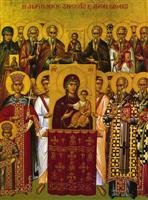
After I formally joined the Orthodox catechumenate earlier this month, my friend Trevor (not my fellow catechumen, but a different Trevor) congratulated me on my catechumenation, then asked if that was a word. I decided that if it wasn't already, it should be! The catechumenate is a period of preparation for the sacraments of Baptism and Chrismation, just as engagement is a period of preparation for the sacrament of Marriage. I was the fourth catechumen. Two others had begun in late November, and one sometime before that. We have recently been joined frequently by a catechumen from a Western Rite mission who intends to transfer to Holy Cross after she is chrismated next month. Today we added six new catechumens. Six! After the homily, when we went forward for the Prayer of the Catechumens, we had nine catechumens and at least five of our sponsors gathered in front of the icon of Christ Pantocrator with Deacon Mark, who led the prayer. In a small parish where 140 is a good attendance on Sunday, we now make up a sizeable share of the congregation. Today was another highly appropriate date for catechumenation – arguably even better than the Presentation (though I wouldn't trade) – the Sunday of Orthodoxy. On the first Sunday of Lent, we commemorate the Church's first victory over the heresy of Iconoclasm in AD 787, at the Seventh Ecumenical Council, and the Church's second victory over Iconoclasm in AD 843, with the subsequent restoration of icons. But we also celebrate the Seventh EC as the last ecumenical council, which finally settled the christological disputes that had rent the Church – and, indeed, the Empire – for the preceding four centuries. This council is understood to have established the Orthodox faith as we know it today. Therefore it has become customary to celebrate the occasion with a procession of icons and the recitation of this portion of the Synodikon of Orthodoxy:

As the prophets beheld, as the apostles have taught, as the Church has received, as the teachers have dogmatized, as the universe has agreed, as grace has shown forth, as truth has revealed, as falsehood has been banished, as wisdom has declared, as Christ has assured, thus we declare, thus we assert, thus we preach: honoring Christ our true God, and honoring his saints, in words, in writings, in thoughts, in sacrifices, in churches, in holy icons; in the first instance worshipping and reverencing Christ as God and Lord, and in the second honoring them as true servants of the same Lord of all and accordingly offering them veneration.

This is the faith of the Apostles, this is the faith of the Fathers, this is the faith of the Orthodox, this is the faith on which the universe is established.

UPDATE: Catechumen number 11 joined us today, 4 March!

Sunday, February 18, 2007

Second Thoughts

I must precede this post with a double apology. First, I am sorry to have kept my readers waiting so long for this post. Second, I'm sorry that it isn't quite up to my usual standards. I actually began composing this one in my mind before I started the blog, intending it to be my second post. I finally began drafting it more than a week ago and have been editing it ever since. It still hasn't quite come together, but I need to let it go and get it off my plate. I can't continue working on it because it upsets me to dwell so much on these issues. But I don't think I can proceed with my apologia until this one is posted.

To summarize my post from earlier this month . . . To the extent that my departure from Anglicanism is a response to current events, I am fleeing more from Archbishop Akinola than from Bishop Robinson. The latter, along with the rest of the liberal leadership of the Episcopal Church, will soon be irrelevant. Unfortunately, the process of excommunicating them is likely either to 1) break up the Anglican Communion, or 2) marginalize Anglo-Catholics.

After I reached my decision and talked with Fr. Gregory about becoming Orthodox, I made an appointment with my rector to inform him of my decision. The very day before the scheduled appointment, I had an experience that induced second thoughts. I was going through my Orthodox links and clicked onto the Interfax religion page for the first time in ages. I saw stories that reminded me once again of my misgivings about the ambitions of the Moscow Patriarchate and its attempts to exert authority over the rest of the Orthodox world. Patriarch Alexy II reminds me too much of Archbishop Akinola.

Just as Nigeria is numerically the biggest Anglican province, Russia is the largest Orthodox jurisdiction. In fact, the Russian Orthodox Church claims more members than all other Orthodox jurisdictions combined. One would think the responsibility of overseeing such a large flock and rebuilding it after seven decades of communism would be more than enough to keep the Russian bishops busy. One might also make similar suppositions about Nigeria, where the rapidly growing church must deal with widespread corruption in society and conflict with Islam. The leaders of both churches, however, seem to think their churches' size and growth in the face of obstacles heighten their authority and responsibility on the world stage. Just as Nigeria sometimes seems to think it should displace Canterbury as the center of world Anglicanism, Moscow often appears jealous of the status of Constantinople as the senior Orthodox see. While some (including me) might dismiss both churches as young and immature, they see themselves, rather, as vital and enthusiastic, in contrast to the more cautious, established churches that have become comfortable and settled in wealthier, more stable cultures. And while some (again including me) see in both churches a dangerous hubris and knee-jerk conservatism, they see themselves as maintaining a purer, more traditional form of their respective religious traditions than the churches of other nations.

In 2004, at the Eighth International Assemblage of the Russian Orthodox Church, Patriarch Alexy revived the "Third Rome" theory, a 16th century notion that, with the fall of Constantinople (the Second Rome) to the Turks, Moscow inherited the prerogatives and responsibilities of Rome. It was on this basis that the Russian rulers adopted the title Tsar, which derives from Caesar. Since then, Russia has always maintained an inflated sense of national destiny. We see this manifested today in Russia's ham-fisted attempts to dominate the neighboring nations that it formerly controlled under the tsars and the communists, as well as in the Russian OC's ongoing attempts to meddle in the affairs of Orthodox churches outside Russia. (Hierourgos notes several such instances in recent months.) In Constantinople, meanwhile, Patriarch Bartholomew promptly dismissed the revived Third Rome theory as "foolish, hubristic, and blasphemous."

So, as I was approaching Orthodoxy, I was reminded that I would not be escaping the sorts of political problems that were wreaking havoc in Anglicanism. In many ways, Orthodox politics are even worse than those of Anglicanism: in their romanticization of the past, and their fantasy-prone views of the present; in their knee-jerk conservatism masquerading as tradition; in the extreme positions of its partisans, as well as their immoderate ways of expressing these positions. It can all be rather upsetting to someone coming from Anglo-Catholicism, where we pride ourselves on the subtlety and understatement with which we express arguments, insult opponents, and issue threats. Unfortunately, the whole world can't live in the rarefied atmosphere of Anglo-Catholicism (though perhaps the Anglo-Catholic diaspora will influence the churches that receive us for the better in such respects).

But Orthodox politics have one major advantage: Orthodox conflicts rarely lead to long-term excommunications or schisms. We somehow remain in communion with extremists whose Roman Catholic counterparts would be sedevacantist schismatics. (Yes, I know there are exceptions. But you can nearly count the schismatic Orthodox groups without running out of fingers. In Anglicanism, on the other hand, no one knows how many break-away groups there are. By this point, I'll bet there are more varieties of Anglicans than of Franciscans!)

So I can look forward to a church with plenty of political conflict, just like Anglicanism. But while I have to be in communion with "those people," they will also be stuck with me; to an anti-ecumenical Russian devotee of the Julian calendar, I am one of "those people." But unlike Western churches, where unresolvable conflicts too often end in schism, most Orthodox will just keep arguing until Judgment Day or the next Ecumenical Council, without imagining there is anywhere else to go.

Wednesday, February 14, 2007

Ruth Gledhill Proposes Anglican Divorce

It would appear that Ruth Gledhill, proposing divorce on Valentine's Day, is no romantic. It would even appear that she regards divorce, in this instance, not as a necessary evil, but as a positive good. Gledhill sees an upcoming Anglican split resulting in two churches, headquartered in Nigeria and the U.S., respectively. She concludes:

An obsession with unity is blinding Anglican leaders from seeing the truth now facing them. It would be a better, braver and more realistic course of action to separate. It is time for the Anglican Communion to divide up the assets and divorce.

I submitted the following response (which has not yet appeared – I assume responses on the Times site are moderated). It doesn't say anything I haven't already been saying for the past few months, but it says it in 998 characters – just under the 1,000-character limit for comments on the Times site).

The unity of the Church in England was a founding principle of the C of E in 1559, and its tradition of comprehension was how that principle was realized in practice. Today, however, the C of E no longer thinks of itself as THE Church OF England, but has settled for being just one sect among many. The rest of the communion has followed this lead. With this change of identity, many Anglicans no longer take the principle of unity as a given, and they have ceased working to accommodate one another.

Ruth Gledhill proposes that the two major factions should simply acquiesce to the inevitable and get on with the schism. But any church built on schism as a founding principle will be inherently Protestant. There will be no place in either post-Anglican denomination for those of us who do not regard ourselves as Protestants. For Anglo-Catholics, and for anyone else whose ecclesiology takes unity as essential, at least in principle, the proposed "solution" is the end of the Anglican road.

Friday, February 2, 2007

The Presentation

Well, it's now official – as of a few hours ago, I am an Orthodox catechumen! At tonight's Vesperal Liturgy for the Feast of the Presentation, I went forward after the Gospel (there was no homily tonight) with my fellow catechumens and our sponsors to stand before the icon of Christ for the Prayers of the Catechumens.

I chose this date primarily for a practical reason – it was the first Divine Liturgy at Holy Cross since I completed my final duties at St. Paul's. But I also think it was symbolically appropriate to make my official Orthodox debut on the day when Jesus made his first visit to the temple.

On Tuesday morning I attended the early Mass at St. Paul's to celebrate the Feast of King Charles the Martyr and to receive communion for the last time as an Anglican. Tomorrow night I will make my first visit to St. Paul's as a non-Anglican for the annual Candlemas service, featuring the Blessing of Candles, a procession, and an orchestral Mass setting by Mozart. It is actually the same feast that we celebrated tonight at Holy Cross. Since the Antiochians normally observe great feasts that fall on weekdays on the eve, I will be able to celebrate one of my favorite feasts a second time!

Monday, January 29, 2007

Why Now?

No one asks me why I’m becoming Orthodox – at least no one who knows me. For many years I have been quite open about the fact that if I ever left the Episcopal Church my likely destination would be Antioch. But friends do ask, "Why now?"

Recent History

It is hard not to know what is happening in the Episcopal Church these days – we’ve been making the headlines a lot. But for those who have somehow missed the story I’ll recap. In 1998, the last Lambeth Conference (a decennial gathering of all the bishops of the Anglican Communion) passed a resolution affirming traditional sexual morality by a large majority. While some bishops questioned the need for the resolution on the principle that the Church’s teaching on sex went without saying, others were distressed by the liberal drift of some of the Western provinces – particularly the Episcopal Church, USA, and the Anglican Church of Canada – and wanted to lay down a marker. Five years later, the Canadian Diocese of New Westminster began permitting same-sex unions and the American Diocese of New Hampshire elected the openly gay Gene Robinson as bishop, despite numerous warnings of dire consequences from the rest of the communion. The Archbishop of Canterbury, Rowan Williams, responded by appointing a commission to reflect on this challenge to the unity of the Anglican Communion and to propose a way forward. The result was the Windsor Report, which placed some demands on ECUSA and the ACC. At its General Convention in 2006, ECUSA produced a last-minute, half-hearted half-response to Windsor. It was universally dismissed as inadequate. Today, more than half of the Anglican provinces are no longer in full communion with ECUSA, which has proceeded blithely on its way, in near-complete denial of its emerging pariah status.

So . . . after decades of liberal drift in the North American provinces of the communion, why have Anglican traditionalists finally reacted now? Gene Robinson is neither the first heretic nor the first sinner to be elected a bishop in the Episcopal Church. If we did not leave the church over Bp. Spong, why should we leave over Bp. Robinson? Personally, I thought this was the wrong time and the wrong issue, but the bishops of the Anglican Communion did not ask my opinion before setting in motion the process of excommunicating the Episcopal Church and the Anglican Church of Canada.

Is it really all about homosexuality? For some Evangelicals, I’m afraid it is. Matters of sex have a tendency to stir the passions, and arguments about sex can draw visceral reactions in a way that debates on other moral questions do not. There really are some homophobes in the churches.

But the current tide of events is driven less by homophobia than by opportunism. Conservatives of various stripes have been increasingly upset with the liberal drift of the Episcopal Church for at least four decades. In the past, however, as a shrinking minority, they were not able to do anything about it. But by 1998 the rapidly growing, conservative churches of Africa were ready to flex their muscles and make their mark on the Anglican world. Homosexuality was simply the first issue to come along since conservatives attained a preponderance in the Anglican Communion. Therefore this was where they chose to take their stand against the advance of revisionism and launch the reconquest.

Communion and Covenant

In the aftermath of the Episcopal Church’s General Convention last year, Abp. Rowan issued his reflection, "The Challenge and Hope of Being an Anglican Today," in which he proposed the creation of a formal covenant to define the commitments of Anglican churches in communion with each other. Provinces (and perhaps dioceses and even parishes) that endorsed the covenant would be constituent members of the communion with representation in official bodies. Those that did not endorse the covenant would no longer be full members of the communion.

For me, as an Anglo-Catholic, this was a hopeful moment – a plausible way forward that would preserve the Anglican Communion by excising the heretical minority in North America, along with any other factions that could not live within the consensus of the communion as defined by the covenant. But almost immediately the Archbishop of Nigeria, Peter Akinola, and others of his ilk began to downplay the importance of the communion and to break ranks with Canterbury and the other provinces and their primates.

The African Evangelicals do not lose any sleep over catholic niceties like tradition, unity, and (most important) ecclesiology. The African-sponsored break-away jurisdictions in North America have been formed by protestant means according to protestant principles. No Anglo-Catholic parish could join these groups without betraying its catholic ecclesiology.

I don't think this is an accident. The Africans are not just trying to separate from revisionist heresy; they are also maneuvering to set aside the catholic elements of Anglican ecclesiology and to exclude those of us who would insist on maintaining them. They might tolerate Anglo-Catholicism as a "worship style," but they will not accept the theology embodied in that worship – a theology on the ascendant in official Anglicanism throughout the 20th century.

Just two weeks ago, Abp. Rowan named the members of the Covenant Design Group, which will draft the covenant. But, without strong support from the provinces, the covenant is fading in relevance before its drafting has even begun.

Heresy vs. Schism

Unlike most of those departing the Episcopal Church these days, I am running not from heresy, but from schism.

I’ve never been all that worried about being in communion with heretics. The notion that it would somehow taint my orthodoxy is a bit silly. Why, rather, would my orthodoxy not compromise the purity of their heresy? If orthodoxy is stronger than heresy, that must surely be the case. If this were just a straightforward contest between orthodoxy and heresy, it would be better to stay in the church, proclaiming the truth, until the heretics give us Anglo-Catholics the boot. Unfortunately, the Episcopal/Anglican endgame is not playing out in such a straightforward way.

The Elizabethan Settlement, the modus vivendi by which Christians of differing theologies were able to maintain their integrities within one national church, has come unraveled. The Church of England no longer makes a serious attempt to be THE Church OF England, but settles for being just one sect among many. Its tradition of "comprehensiveness" is falling by the wayside, allowing the centrifugal forces of its various factions to pull it apart. This disintegration is playing out even more quickly within the North American provinces and at the international level.

The Revisionists who have come to dominate the Episcopal Church have slowly tightened the screws on everyone who is not down with their agenda. They are trying to exclude traditionalists, conservatives, and even moderates and those who are undecided on the issues du jour from having a voice in the church. Meanwhile, the various schismatic Evangelical denominations are forming on a basis that excludes anyone who does not share their theology. In the process of trying to exclude each other, the Revisionist protestants and the Evangelical protestants are both excluding the Anglo-Catholics. The way things are breaking down, it appears there will be no place for us in the emerging post-Anglican churches of North America.

Anglo-Catholic Twilight

The Church of England recently began the process that will eventually lead to the consecration of women as bishops. In reaction, Anglo-Catholics in the UK are likely, at some point in the next five years, to flock to Rome en masse. It is rumored that a document on this subject has already crossed the Pope’s desk. I think that Benedict, unlike John Paul II, will not let the Anglo-Catholics in the Mother Country slip through his fingers.

Where does that leave Anglo-Catholics in the US? I doubt our remaining bishops in Quincy, Fort Worth, and San Joaquin will have enough clout to do much for those of us outside their own dioceses. Perhaps the more tolerant of the liberal bishops will find a creative way to let Anglo-Catholic parishes in their dioceses remain in communion with Canterbury. But the fact that Canterbury is having trouble holding onto its own Anglo-Catholics will make communion with Canterbury increasingly irrelevant to us.

Anticipating all of this, American Anglo-Catholics are already beginning to trickle away to the Roman Catholic and Eastern Orthodox Churches. Of my original demographic peer group at St. Paul’s, I am the last remaining Anglican, the rest already having departed for Antioch or Rome. We did not discuss this among ourselves – that would be difficult, given our current geographical dispersion – but it appears we all came to the same conclusion independently: there is no future for those of our ilk in Anglicanism.

Monday, January 15, 2007

Benedictine Cell

The Pharisee stood there and said this prayer to himself, "I thank you, God, that I am not grasping, unjust, adulterous like everyone else, and particularly that I am not like this tax collector here. I fast twice a week; I pay tithes on all I get." The tax collector stood some distance away, not daring even to raise his eyes to heaven; but he beat his breast and said, "God, be merciful to me, a sinner." - Luke 18:11-13 Thursday evening was my final Benedictine Cell meeting at St. Paul's. The cell has been meeting on the second Thursday of the month, eleven months a year, for four-and-a-half years now, and I've been a member since the beginning. Following Evening Prayer and Low Mass, we eat dinner, study a section of the Rule of St. Benedict (we're up to chapter 48), engage in a group form of lectio divina, and conclude with the office of Compline, after which everyone departs silently. We take turns providing food and drinks for supper, choosing the lectio passage, and leading Compline. Last night I brought the main dish for supper. As usual, I made something in my crock pot - in this instance brown rice and chicken. As at the last meeting, I had to field many questions about my upcoming move to Eastern Orthodoxy. I had to assure everyone I would still come back to visit St. Paul's on special occasions, like Candlemas and Advent Lessons and Carols. For lectio, Janet read Luke 18:9-14, the Parable of the Pharisee and the Tax Collector, which begins by providing the context: Jesus spoke this parable "to some people who prided themselves on being upright and despised everyone else." At an Anglo-Catholic shrine parish like St. Paul's, you can't swing a thurible without censing a dozen such upright people. "We thank thee, O God, that we are not like those Nonconformists, who lack the Prayerbook and decent church music. Or our fellow Anglicans of Latitudinarian churchmanship, who are lazy and indifferent in their practice of the faith." But, of course, one finds the same sort of thing in Orthodoxy. "Thanks be to God that we are not like those Romanists and Protestants, suffering the inevitable consequences of their Western heresies. Or our fellow Orthodox who use the wrong calendar." And now, by pointing out these instances of ecclesiastical pride in both the church I'm leaving and the one I'm joining, I am implicitly saying to myself, "Thank God I'm not like those immature, pride-besotted people praying next to me!" The tax collector shows us the way out of this never-ending circle of pride when he beats his breast and prays, "God, be merciful to me, a sinner." Perhaps the need to counter religious pride is one reason why Orthodoxy, a tradition with much to be rightly proud of, so often commends recitation of the Jesus Prayer: "Lord Jesus Christ, Son of God, have mercy upon me, a sinner." With lectio completed, our leader produced a gift-wrapped package with a bow on it and handed it to me. I quickly looked at the card, signed by my fellow cell members, and then opened the package to find . . . a Byzantine cross. I recalled Fr. Stephen's recounting of the Orthodox folklore that the proper way to collect icons is not to go looking for them, but to wait for them to come to us, and I thanked them for the thoughtful gift. We then concluded with Compline. About two times out of three, we actually follow our rule and depart, more or less, in silence. But other times there is an unspoken consensus that the need for speech outweighs the rule of silence, and this was one of those times, as everyone wanted to say goodbye again. In my remaining two weeks at St. Paul's, I'm sure this ritual will be repeated several more times.

Friday, January 12, 2007

Stability

This is my contribution to a conversation on loneliness and transience in the modern world begun by Fr. Stephen and continued by Trevor.


I think the natural state of man is to live in an organic community, complete with a fully integrated culture and religion. And it's all given, not chosen - that's really the key.

But the project of modernism was to undermine the patriarchal institutions that embody culture - the family, the church, and the community - in order to establish a new order based on individual freedom. All power was pushed to the extreme ends of the spectrum - to the central government at one end and the lone individual at the other end. The values of this new "culture" (to use the term loosely) - wealth, sex, power, and freedom - are diametrically opposed to the Benedictine vows of poverty, chastity, obedience and stability. Without community, there is no discipline.

The minions of Satan on Madison Avenue have joined the founding radicals in promoting the modern lifestyle of individualism and alienation because it creates new marketing opportunities. A culture of people living disciplined Benedictine lives, on the other hand, would be the bane of modern consumerism. (I said something similar in a letter to First Things a decade ago.)

Today churches find themselves in the unnatural position of having to exist without being integrated into a local culture or community. Many churches - especially Orthodox and Anglo-Catholic parishes - respond by creating a community coterminous with the church and maintaining a culture (preferably inherited, but in convert parishes more likely created) within the church.

In the same way that Benedictine monasteries preserved the remnants of ancient culture within their walls through the Dark Ages, perhaps the churches must now preserve the remnants of community until our culture recovers from the devastation of the Modern Age.

Friday, January 5, 2007

Patron Saint

This morning I attended the Royal Hours of Theophany at Holy Cross. Afterwards I spoke briefly with Fr. Gregory about two matters that need to be resolved before my admission as a catechumen – my sponsor and my patron saint. For the latter, I proposed St. Joseph of Arimathea.

In explaining my choice, I offered both a frivolous reason and a serious one. As a fan of the Arthurian legends, I often encounter passing mentions of the Holy Grail’s connection to St. Joseph and his descendants. His name is even mentioned in Monty Python and the Holy Grail!

More seriously . . . In the parable of the Prodigal Son, I have always identified more with the older brother than with the prodigal himself. I am literally an older brother, with siblings two and three years younger, but it’s more than that. Like the older brother in the parable, I am the dutiful, thrifty sort that stays at home and plods along with his life instead of going off in search of thrills, squandering his inheritance, and hitting bottom before coming to his senses. Christianity often seems like a religion designed with the younger brother in mind – Jesus came to call the sinners, not the righteous; the outcasts, not the privileged. But those who tend to think of ourselves as righteous and privileged face other sorts of difficulties, and ultimately we need God’s grace as much as our younger brothers. I take comfort in the fact that when Joseph and Nicodemus, older brothers if ever there were, came to Jesus, he did not turn them away.

Fr. Gregory directed my attention to the epitaphios, the large cloth icon of Great Friday, which depicts St. Joseph preparing Christ’s body for burial. It is inscribed with the words of the troparion, "The noble Joseph, taking down thy most pure body from the tree, did wrap it in clean linen with sweet spices, and he laid it in a new tomb." Perhaps coincidentally – or perhaps not! – the Epitaphios service (technically Matins of Holy Saturday, but normally observed the preceding evening) has always been my favorite Byzantine service, from the first time I experienced it with the Melkites.

I have informally regarded St. Joseph of Arimathea as my patron for at least a decade, and I am happy to have an opportunity to make it official. The epitaphios icon is displayed on a shelf in my bedroom, flanked by a print of Rembrandt’s Descent from the Cross and a photo of Jan de Rosen’s mural of the procession to Christ's tomb.

May St. Joseph of Arimathea pray for me and for all of the older brothers who read this.

Thursday, January 4, 2007

Background

Before I begin to explain my reasons for becoming Orthodox, I suppose I should provide some background on where I am now and how I got here. Different people know different parts of the story, but few know everything, so I'll start at the beginning, moving quickly and avoiding tangents (I need to save something for future posts!).

I was raised as a United Methodist in Indiana. I grew up in a county where there was no Episcopal church, let alone an Orthodox church! I participated in my UM church's very active youth group, served on the District Council on Youth Ministries, and assisted my mom with her duties as the church's custodian. When it was time for college, I attended DePauw University, a Methodist-affiliated liberal arts college in Indiana. During my four years there I attended Gobin UMC on campus nearly every Sunday, attended chapel nearly every Wednesday, and participated in an InterVarsity Bible study co-led by my roommate. After graduation I proceeded directly to graduate school at the University of Illinois, where I was active in the Wesley Foundation and became a regular at the weekly, student-led Midweek Worship service. When I moved to Virginia to start my first real job, I quickly found Wesley UMC, where I would eventually lead the young adult class on Sundays and serve as secretary of the Administrative Board. By this point I was 30 years into my life and had never really considered alternatives to the denomination I was raised in. But that was about to change.

In 1991 I was hanging out with my colleague Pat at a Russian festival sponsored by our Russian teacher's church. We ran into Pat's old friend from O'Connell High School, Mark, who was in the process of converting from Catholicism to Orthodoxy. At the time, he was attending Holy Transfiguration Melkite Greek Catholic Church. That day just happened to be Pentecost, and from the Russian festival he was headed for Kneeling Vespers with the Melkites. At Mark's invitation, Pat and I tagged along.

This was a real eye-opening experience for the Methodist boy from rural Indiana. I had never seen a sung liturgy with incense before. It got me asking a lot of questions like, "Why don't we do this?", "Should we do this?", and "What else is there besides Methodism?" I initiated an intensive campaign of research on Christian denominations, just to see what options were out there.

Several months later, my colleague Elizabeth and I were trying to figure out what Candlemas was. A few days after that, I saw an ad in The Washington Post for the annual Candlemas service at St. Paul's Episcopal Church, so I decided to attend and see what I could learn. The service lived up to its elaborate, impressive title: Blessing of Candles, Procession, Solemn Evensong, and Benediction of the Most Blessed Sacrament. As if that were not enough, it was also the parish's Annual Service of Catholic Witness. When all the lights dimmed except those aimed behind the altar, and the back-lit priest, obscured by the thick incense, held up the monstrance, it was the spookiest thing I had ever seen in church – but in a good way!

On Wednesday evenings of Lent that year, I alternated between St. Paul's (Evening Prayer and Low Mass with hymns, followed by dinner and a guest speaker) and Holy Transfiguration (Presanctified Liturgy followed by a light fasting meal). I continued visiting both parishes whenever nothing was happening at Wesley UMC, which was just about any time except Sunday morning.

Around this time I heard of the Order of St. Luke, a high-church Methodist group, but I was never able to get information about it (this was back in the dark ages before the Internet!), so the UMC lost what might have been its one chance to hold onto me. It was also around this time that my colleague John gave me a copy of Peter Gillquist's book, Becoming Orthodox, which clarified many bits about Orthodoxy that might otherwise have remained mysterious or inaccessible.

And then I began attending the catechumenal class at St. Paul's, not yet committed to becoming Episcopalian, but just to learn more. I was still attending Wesley UMC most Sundays at 11:00, often preceded by the 9:00 Sung Mass at St. Paul's. I was pleased to find that everything I was learning at St. Paul's was consistent with what I was learning from Orthodox sources. Where (as I was later to learn) most Anglo-Catholic parishes are quasi-Roman in their teaching, ethos, and worship, St. Paul's was essentially Western Orthodox – and often self-consciously so. This meant that my choice between Anglo-Catholicism and Orthodoxy would have to be determined on other bases.

At that time my sister had been going to an Episcopal church for a few years. So if I were to become Episcopalian I would not be adding a new denominational division to my family. Also, I had not yet been exposed to the arguments against the ordination of women, so I tended to think it was a good thing, which was another point for the Episcopalians. I was also interested in exploring a possible monastic vocation, and I had learned that there were religious orders in the Episcopal Church. But, most important, as a devout Methodist I had to ask, "What would John Wesley do?" The Episcopalians taught me something the Methodists did their best to downplay: John Wesley never left the Church of England, but remained an Anglican priest until he died. So, at the time, joining St. Paul's seemed like the logical thing to do – a fulfillment, rather than a betrayal, of my Methodist upbringing.

I still wasn't sure I would go through with it until the bishop's hands were on my head, but when he dealt me a resounding slap that could be heard at the back of the nave, I and everyone else at St. Paul's knew that I had been confirmed and was now a member of the Episcopal Church.

Sunday, December 31, 2006

On the Road with Jesus

Then they came to Capernaum; and when he was in the house he asked them, "What were you arguing about on the road?" But they were silent, for on the way they had discussed with one another who was the greatest. - Mark 9:33-34

Two weeks ago it was my turn to choose the scripture passage for lectio divina at my monthly Benedictine Cell meeting. Looking for inspiration, I checked the Byzantine lectionary and found the Gospel readings for the week were mostly from Mark 9, and I settled on vv. 30-37. After the Transfiguration, as Jesus and his disciples were walking through Galilee to Capernaum, he told them of his upcoming death and resurrection, but they did not understand and were afraid to ask what he meant. The subsequent verses, quoted above, suggest they might not have been paying close attention because their thoughts were focused elsewhere.

This reminds me of too much on-line religious discussion. We are supposedly all following Jesus, but we waste our time and efforts in arguments that often boil down to questions of who is the greatest.

This is not, of course, to invalidate all argument! Sometimes disagreements must be clarified, and sometimes errors must be corrected. But arguments in the service of our own egos typically edify no one, least of all we who offer them. "If anyone would be first, he must be last of all and servant of all."


At the Benedictine Cell meeting, before I read the passage from Mark to begin the group lectio, my friends spontaneously interrupted the order of the meeting to begin peppering me with questions about my upcoming move from Anglicanism to Orthodoxy. It reminded me that even the friends who have accompanied me on the road with Jesus for several years have questions about this step I am preparing to take - and those who know me less well probably have even more questions. By the conclusion of lectio, I had resolved to start this blog and committed myself to doing so. But I also resolved not to let it become just another forum for arguing about who is the greatest.

I do not intend for this blog to be just an apologia for my becoming Orthodox, but that subject will probably dominate my first several entries. As I exhaust that topic, the subject matter of my posts will broaden to encompass more of my wide-ranging interests. I anticipate that a majority of my posts will remain broadly within the realm of religion and spirituality, but I might also stray into the areas of culture, history, science, and music, among other things.

If there is a single theme that runs through all of my thought, it is the Incarnation - specifically the perfect union of the two natures, divine and human, in the person of Jesus Christ, as defined by the Council of Chalcedon. This is my touchstone, and I hope it will always be implicit (when it is not explicit) in what I post here.

It is appropriate that this initial post will appear in the midst of Christmas season, as we celebrate Christ's nativity, and on the eve of the new year, a time for new beginnings.