Saturday, December 22, 2007

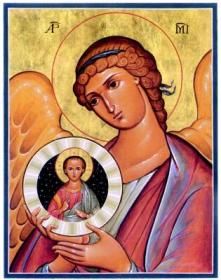
When Half-Spent Was the Night

Antiphon. When all things were in quiet silence and night was in the midst of her swift course, thine almighty Word, O Lord, leaped down from heaven out of thy royal throne. [Wisdom of Solomon 18:14-15a]

Verse. The Lord is King, and hath put on glorious apparel; the Lord hath put on his apparel and girded himself with strength. [Psalm 93:1]
Glory be to the Father, and to the Son, and to the Holy Ghost: As it was in the beginning, is now, and ever shall be, world without end. Amen.

Antiphon. When all things were in quiet silence and night was in the midst of her swift course, thine almighty Word, O Lord, leaped down from heaven out of thy royal throne. [Introit for the First Sunday after Christmas]


The Bible is sometimes quite specific about the time of day when an event occurred – for example, Acts tells us that the descent of the Holy Spirit took place at “the third hour” – i.e., mid-morning. But where the Scriptures offer less detail, Christian imagination has filled in the gaps in symbolically appropriate ways. Thus, we usually think of the Resurrection as happening at sunrise: It is consistent with what the Gospels do tell us, and it is fitting that the return of the Light of the World should coincide with the dawning of the new day.

It is customary to depict Jesus’ birth as occurring at midnight. This is consistent with Luke’s report that the angels appeared to the shepherds by night to announce Christ’s birth. But midnight is the appropriate time for symbolic reasons, as well. Midnight is a pivotal moment, neither part of the old day nor of the new, but a time out of time. For this reason, people in some cultures have believed that the doors between worlds are open at midnight – thus the idea of midnight as “the witching hour,” when spirits can cross into our world.

The midnight of the Nativity was the pivotal point in all of history, the moment between BC and AD, neither part of the new era nor of the old. A momentary lull enveloped all of creation in stillness. The door between heaven and earth stood open as the mystery of the Incarnation was accomplished in Bethlehem. Then the silence was broken as the hymn of the angelic choir in heaven came to shepherds on earth.

Wishing you all a joyful Christmas and a happy 2008,
Roland


Es ist ein Ros’ entsprungen

There is a rose-tree springing
forth from an ancient root,
as those of old were singing.
From Jesse came the shoot
that bore the blossom bright
amid the cold of winter,
when half-spent was the night.

This rose-tree, blossom-laden,
as spake Isaiah of yore,
is Mary, spotless Maiden,
for us this Flow’ret bore:
by God’s eternal will,
a little Babe she childeth,
yet Maid remaineth still.

This Flower, whose fragrance tender,
with sweetness fills the air,
dispels with glorious splendor
the darkness everywhere;
true Man yet very God,
from sin and death he saves us
and shares our every load.

With heartfelt prayer we ask thee,
O Mary, sweetest Rose,
by this thy Flow’ret’s sorrows
– as his he bare our woes –
to come unto our aid:
that for him, fine and ready,
a dwelling-place be made.

[Four verses of a 22-verse Rheinland Marienleid as given in a manuscript prayer book (Trier, ca. 1587), of the Brother Conrad, O. Cart., Procurator of the Charterhouse at Mainz; translated cento 1986 by John H. Uhrig, after translations and versions by Harriet Reynolds Krauth Spaeth, 1875; Theodore Baker, 1894; and George Ratcliffe Woodward, 1904.]


I’m recycling this from 2002. That was a slow year for me and I didn’t have any news to share in my annual Christmas letter, so I wrote this instead. It is based on earlier versions going all the way back to ca. 1985, when I first shared something like this orally with a few friends around All Saints’ Day.

Monday, December 17, 2007

Fred Sherrer, RIP


Tonight I received e-mail messages and phone calls from a number of friends to inform me of the death of Fred Sherrer. I knew Fred from my former parish, St. Paul’s, K Street, where he had been a member for many years. He was the sort of unique character that Anglo-Catholic parishes always seem to attract in far greater numbers than other churches, proof of both the inclusiveness and the pastoral nature of Anglo-Catholicism. Tonight at Evensong & Benediction, right after the Magnificat (Dyson in C Minor for you Anglican music aficionados), he lay down in the pew and became unresponsive. His doctor administered CPR and the curate administered the Last Rites before the paramedics arrived to take him to the hospital, where he was pronounced dead on arrival.

Fred’s life began with great misfortune: As an infant, he suffered brain damage in a car crash. Based on stories he told me of his childhood, I would surmise that he was quite a handful as a child and was lucky to have survived some of his dangerous experiments with electricity. Still, Fred continued to tinker with electrical and mechanical devices all his life. Somewhere along the line he learned to unplug electrical devices before tinkering with them!

For some reason, Fred was attracted to Catholicism as a child, even though his parents do not seem to have been Catholic. (When I knew Fred, his mother attended a United Methodist church.) But, because of his mental disability, probably exacerbated by a cantankerous streak, he faced continual rejection by the Catholic Church. One priest refused to confirm him. Later in life he looked into joining religious orders but, for obvious reasons, he was never accepted. He finally gave up on the Roman Catholic Church and became an Anglo-Catholic, which turned out to be a much better fit for him. He was often distressed by the Episcopal Church’s descent into heresy and weirdness, but as often as the subject came up he would announce his resolve to stay at St. Paul’s.

I think Fred always dreamed of being a priest. When in public, he always dressed in black. He never confessed this to me himself, but I am reliably informed that he would sometimes don a Roman collar and try to impersonate a priest!

Despite his condition, Fred managed to remain fairly independent. Between Social Security disability payments, other public subsidies, and help from his mother, he managed to live in an apartment by himself and travel a lot. He would often take the train to Philadelphia, where his mother lived, or to Richmond, where he had a number of friends, and stay for a month at a time. In the Washington area he had friends at a number of churches who welcomed him to Bible studies, concerts, and dinners.

But St. Paul’s was where he truly felt at home. While some parishioners gave him a wide berth and Fred himself avoided others of whom he had formed a negative opinion, he found many friends who would talk with him at coffee hours and receptions and occasionally give him a ride home after church. He would stay in touch with his friends from St. Paul’s and beyond by frequent phone calls, in which he would often ask for clarification about some bit of ecclesiastical news or gossip that he had heard or read but did not understand. Whenever he was reminded of a story about another priest or church or an episode from his childhood he would recount his experience in great detail – there was clearly nothing wrong with the part of his brain that governed memory!

At one point early in my relationship with Fred, I was beginning to resent his neediness and his demands on me. I thought, Why me? But it did not take me long to realize that he liked me because I had the patience to deal with him, whereas most others did not. I started to look at my friendship with Fred as a opportunity for ministry that I was being called upon to exercise in my parish. Here was a need, and God had given me the gifts to address it. After that, while Fred would occasionally try my patience, my resentment evaporated. When my phone would ring at 12:30 AM – Fred’s usual time to call, since he found by trial and error that was the time when I was most likely to answer the phone, night owl that I am – I would nearly always answer. And, unless I had to get up early the next morning to serve at Mass, I would usually listen for as long as he wanted to talk. I could sense that he was rationing the number and length of his phone calls to me and not abusing this privilege.

A visit to Fred’s apartment could be an adventure. Fred loved clocks, and he had several that went bong, ding-dong, or cuckoo every 15 minutes. Besides the clocks, his walls were filled with various religious pictures and calendars, and his shelves and coffee tables supported various statues, such as one of Our Lady of Walsingham. In the last few years, after his mother died, perhaps as a result of my influence, Fred also began to acquire icons, which displaced some of the previous art from his walls.

Fred was never particularly healthy, but he began to deteriorate markedly over the past few years. His emotional health declined first, after his mother died, followed closely by his aunt. They were the only living relatives he was at all close to, and he had depended heavily on his mother’s love and guidance. Then his arthritis worsened to the point where he could no longer walk around as he used to, and the reduction in exercise further weakened him.

When he began to need help for routine cleaning of his apartment, my spiritual director, Bill, suggested that we could take up that task ourselves. So every few months we would meet at Fred’s apartment, where I would pick up old papers and trash from the floor and vacuum, and Bill would clean the kitchen and the refrigerator. Occasionally we would do additional things, such as clean the bathroom or help him decorate for Christmas. As Fred’s needs increased, last year several young men from church, including Fred’s doctor, joined our team. Fred appreciated not only the things we did for him, but also our company and our attention.

A few months ago Fred was hospitalized following a heart attack. He told me last Saturday that he never felt he had recovered from that episode. The following morning at church, he passed out before Mass and was anointed for healing. At that time he told the curate that when he died he wanted to die at a service at St. Paul’s. Tonight he got his wish, and, in the rector’s words, he “left this life fortified by the sacraments of the church.”

May he rest in peace and rise in glory.

Monday, December 10, 2007

My New Pet Peeve about Orthodoxy

Since I have not written anything in nearly two months, I fear some of you might be wondering whether I still have anything to blog about after completing my transition to Orthodoxy. The answer is an emphatic yes, but I’ve been channeling my writing energies in other directions lately, leaving me with a growing backlog of bloggable topics that are stranded in my head, rather than flowing across your screens. I hope to resume my more-or-less weekly blogging pace soon, but I can’t make any promises about when.


I am finding Orthodox Christians, collectively, very odd in their consensus about which bits of Anglophone Christianity to embrace and which to reject. Many Orthodox, for instance, insist on saying Pascha, rather than Easter, as if these were two different, totally unconnected events. Or as if Easter somehow embodied the peculiarities of Western or Catholic or Protestant belief. Some claim to reject it because of its possible indirect connection to a putative ancient pagan goddess, Eostre. But the only testimony we have to the worship of a goddess of this name comes from the Venerable Bede, a 7th-century English monk, in his speculation about the etymology of the term Easter. Bede himself was, of course, an Orthodox Christian who called the feast by its English name when speaking English. It goes by similar names in other Germanic languages, all corresponding to their languages’ names for the month of April.

(In the early days of Anglo-Saxon Christianity, the speakers of Old English often avoided transliterating terms from Latin and Greek, instead preferring to coin new words rooted in their own language. This preference even persisted into the early modern period, resulting, for example, in the peculiarly English word atonement for reconciliation.)

Yet Orthodox Christians do not hesitate to call the Great Fast by its English name, Lent, which comes from the Anglo-Saxon name for the season of spring, corresponding to the lengthening of days at that time of year. Nor do they shrink from calling the morning office Matins, which is cognate with the name of Matuta, the Roman goddess of the dawn.

My newest pet peeve about Orthodoxy is its ubiquitous adoption of the Puritan practice of capitalizing divine pronouns, i.e., pronouns that refer to God. It seems that some people have actually been taught that this practice is a rule of English grammar! But if you look at the King James Version of the Bible or any edition of the Book of Common Prayer, you will find that the practice of official English-speaking Christianity (i.e., Anglicanism) has always been to treat divine pronouns like any other pronouns. Nor does this practice have precedent in the original Hebrew and Greek texts of Scripture. The use of mixed cases – i.e., uppercase and lowercase letters together in the same text – developed long after the Scriptures had been written and collected. No, this practice was first introduced by the Puritans, who published their own Bibles and devotional materials outside England, in defiance of the Established Church.

(I understand that those who capitalize divine pronouns intend thereby to “honor” God. I try to imagine what the prophets might say to them about the proper way to honor God. Perhaps, “This people honors me with its capital letters, but its heart is distant from me.” cf. Isaiah 29:13.)

My first objection to the capitalization of divine pronouns is practical and asesthetic: I find it hard to read a text cluttered with capitalized words that are not nouns and that do not begin a new sentence. Every time I run into Thou or Thee, I want to start reading a new sentence! But I object even more to the Protestant hermeneutic implicit in this capitalization. It assumes that one can always identify every pronoun as referring either to God or not to God. This, in turn, rests on assumptions that 1) the meaning of Scripture is transparent, and 2) Scripture is only to be read literally. These assumptions defy the Orthodox method of reading Scripture inherited from the Fathers. In addition to the literal level, we Orthodox read Scripture on a typological level. A person or event might be interpreted simultaneously on both levels. The entire book of Song of Solomon, for instance, has traditionally been read typologically as describing the relationship between Christ and the Church, yet the capitalizers do not capitalize any pronouns in this book of the Old Testament.

(If the Puritans were reading Song of Solomon literally, perhaps they were not as “puritanical” as is often supposed!)

In short, I object to the practice of capitalizing divine pronouns in texts intended for Orthodox use because 1) it is contrary to standard English usage; 2) it has no precedent in the original Greek texts of the Scriptures; and 3) it is inconstent with Orthodox readings of Scripture.

While most Orthodox Bibles and liturgical books continue to capitalize divine pronouns, I have found some exceptions, so I know I’m not alone. In the liturgical texts on the Anastasis Website, for instance, Archimandrite Ephrem’s translations follow the traditional English liturgical usage, which does not capitalize divine pronouns.

Tuesday, October 16, 2007

Road Trip to Western Pennsylvania

I concluded my first week as an Orthodox Christian with a trip to the Pittsburgh area. The main reason for the trip was the fall meeting of the Ecumenical Society of the Blessed Virgin Mary, which was to be held at St. Nicholas Greek Orthodox Cathedral. I have been an active member of the ESBVM for nearly a decade, and I usually attend the semi-annual meetings. I even gave presentations at the 2003 and 2006 fall meetings.

I drove up a day early to visit the Monastery of the Transfiguration in Ellwood City while I was in the area. I had originally planned to visit this monastery the previous week as part of my preparation for chrismation, but I just could not fit it into a week that was already packed with activity. Their limited guest facilities were already full when I scheduled my visit, so I spent Thursday and Friday nights at the nearby Beaver Valley Motel. I arrived after midnight. After a short night's sleep, I went to my car and found the battery dead. (My dome light has not been working, so I turned on the map light when I was unloading the car and forgot to turn it off.) Fortunately, I always carry jumper cables, and the man working the desk at the hotel gave me a jump, so I lost less than ten minutes.


When I arrived at the monastery, Matins, which had begun at 7:30, was already in progress. I remained in the narthex, which was larger than the nave and separated from it only by a pew on either side of the entrance. After they completed the Six Psalms, one of the nuns came out to greet me and invite me to sit in the back pew. Matins continued with the kathisma, the assigned section of the Psalter, which is often skipped or truncated in parish worship but not in monasteries. This was followed by the canon, a long hymn that has come to substitute for the Biblical canticles at Matins in some Orthodox traditions. The canon was interrrupted by two readings of spiritual advice from the writings of an elder. Matins was followed by the Divine Liturgy. Even though everything was in English, I had refrained from joining in the singing at Matins. In the Liturgy I couldn't not sing, but I kept it soft since I was at least an octave below all the other voices.

After the Liturgy, Mother Barbara, the guestmistress, introduced herself. Then I joined the priest who had celebrated the Liturgy, Fr. John, in the dining room with one of the nuns, who made us coffee and toast. Fr. John, who was originally from northern Indiana, is now the priest of the local parish, St. Elias. After breakfast I spent the morning in the library reading a book I found on the shelf there, Liturgy and Architecture, by the French Catholic scholar Louis Bouyer. At lunch I sat next to the abbess, Mother Christophora, at the head of the table. Unlike monasteries I had visited previously, where everyone eats in silence while one monk reads, here we conversed as we ate. Even though it was Friday, a fasting day, the food was quite good. After buying a few things in the gift shop and reading some more Bouyer, I returned to the dining room to make a cup of tea. As I was drinking it, one of the sisters brought me a piece of apple pie, which was delicious. I took my dirty dishes to the kitchen and found a nun and another guest shelling chestnuts. When they both wondered if they would finish the job before they had to run off and do other jobs, I said, "Give me a knife!" We finished early, and I returned to the library to resume reading.

On Friday it is their custom to follow Vespers with an Akathist, during which they intercede for youth whose names have been submitted in prayer requests. This day they sang an Akathist to St. Paraskeva in honor of her upcoming feast day. I was given a stack of slips of paper with the names of young people, which I read quietly as the Akathist was sung. After an un-eventful night at the motel, I returned in the morning for the first hour of Matins, and then headed for Pittsburgh.

The topic of the ESBVM meeting was Marian apparitions, in honor of this being the 90th anniversary of the Miracle of the Sun at Fatima, Portugal. The meeting began with the viewing of a new DVD on the apparitions and message of Fatima. After lunch, we heard from three speakers: Fr. Brian J. Welding, a Roman Catholic priest, spoke about criteria for Vatican-approved apparitions; Fr. Gregory Jensen, a Greek Orthodox priest, spoke about apparitions in the Orthodox tradition; and the Rev. Dr. Judith Marie Gentle, an Episcopal priest, spoke on the significance of the Fatima apparitions and messages. Their talks were followed by a too-short question-and-answer period, during which most of the written questions submitted seemed to be for Fr. Gregory to answer. This was the best-attended ESBVM meeting I have seen, with a lot of Pittsburgh locals, including a number of college students, and a group that came all the way from Wisconsin, in addition the the regulars.

After the meeting, I spent the rest of the day with Mother Judith and Virginia Kimball, an Orthodox theologian. After coffee, we went to Vespers at St. George Cathedral, Oakland, a cathedral of the Antiochian Diocese of Charleston, Oakland, and the Mid-Atlantic (my own diocese). Oakland is a neighborhood of Pittsburgh, and St. George Cathedral is only a mile from St. Nicholas, the Greek cathedral where the ESBVM met. The iconography at St. George's is extensive and beautiful. The side walls feature icons of saints in roundels, surrounded and connected by vines. The lead chanter was one of the students we had met earlier in the day at the ESBVM meeting, a student of engineering at the nearby University of Pittsburgh and a friend of Fr. Gregory. We concluded the day with dinner at the Holiday Inn where the ESBVM's International Congress will be held next year.

Wednesday, October 10, 2007

Chrismation Completion

I am now officially a member of the Orthodox Church! Here are a few of the photos taken by Jim, the parish webmaster. In the first picture, I stand with my fellow catechumen and his sponsor at the back of the church. It looks like our eyes are closed, but we're looking down at the service books in our hands. Our sponsors are holding our candles.


In the second picture we have moved to the front of the church. We made our confessions earlier in the week, but absolution was withheld until now. Here, Fr. Gregory absolves me of my sins.

Next came the actual Chrismation (anointing), followed by the Ablution (washing) and Tonsure (haircut). Finally, my sponsor placed my cross around my neck. In this next picture, with the Chrismation rite completed, Fr. Gregory presents the newly illumined Simeon and Joseph as the congregation sings, "God Grant You Many Years."


On the Byzantine calendar, this was the Feast of Saints Sergius and Bacchus. (Do you see the resemblance?)

On the Western calendar, it was the Feast of Our Lady of Victories, which commemorates the victory of the Catholic alliance over the Turks on this date in 1571 at Lepanto. The victory was credited to the intercession of the Virgin Mary after the Pope ordered everyone in Rome to pray the Rosary to implore her prayers.

In his homily, however, Fr. Gregory did not mention Sergius and Bacchus or the Mother of God. Instead, he spoke about our patron saints, Simeon the God-receiver and Joseph of Arimathea. They are like bookends of the Gospel, one appearing at the beginning of Christ's life (Luke 2:25-35) and the other at the end (Luke 23:50-53).

In accordance with custom, the newly illumined were the first to receive Communion. We will continue to hold our candles at Liturgy and be first in line for Communion for a period of 40 days. Here, my sponsor looks on as I receive for the first time.


In recent weeks many of my friends have recounted how many years I have been on this road. I attended my first Byzantine service 16 years ago, and I have been visiting Holy Cross semi-regularly for more than 8 years. Some of my Orthodox friends have been waiting a long time for this day, though I think we all knew it would come eventually. But I kept two of my friends waiting too long. I attended their chrismations, but they reposed too soon to see mine. I lit a candle for Geoffrey and Roxane, and it burned all morning by the Crucifixion icon, the customary location in the church for commemoration of the departed. I would like to think they were both present in spirit to witness the completion of this journey on which they each accompanied me for many miles.

Friday, October 5, 2007

The Mystery of Holy Chrismation

On Sunday at 9 AM, the action will begin at the back of the church, just inside the door. After breathing on the catechumens and making the sign of the Cross on them, the priest will lay his hand on the heads of the catechumens and recite the Prayers at the Reception of the Catechumens:

In thy Name, O Lord God of truth, and in the Name of thine Only-begotten Son, and of thy Holy Spirit, I lay my hand upon thy servants, N1. and N2., who have been found worthy to flee unto thy holy Name, and to take refuge under the shelter of thy wings. Remove far from them their former delusion, and fill them with the faith, hope and love which are in thee; that they may know that thou art the only true God, with thine Only-begotten Son, our Lord Jesus Christ, and thy Holy Spirit. Enable them to walk in all thy commandments, and to fulfil those things, which are well pleasing unto thee; for if a man do those things, he shall find life in them. Inscribe them in thy Book of Life, and unite them to the flock of thine inheritance. And may thy holy Name be glorified in them, together with that of thy beloved Son, our Lord Jesus Christ, and of thy life-giving Spirit. Let thine eyes ever regard them with mercy, and let thine ears attend unto the voice of his hands, and in all their generation; that they may render praise unto thee, may sing, worship and glorify thy great and exalted Name always, all the days of their life. For all the Powers of Heaven sing praises unto thee, and thine is the glory, of the Father, and of the Son, and of the Holy Spirit, now, and ever, and unto ages of ages.
This prayer will be followed by the Scrutiny. The priest will ask the catechumens if they believe in the teachings and sacraments of the Church and promise to obey her clergy, and they will respond in the affirmative.

Next comes the Exorcism. The priest will say two prayers of exorcism (listed in most books as the Third Exorcism and a Fourth Prayer − we skip the first two exorcisms). The priest then breathes on each catechumen again, saying thrice, "Expel from him every evil and impure spirit which hideth and maketh its lair in his heart." He will then expand on this:

The spirit of error, the spirit of guile, the spirit of idolatry and of every concupiscence; the spirit of deceit and of every uncleanness, which operateth through the prompting of the Devil. And make him a reason-endowed sheep in the holy flock of thy Christ, an honorable member of thy Church, a consecrated vessel, a child of the light, and an heir of thy kingdom; that having lived in accordance with thy commandments, and preserved inviolate the seal, and kept his garment undefiled, he may receive the blessedness of the Saints in thy kingdom. Through the grace, and bounties, and love towards mankind of thine Only-begotten Son, with whom thou art blessed, together with thy most holy, and good, and life-giving Spirit, now, and ever, and unto ages of ages.
The catechumens will then turn and face the back of the church, and the priest will then ask them thrice, "Dost thou renounce Satan, and all his Angels, and all his works, and all his service, and all his pride?" (Response: I do.) He will then ask them thrice, "Hast thou renounced Satan?" (I have.) He will then instruct them, "Breathe and spit upon him." The catechumens then turn and face the front of the church, and the priest asks them three more questions, thrice each: "Dost thou unite thyself unto Christ?" (I do.) "Hast thou united thyself unto Christ?" (I have.) "Dost thou believe in him?" (I believe in him as King and God.) Then the catechumens recite the Nicene Creed. The priest asks them again thrice, "Hast thou united thyself unto Christ?" (I have.) He then instructs them, "Bow down before him." (I bow down before the Father, and the Son, and the Holy Spirit: the Trinity, one in Essence and undivided.) The priest concludes, "Blessed is God, who willeth that all men should be saved, and should come to the knowledge of the truth: now and ever, and unto ages of ages."

After this, the priest, deacon, catechumens, and sponsors move to the front of the church, where the first order of business is the Absolution. The catechumens made their confessions earlier in the week, but their absolution was delayed until now. They kneel before the book of the Gospels as the priest prays for them once again. Then they stand and make this declaration:

This true faith of the Holy Orthodox-Catholic Church, which I now voluntarily confess and unfeignedly hold, I will firmly maintain and confess whole and in its fullness and integrity, until my last breath, God being my helper; and will teach it and proclaim it, so far as in me lieth; and will strive to fulfill its obligations cheerfully and with joy, preserving my heart in purity and virtue. And in confirmation of this, my true and sincere profession of faith, I now kiss the Word and Cross of my Savior. Amen.
The catechumens then kiss the Gospel book and the Cross, after which they kneel again, and the priest proncounces the absolution.

Then it is finally time for the Sacrament of Holy Chrismation. The priest says a prayer for the catechumens, and then he anoints them with Holy Chrism, making the sign of the Cross on the brow, the eyes, the nostrils, the lips, the ears, the breast, the hands, the feet, and between the shoulders. With each anointing, he says, "The seal of the gift of the Holy Spirit," and the congregation responds, "Seal."

The priest then says a prayer for the illumination of the newly chrismated. And then this prayer:
He who hath put on thee, O Christ, our God, boweth also his head with us, unto thee. Keep him ever a warrior invincible in every attack of those who assail him and us; and make us all victors, even unto the end, through thy crown incorruptible. For thine it is to show mercy and to save us, and unto thee do we send up glory together with thine everlasting Father, and with thine all-holy, and good, and life-creating Spirit, now, and ever, and unto ages of ages.
At the Ablution, the priest dips a sponge in water, sprinkles the newly illumined with water, and then washes off the Chrism. Next comes the Tonsure. After saying a prayer, the priest cuts the hair of the newly illumined using a small pair of scissors. With the Chrismation concluded, the congregation sings to the newly illumined, "God Grant You Many Years."

Monday, October 1, 2007

Chrismation Preparation

With my chrismation less than a week away, a post to prepare my friends who will attend is overdue.

Schedule for the day
8:30 First and Third Hours
9:00 Chrismation
9:30 Divine Liturgy
11:30 Coffee Hour
1:30 Party

Don't feel obligated to show up at 8:30 for the hours − the church will be mostly empty at that point and gradually fill up over the course of the following hour. But you'll want to be there before 9:00 − otherwise you might miss my exorcism!

Some things to keep in mind: Wear comfortable shoes, since you'll be on your feet much of the time. Most people will stand for the entire morning except during the sermon, when most of us sit on the floor (which is covered with oriental rugs). There are chairs along the sides, and you shouldn't have any trouble getting one if you're there by 9:00. Don't hesitate to sit down if you need to, even if most others are standing. Dress is conservative but not formal, ranging from very casual to semi-formal (a few men wear ties, but most do not). Also, since the service is so long, people wander in and out as necessary − one of the advantages of not having pews is that we're not stuck in one place all morning.

The action is not always at the front of the church. For example, the chrismation service will actually begin at the back of the church, then we'll move to the front. At the Great Entrance, people will clear a path for the procession through the congregation, and during Communion we clear two paths for those who are lining up to receive. So be prepared to go with the flow and move when necessary.

One unique feature of our Liturgy, which you won't see in most Orthodox churches, is that we take the Kiss of Peace literally. The standard exchange is as follows: The first person says, "Christ is in our midst," and the second responds, "He is and ever shall be." Then they kiss three times, cheek to cheek, starting with the right cheeks. Physical contact can be minimal − air kisses are not uncommon. If you would rather refrain, after you give the response just stick out your hand instead of leaning forward and most people will get the idea. This part of the Liturgy lasts about 10 seconds − just long enough to greet two people.

Immediately after the Liturgy, while the servers recite the Post-Communion Prayers, we line up to venerate the cross and receive a piece of antidoron (blessed bread). Non-Orthodox visitors are welcome to participate but not obligated. When you reach the front of the line Fr. Gregory will hold up his brass hand cross, you kiss the cross, then kiss his right hand, then move to make way for the next person in line. One of the servers will be standing nearby with a big wicker basket full of small pieces of bread. You may take a piece − or more if you're hungry. (If you don't want to kiss the cross, you can take a piece of antidoron anyway − or have someone bring you a piece.) Most people will leave immediately after this and head downstairs to coffee hour, but some stay and line up to be anointed for healing. When you reach the front of the line this time, hold out your hands, and Fr. Gregory will anoint your forehead and hands with oil as he says a prayer for healing, then he will hold up his right hand for you to kiss.

Photography is not a problem − bring your camera if you're so inclined.

You might find the Parish Visitor's Information helpful. And if this will be your first Orthodox service, you might want to read 12 Things I Wish I'd Known . . .

I'm sure I forgot something important − I usually do − so I might update this post later in the week.

The address of the church
Holy Cross Antiochian Orthodox Church
105 N. Camp Meade Road
Linthicum Heights, MD 21090

Holy Cross is located just outside the Baltimore Beltway. A few hundred yards beyond the Beltway, you'll see parked cars lined up along the side of Camp Meade Road. Just pull off the road and get in line, and you're parked. The church is at the intersection, where there is a traffic light.

The party will be at my sponsor's home in Laurel, which is just off I-95. For those coming from the DC area, it's not too far out of the way on your return trip.

Finally, some friends who would like to attend do not have cars − one in Arlington and another in the District. If you need a ride or can offer someone a ride, please e-mail me by Friday evening.

Tuesday, September 18, 2007

Reading List

Many of you are probably busy following the rapidly accelerating developments in the denouement of Anglicanism. I've been reading about it too, but I'm not going to write about it here – not today, anyway. So if you're looking for a break from stories about realignments, boundary crossings, gay bishops, canon law, and speculation about what the Archbishop of Canterbury might have said to his wife at breakfast this morning, you've come to the right place! Here are some things I've been reading that have nothing to do with the Anglican meltdown, along with my own mini-rants on these subjects.

In the Australian on-line newpaper, The Age, David Campbell challenges the careless English that pollutes our electronic world. I have always disputed the notion that the standards of grammar and spelling should be relaxed in electronic communications. E-mail is real communication. If you can't be bothered to use capital letters and punctuation and look up the proper spellings of words, don't be surprised if your readers don't expend the effort required to decipher and interpret it. (Unless, of course, they're your employees, in which case you can expect them to waste hours deciphering what it would have taken you two extra minutes to write properly.) One kind of error that Campbell attacks is confusion between sound-alike words. Two errors of this kind that I see far too often are the use of "illusive" for "elusive" and "adverse" for "averse." When someone uses a sound-alike word, it makes me strongly suspect that they are ignorant of the meanings of both the word they intended to use and the one they actually used. They are just parroting something they heard without understanding it.

Laurie Goodstein, writing in The New York Times, reports that prison libraries are being systematically purged of books on religion. The Bureau of Prisons has decided the standardize its libraries by limiting their holdings to only 150 books in each of 20 religious categories. This was done without broad input, so the lists are narrowly biased toward certain theological or denominational positions. The prisons are trying to eliminate works that might provoke intolerant or violent behavior in their readers – a reasonable motive for prison officials. But this method is backwards. Instead of simply banning potentially dangerous books, they are effectively banning all books that were not on the "favorites" list of their arbitrarily chosen anonymous book pickers. This is the sort of folly that inevitably results from an attitude toward religion that is implicit in much of our government and society today: that some religions are bad, but because this knowledge is politically incorrect we are not allowed to acknowledge it or act on it. Therefore, instead of condemning a religion that is evil or anti-social, the government must find some artifical pretext for dealing with it – and in the process it must equally inconvenience all other religions in the name of equal treatment. The only winners in this game are secularists, who are happy to see all religions inconvenienced.

Finally, in another New York Times article, Nicholas Wade explores the work of moral psychologist Jonathan Haidt, who outlines the biology of natural law. Haidt "identified five components of morality that were common to most cultures. Some concerned the protection of individuals, others the ties that bind a group together. Of the moral systems that protect individuals, one is concerned with preventing harm to the person and the other with reciprocity and fairness. Less familiar are the three systems that promote behaviors developed for strengthening the group. These are loyalty to the in-group, respect for authority and hierarchy, and a sense of purity or sanctity." All of these dimensions of morality are part of our human nature. Our liberal society, however, has de-emphasized the group dimensions of morality and focused nearly exclusively on the individual dimensions. Liberals have systematically lowered people's moral thresholds regarding the group-oriented elements of morality, just as totalitarians have systematically lowered people's moral thresholds regarding the rights of individuals. Those of us who truly respect human nature cannot acquiesce to either sort of reductionism.

Thanks to Stephen for sending me the first and second articles and to Bill for the third.

Friday, September 14, 2007

Taking Up the Cross

At last night’s Liturgy for the Feast of the Exaltation of the Holy Cross, Bishop Thomas once again exhorted us to take up our cross, reminding us that there can be no resurrection without the cross.

In just three weeks I will literally be taking up my cross. Not a big wooden one, but a small silver one, which my sponsor will place around my neck as part of my Chrismation. Last night I began perusing the collection of crosses at Gallery Byzantium in order to come up with some suggestions for my sponsor. I quickly narrowed it down to twelve and hope to reduce the list to five for my sponsor’s consideration.

The Chrismation itself will also involve the sign of the cross. The priest will anoint me with chrism (holy oil), making the sign of the cross on my brow, eyes, nostrils, lips, both ears, breast, both hands, and both feet (I’ll be barefoot). With each anointing he will recite, “The seal of the gift of the Holy Spirit,” and the congregation will respond, “Seal!”

I thought today would be an appropriate time to share some thoughts on the Cross. The following passage about the Cross appears without attribution on various Roman Catholic Websites:

The Cross – because of what it represents – is the most potent and universal symbol of the Christian faith. It has inspired both liturgical and private devotions: for example, the Sign of the Cross, which is an invocation of the Holy Trinity; the “little” sign of the cross on head, lips, and heart at the reading of the Gospel; praying the Stations of the Cross; and the Veneration of the Cross by the faithful on Good Friday by kissing the feet of the image of Our Savior crucified. Placing a crucifix in churches and homes, in classrooms of Christian Schools and in other institutions, or wearing this image on our persons, is a constant reminder – and witness – of Christ’s ultimate triumph, his victory over sin and death through his suffering and dying on the Cross.

If you’re Orthodox, chances are you’ve already seen the following meditation on the Cross, written by the Rev’d Marc Boulos of St. Elizabeth Orthodox Mission, Eagan, MN, on the September page of your calendar, next to the icon of the Elevation of the Precious and Life Giving Cross:

Death is the source of absolute human power. Civilization is predicated on the fear of death. Every sin committed by human beings is derived from this fear. When we sin, as our monastic tradition tells us, we are running from our own death, trying to convince ourselves that the inevitable does not apply to us.

In contrast, in obedience to the Law of Moses, Jesus chose to face his death on the Cross. He did not make this choice because of false hope in a happy ending, or because his death was not real or painful. Jesus did so, simply, to show us that real love, biblical love – the love of the Cross – is only possible when we refuse to fear death; when we refuse to give in to it, or to engage in it.

In his letter to the Hebrews, St. Paul writes that “through death” Jesus destroyed “him who has the power of death, that is, the devil” in order to deliver “all those who through fear of death were subject to lifelong bondage.” (Hebrews 2:14-15)

When the Lord Jesus refused to defend himself on the Cross, he destroyed Satan’s power. He revealed to the world that Satan cannot control or manipulate someone who is willing to freely give his life for the sake of others. This is the freedom of the Gospel, openly shared by those who accept the crucified Lord as their king.

Death, as we hear on Pascha, “took a body, and met God face to face. It took that which was seen, and was overcome by what it could not see.” To underscore this point, on the Feast of the Exaltation of the Cross, we elevate as the symbol of Christ’s victory, the very instrument of His murder.

Those of us who claim accountability to the crucified Jesus, and who claim to be members of his church, are accountable to proclaim his death: to proclaim the way he died and to proclaim his victory over the same. The Feast of the Exaltation, celebrated at the beginning of the liturgical year, is a powerful reminder that our entire cycle of worship and everything that we trust as Orthodox Christians, revolves around this proclamation.


In a recent episode of The Illumined Heart Podcast on Ancient Faith Radio, the guest was Dr. Joel B. Green of Asbury Theological Seminary, co-author of Recovering the Scandal of the Cross: Atonement in New Testament and Contemporary Contexts. While the interview mostly dealt with theologies of the Atonement, Dr. Green also discussed the scandal in the book’s title. It is hard for us, in our modern Western cultural context, to grasp what was so scandalous about the Cross in the context of pre-Christian Mediterranean culture. In that culture, centered on the concepts of honor and shame, the Romans had designed crucifixion not just to kill or torture their enemies, but to humiliate them and discredit them with their own honor-obsessed peoples. The victim of crucifixion is displayed naked, powerless, and defeated for his community to witness.

It is therefore amazing that Christians took the Cross as their symbol. In doing so, they were making a radical counter-cultural statement, mocking the claims of the state to control their lives and their honor with its constant threats of death and humiliation. By bearing the symbol of death, they were defying the culture of death that it represented. Contemplating this, I am eager to take up my cross.

Interfax recently reported that a Christian group in Kenya, which calls itself Friends of Jesus, had petitioned the country’s high court to declare Jesus’ crucifixion illegal. One member said: “We need the court to clarify, for the record, that Jesus was not a criminal. He advocated for the rule of law. Do you mean to worship a convicted criminal?” It would appear that this group rejects the scandal of the Cross and wants to make their religion more respectable by worldly standards.

Today is also, appropriately, the anniversary of the martyrdom of St. Cyprian in 258. I took the following passage from this month’s edition of The Tilma (#192), the newsletter of the Ward of Our Lady of Guadalupe, the Dallas chapter of the Society of Mary.

When the second edict was issued, condemning Christian clergy to immediate death, Cyprian was returned to Carthage to face [Governor] Paternus’ successor, Galerius Maximus. Because Maximus was ill when Cyprian arrived, he was taken to the home of the chief gaoler where he was treated as a house-guest until the trial. When Cyprian and Maximus met, the meeting was again very congenial. Maximus began by asking if Cyprian was Thascius Cyprianus.

CYPRIAN: I am.
MAXIMUS: Have you allowed yourself to be called “father” of persons holding sacrilegious opinions.
CYPRIAN: Yes.
MAXIMUS: The most sacred emperors order you to sacrifice.
CYPRIAN: I will not sacrifice.
MAXIMUS: Consider your own interests.
CYPRIAN: Do what is required.

Galerius Maximus then, regretfully, condemned Cyprian to death by the sword, to which Cyprian replied, “Thanks be to God!”

Accompanied by a large throng of people, Cyprian was led to a field near the home of someone named Sextons. His followers laid clothes and napkins near his feet. Cyprian turned to them and ordered that the executioner should be paid twenty-five pieces of gold. He then attempted to blindfold himself, but had difficulty tying the knot behind his head, so he was aided by a fellow Christian.

Cyprian’s body was laid on the ground in display to satisfy the curiosity of the pagans. But it was retrieved that night and carried in a procession replete with tapers and torches to its final resting place. Galerius Maximus died a short time later.


Cyprian and his flock show us that when one takes up the Cross, one abandons the fear of death. For those who have already died with Christ in baptism, death holds no power.

Tuesday, September 4, 2007

The Fathers on Episcopal Ministry

Last week in Nairobi, two American priests were consecrated as bishops to minister to 32 American congregations that have placed themselves under the oversight of Kenyan Archbishop Benjamin Nzimbi. The preacher for the occasion was the Most Rev’d Drexel W. Gomez, Archbishop of the West Indies. In his homily, Archbishop Gomez cited an interesting passage on patristic theories of episcopacy from a recent document of the Inter Anglican Standing Commission on Ecumenical Relations, which is chaired by Archbishop Gomez. I have not been able to locate the full docmument on-line – perhaps Archbishop Gomez was giving us a sneak preview. Also, it is not clear where his quotation of the IASCER document ends, since all of the on-line versions of his homily lack a closing quotation mark. Without further comment, here is the passage from the homily.


In IASCER’s response to the Lutheran document “The Episcopal Ministry within the Apostolicity of the Church,” particular note was taken of the patristic tradition concerning episcopal ministry:

Historians commonly agree that there are three principal images or models of the office of a bishop in the pre-Nicene church, which are best exemplified in Ignatius of Antioch, Irenaeus, and Cyprian.

“For Ignatius, the bishop is primarily the one who presides at the eucharist. This is central for Ignatius because of his understanding of the nature of the church. For Ignatius, then, the bishop is . . . the one who presides at . . . the eucharistic liturgy.

Irenaeus, on the other hand, while echoing the eucharistic teaching of Ignatius, places primary emphasis on the bishop’s role as teacher of the faith. The context here is the conflict with Gnosticism. For Irenaeus, the bishop is above all the one who preserves the continuity of the apostolic teaching in unbroken succession from the apostles. It is through the bishop's faithful proclamation of the Gospel in each local church that the unity of the church and the continuity of the church in the apostolic tradition is preserved.

For Cyprian, the bishop serves as the bond of unity between the local church and the universal church. Here the collegial aspect of the bishop’s role comes to the fore. The bishop is one member of a worldwide ‘college’ of bishops who are together responsible for maintaining the unity of the churches. Cyprian’s primary emphasis, therefore, is upon the bishop as the bond of unity between the local church and the church universal.

In each of theses models, therefore, the bishop is the sign of unity between the local and the universal church, either through the maintenance of eucharistic communion, continuity in apostolic teaching, or common oversight of the churches.