Friday, July 8, 2011

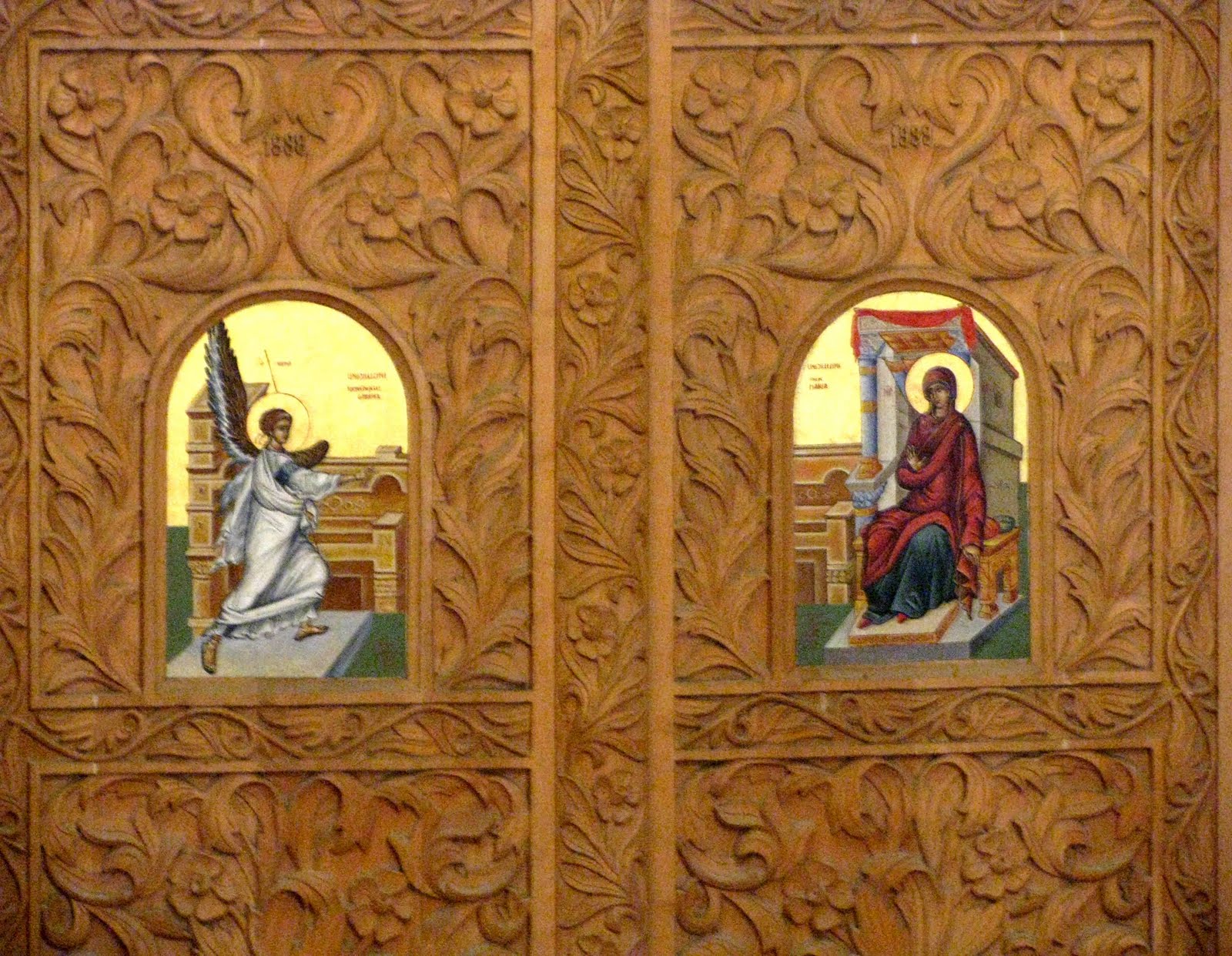
Albanian Iconography

Last year when I posted my photos from Albania, I promised a follow-up post focusing on iconography. Reading about the Albanian adventures of this year’s missiology class inspired me to resume work on that post.

As with my previous Albania post, I drew heavily on the photos taken by other members of the expedition. The pictures will be organized roughly in the order of our itinerary in Albania. My narration will be minimal.

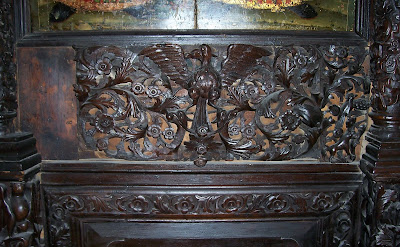
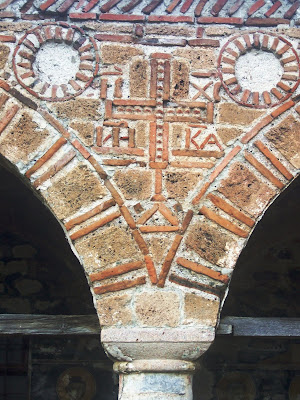
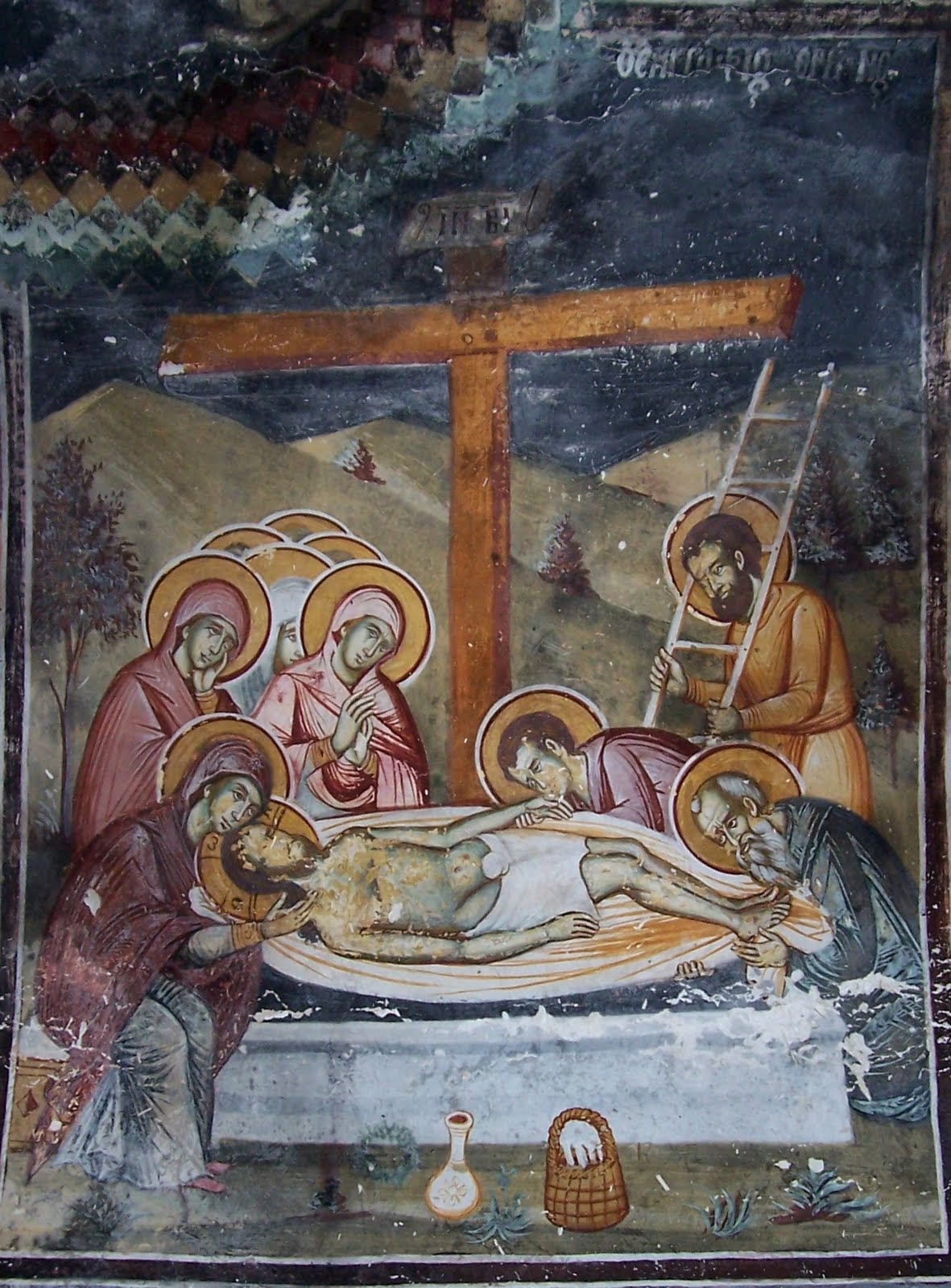
In addition to iconography in the narrow sense, I will feature other aspects of church art, particularly wood carving. And besides traditional ecclesiastical iconography, I will include some less traditional religious art. You can click on any picture to see it full-size.

Our first stop was Annunciation Cathedral, Tirana.


St. Anastasios

The archbishop’s throne

The baptistery chapel


St. Constantine

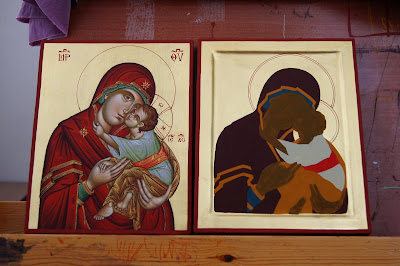
The Theotokos

St. Panteleimon

Two days later, we stopped at two schools on our way to Shen Vlash Monastery.


The Resurrection of Christ is a popular subject in new Albanian iconography.


At Shen Vlash

The refectory

The monastery chapel


Shen Vlash (aka St. Blaise)

The chapel at the diagnostic clinic.


Framed art at the student center

Nazareth Center houses various ecclesiastical arts, including the creation and restoration of icons and wordworking.


On our way to Korça we stopped for a fish supper at this restaurant in Shen Naumi.

The next day we visited the Metropoly.

Then we spent the rest of the morning sightseeing in Korça, starting with this church.

St. Haralambos


Inside a small shrine

The old cathedral


Monastery of the Nativity of St. John the Baptist, Voskopoja


St. Ignatius

St. Nicholas

St. Katherine


Monastery of Ss. Peter & Paul, Vithkuq


The new cathedral in Korça

Church of St. Anna


Shen Naumi (St. Nahum)

Prophet Elijah

Chapel of St. Elijah, high above Korça

Church of the Resurrection, Pogradec

St. Marena


The Last Judgment

Exaltation of the Holy Cross

Wednesday, June 15, 2011

Yannaras vs. the Zealots

In my systematic theology classes this year we read a few articles by Greek Orthodox theologian Christos Yannaras. We also got to hear him speak in person when the seminary presented him with an honorary degeree. While I respect Yannaras’s ability to tackle interesting, relevant topics (e.g., human freedom) from a point of view that is modern, original, and Orthodox, I disagree so strongly with his central philosophical commitment that I usually cannot follow him to his conclusions (though I can sometimes reach similar conclusions by a different route). In my reading of Yannaras, I quickly sensed a foundation of Sartrean-style existentialism underlying his thinking. My reaction to John Zizioulas was similar. I guess it should not be surprising that Greek theologians of the mid 20th century would engage with the dominant European philosophy of their day, just as Bulgakov and his generation had earlier engaged with Hegel and German idealism.

I am not entirely opposed to existentialism. I went through an existentialist phase in my early 20s, and I still retain a soft spot for Kierkegaard. But the more I thought about Sartre’s blunt assertion, "There is no human nature," the more I realized that 1) it is nonsense, and 2) it is irreconcilable with traditional Christology. If there is no human nature, then the whole concept of species does not apply to humans, and each of us is a sui generis being (rather like the Christ of Arius). If there is no human nature, then we cannot say that Christ assumed human nature, and the traditional explanation of the Incarnation falls apart. I think Yannaras and Zizioulas come dangerously close to Sartre with the notion of person transcending nature. As I understand it, this means that our path to theosis must lead to a transcending of our human nature. That strikes me as gnostic.

While Zizioulas has not, to my knowledge, accepted the existentialist label, Yannaras has been open about his influences. Toward the end of his recent commencement address at Hellenic College and Holy Cross Greek Orthodox School of Theology, for instance, he lauded Nietzsche, Heidegger, and Sartre, who "boldly attempted to make a painful break with moral error." To be fair, Yannaras went on to say that his ontology of the person was a response to "the need to confront Heidegger’s nihilism," so we should not imagine that he is an uncritical Heideggerian. But, still, he typically operates within a modernist framework of mid-20th-century European existentialism.

The main body of this commencement address, however, constituted a postmodern critique of "the problem of neoconservatism and fundamentalism which currently afflicts the way life is led in most Orthodox churches." (I’m really not sure what neoconservatism means outside the context of U.S. politics − in fact, I’m a bit hazy on what it means even in that context. Since the term did not recur, I will assume it is just a synonym for fundamentalism, and not a significant term in itself.) Yannaras clearly and correctly identifies the fundamentalist "zealots" of modern Orthodoxy − those who oppose all ecumenical dialogue and who pose as defenders Orthodox Tradition against the West − as unwitting examples of the very modernist Western ideology they claim to oppose. They set their own judgment above that of the Church and its bishops. They embrace a commitment to formal propositions and authoritative texts akin to Marxists, thereby reducing Orthodoxy to an ideology.

Yannaras then pointed out that it is not only the zealots who have fallen into a Western way of thinking and living, but "the whole of Christendom." Overcoming the pitfalls of Westernization, then, is not a matter of resisting the "other," but of self-criticism and repentance.

Read the whole address here.

Thursday, May 5, 2011

Questions on Islam

Nearly a decade ago, public interest in Islam spiked in the wake of the 9/11 attacks. It gradually subsided thereafter but still remained much higher than before. In 2011, various stories related to Islam are once again dominating the headlines:
  • Unrest and protest in Tunisia, Algeria, Lebanon, Yemen, Egypt, Jordan, Palestine, Bahrain, Libya, Iran, and Syria (and probably a few I missed).
  • Florida pastor Terry Jones announced he would burn a copy of the Qur'an, backed down in response to pleas and advice from other American religious leaders, and then went ahead with his original plan, sparking worldwide outrage among Muslims.
  • The House Committee on Homeland Security held a hearing on “The Extent of Radicalization in the American Muslim Community and that Community's Response.”
  • Several states are considering bills to ban Shari'ah law (and foreign law in general) from being applied in state courts.
  • This week the long manhunt for Osama bin Laden concluded with his death in a U.S. raid on his compound in Pakistan.
In this post I want to address two recurring questions about Islam:
  1. Do Muslims worship the same God as Christians?
  2. Are violence and terrorism endemic to Islam?

No God but Allah

Some imagine Allah to be the proper name of the Muslim deity. But, in fact, it is the generic divine name in Arabic. Allah is a contraction of the Arabic al-'ilah, which means literally, "the deity." The definite article serves to emphasize singularity, so it is understood as "the sole deity," i.e., God. This name for God is not specific to Muslims but is used by all Arabic-speaking monotheists, including Christians. In my Antiochian Orthodox parish, when we sing the Trisagion in Arabic we address God as Qudduson ullah.

Others argue that Muslims worship "a different god" than Christians. I have found that the straightforward counter-argument – that a monotheist cannot logically posit the existence of "a different god" – does not phase them. When probing beneath the "different god" argument, I occasionally find a belief that Muslims are either pagans who worship a non-existent mythological deity or deluded devil worshipers (I have encountered both versions of the argument). In either case, I suppose one could argue with some logic that Muslims are worshiping a different god. But this is not what is usually meant by "a different god."

Typically those who make the "different god" argument will point out that Christians worship Jesus or the Holy Trinity and Muslims do not. But the same could be said of Jews, and most Christians would not say that Jews worship "a different god." What they really mean is that Muslims have a different conception of God than Christians do, and this is certainly true. But we do not (or at least ought not) worship our conception of God. To worship a conception produced by our minds would be every bit as idolatrous as to worship an image produced by our hands. We do not worship any conception of God, but the ineffable reality behind all conceptions.

It was the intention of Muhammad to introduce the God of the Bible to his people, the Arabs. There can be no doubt of the strong influence of Christianity on early Islam. Muhammad's wife's cousin, Waraqah ibn Nawfal, an Ebionite Christian priest, was the first to acknowledge Muhammad as a prophet. St. John of Damascus, who had grown up in the Damascus court of the Umayyad caliphate, classified Islam as a Christian heresy. In the early 20th century, Hilaire Belloc came to the same conclusion. Without necessarily endorsing that hypothesis, I think we can safely say that Muslims worship the same God as Christians, though they might hold incorrect beliefs about him and serve him badly (as, indeed, do many Christians).


The Religion of Peace?

The word islam is the infinitive of the Arabic verb 'aslama, which means "to surrender" or "to submit." A Muslim, then, is one who surrenders to Allah. The same triliteral root, s-l-m, is shared by salaam, which means "peace." But Islam does not have a reputation as a peaceful religion, either historically or today.

In the time of Muhammad, Arabic society was filled with injustice and violence and the tribes were constantly feuding with each other. Muhammad brought all of the Arabic tribes into a confederation, which resulted in inter-tribal peace. Since the united Arabs could no longer raid one another, they redirected their raids against their non-Arabic neighbors. In her book Islam: A Short History, Karen Armstrong describes the resulting conquests:

[W]hen the Arabs burst out of Arabia they were not impelled by the ferocious power of "Islam." Western people often assume that Islam is a violent, militaristic faith which imposed itself on its subject peoples at sword-point. This is an inaccurate interpretation of the Muslim wars of expansion. There was nothing religious about these campaigns, and Umar did not believe that he had a divine mandate to conquer the world. The objective of Umar and his warriors was entirely pragmatic: they wanted plunder and a common activity that would preserve the unity of the ummah. . . . Later, when the Muslims had established their great empire, Islamic law would give a religious interpretation of this conquest, dividing the world into the Dar al-Islam (the House of Islam), which was in perpetual conflict with the Dar al-Harb (the House of War).

It should be emphasized that being conquered by Muslims does not necessarily entail an expectation of conversion to Islam. In fact, for the first century of Islam, conversion was not an option. Islam was conceived by Muhammad and his immediate successors as a religion for Arabs only. Anyone who wanted to convert to Islam would have had to join an Arab tribe. Conquered peoples were expected to live as they did before the conquest, but to pay the jizyah, a per-capita tax on non-Muslim subjects. Later regimes permitted or even encouraged conversion to Islam, but this often caused fiscal problems, as mass conversions resulted in an equally massive decline in state revenue. Therefore some regimes actually discouraged conversion, which was seen as a form of tax evasion!

Centuries later, Islam was adopted by many of the Mongol and Turkish tribes that were raiding and conquering Asia (and trying to do the same to Eastern Europe). But these tribes were not motivated in their efforts by Islam; they had been trying to conquer the world (with some success) long before they converted to Islam. Rather, Islam was a religion of convenience that was more accommodating of their culture of raiding and conquest than the Buddhism and East Syrian Christianity previously popular among the Mongols.

Still, a religion that is attractive to violent cultures and which accommodates their violence by directing it outwards might have something to answer for. It has been noted that Islam has "bloody borders." Many of the world's recurring-conflict zones involve an Islamic presence – the Balkans, the Caucasus, the Middle East, South Asia, East Africa. Islamic history and ideology can facilitate a presumption of a God-given right of Muslims to rule over non-Muslims, which inevitably leads to conflict. Today, however, this archaic ideology more often serves as a cover for nationalism or personal and factional agendas. And much of Islamic violence today is between different factions of Muslims.


Schools of Thought on Islamic Terrorism

Muslims did not invent religiously motivated terrorism. That distinction might go to the Sicarii, first-century Jewish anti-Roman fanatics. But their tactics were replicated by the Assassins, a 12th-century Persian Isma'ili Shi'ite sect known for murdering opposing leaders by stealth.

But the Sicarii and the Assassins were both well organized factions with clear political goals who targeted specific known enemies. Today's Islamic terrorism, by contrast, is a loosely organized mass movement that shares common enemies, rather than common goals. It is distinctly modern in its ideology and its methods. And it engages in mass murder rather than targeted killings.

Is mass violence inherent to Islam in the modern context? Are all Muslims potential terrorists? I define three schools of thought on these questions: the 1% school, the 10% school, and the 100% school. These percentages are different answers to the question, "What percentage of Muslims supports militant Islam?"

The 1% school encompasses most U.S. politicians of both major parties. They profess that the terrorists and their sympathizers are a small fringe of Muslims, which certainly does not include Wahhabis. This is a convenient view to espouse since it does not require a strong policy response and does not risk upsetting our supposed allies in Saudi Arabia.

According to the 10% school, the terrorists and their sympathizers are a large minority of Muslims that includes Wahhabis. This school is represented most clearly by Daniel Pipes and Stephen Schwartz. (Pipes inspired my development of this classification system when he estimated that 10-15% of Muslims worldwide support militant Islam.) This is the school that I identify with.

Finally, the 100% school says that all Muslims (or, at least, all real Muslims) sympathize with Islamic terrorism – i.e., that Islam is inherently a terrorist religion. The most outspoken proponent of this school is Serge Trifkovic.

One might think the 100% school would be the most strongly opposed to militant Islam, but the 100%ers, ironically, largely agree with the militants. These nominal enemies agree that Islam is inherently committed to imposing its rule on the entire world and that self-described Muslims who disagree are either liars or apostates. They both embrace the same all-encompassing us-vs.-them worldview. They even respect each other as adversaries who are playing the same game. Trifkovic and militant Muslims have actually engaged in tactical alliances against Pipes and Schwartz, whom they despise in common.

What game is Trifkovic playing? He is a professional apologist for Slobodan Milosevic and his cronies. The subtext of everything he writes is to justify Serbian actions, including atrocities against Muslims, in the Balkan wars of the 1990s. His portrayal of Islam implicitly castigates the Western powers that intervened to save Muslims in Bosnia and Kosovo and warns us that we will one day be sorry we did not let them finish the job.

Pipes and Schwartz, by contrast, by distinguishing between good Muslims and bad Muslims – and naming the militants as the bad Muslims – challenge the whole worldview shared by Trifkovic and the militants. While they do not downplay the challenge posed by militant Islam (which separates them from the 1% school), neither do they portray all of Islam as an enemy that must be annihilated to save the world (which separates them from the 100% school). This school of thought presents us not with Armageddon, but with a problem like the Cold War – a self-declared enemy that we must take seriously and resist consistently, which we can defeat in time if we persist. If we succeed, we may be able to help save Islam rather than annihilating it.

Friday, April 15, 2011

A Child's Life at Seminary

The daughter of one of last year's graduates reads a short memoir about her three years at St. Vlad's, accompanied by pictures of the campus, students, and families.


My Other Home: A Memoir of Living at St. Vladimir's Seminary, by Ayame Whitfield from St Vladimir's Seminary on Vimeo.

Monday, April 11, 2011

Christology in Dialogue

My favorite class this semester has been Christology in Dialogue. We have carefully examined the Christological disputes of the fifth century that culminated in the Council of Chalcedon and resulted in ecclesial schisms that are with us to this day. We have also looked at the 20th-century dialogue process between the Eastern Orthodox and Oriental Orthodox Churches that has resulted in surprising agreed statements on Christology. Now, in the later part of the class, we are hearing from representatives of the Oriental Orthodox churches while working on our research papers. Tomorrow afternoon we will meet with Fr. Daniel Findikyan, the dean of nearby St. Nersess Armenian Seminary, and theologian Dr. Abraham Terian.

Last Sunday we visited St. Mark's Cathedral, Teaneck, NJ, American headquarters of the Syriac Orthodox Church of Antioch. The Liturgy was about 70% Syriac, but we were able to follow it in the tri-lingual Liturgy books (with the help of the page numbers on the TV screen on the wall in front of us). (This was apparently more English than usual - and some of the youth conveyed to their bishop that they would like hear more English even when visitors are not present!) After the Liturgy we were ushered into a large, plush meeting room. We got to spend nearly an hour in conversation with Abp. Mor Cyril Aphrem Karim and Dr. George Kiraz, founder of Gorgias Press. Each student received a copy of the Liturgy book, a copy of the collection of Eastern-Oriental Orthodox dialogue documents, and a CD of the Syriac Orthodox Footwashing service of Holy Thursday.

As we were leaving, Abp. Cyril remembered something he wanted to show us. He and Dr. Kiraz moved a couple of chairs out of the way and pulled back a plastic sheet to reveal two sixth-century mosaics from Edessa they had just received. Here, Abp. Cyril translates the Syriac inscription for us.


This past week I think I set a personal record for the number of library books checked out at one time: 40, of which 33 were from the St. Vlad's library and the remaining 7 from inter-library loan. While some were for my thesis, most were for my Christology paper on the Formula of Reunion, which reunited the Church in 433, following a brief schism after the Council of Ephesus. I've already begun to break up the collection, but here it is at its peak.

Monday, February 21, 2011

Same-Sex Marriage vs. Religious Freedom

It now appears that the Maryland legislature is likely, in coming weeks, to legalize same-sex marriage in the state. Coming from a notoriously liberal state that just elected Barbara Mikulski to her fifth term in the Senate, this will not surprise anybody. Still, it might constitute a milestone for the gay marriage movement because Maryland was the first state in the US to ban same-sex marriage by law. Under the Family Law Act of 1973, "only a marriage between a man and a woman is valid in this State." Before that, marriage in the US was regulated by common law, not by statute. By 1994, in the face of increasing activism by same-sex couples seeking marriage, 45 states had passed marriage laws that defined marriage as being between a man and a woman. In 1996, President Clinton signed the Defense of Marriage Act, which prohibited the federal government from recognising same-sex marriages or any other kind of same-sex union. This turned out to be the high-water mark for the effort to prevent same-sex marriage.

The following year, the Supreme Court of Hawaii became the first to find prohibition of same-sex marriage unconstitutional. Hawaiians responded by voting, by a margin of 69% to 31%, to amend the state constitution to relieve the state courts of jurisdiction over marriage. In late 1999, Vermont's Supreme Court issued a similar ruling, and in 2000 the Vermont legislature acquiesced by recognizing same-sex civil unions. This established the pattern that has been followed for the past decade: activist courts imposed legal recognition of same-sex relationships contrary to the will of democratic majorities, who sometimes succeeded in reversing the courts' radical reinterpretations of marriage and sometimes failed.

The reasoning of same-sex marriage proponents is invariably based on an absolutist form of individualism, which recognizes no criterion of justice besides the equal treatment of all competent adults. Other criteria, such as the impact on families and children, public morals, social stability, and religious freedom, are ignored or dismissed. Some courts have gone so far as to state that hatred of homosexuals is the only possible reason why anyone would want to differentiate between same-sex and opposite-sex couples. Thus, they wield their liberal prejudices as a preemptive ad hominem attack to dismiss all opposing arguments before they are even enunciated.

Wherever same-sex marriage is enacted, conflicts with religious liberty inevitably emerge. In Canada, Catholic clergy have faced hate-crime investigations by human rights commissions for simply reiterating Catholic teaching on homosexuality. In Massachusetts, Catholic Charities was forced out of the adoption business because it could not agree to place children with same-sex couples. In California, doctors may not refuse to artificially inseminate lesbians on religious grounds. And in a number of cases in both Canada and the US, photographers have been fined for discrimination after they declined to photograph gay weddings. The most extreme views have been put forth by EEOC Commissioner Chai Feldblum, who states, "There can be a conflict between religious liberty and sexual liberty, but in almost all cases the sexual liberty should win because that's the only way that the dignity of gay people can be affirmed in any realistic manner."

Feldblum is unusual only in her candor. The primary agenda of the ACLU for the past two decades has had a similar point: to transpose the traditional places of sex and religion in our culture. Where religion was once expected to be a person's primary public affiliation, source of identity, and basis of social behavior, sexual expression was expected to be conducted discreetly in private between two consenting adults. A presumption of privacy in matters related to sex and reproduction was the basis of the Supreme Court's 1973 decision in Roe v. Wade. But liberal activists now despise privacy in sexual matters, holding that insistence on privacy facilitates shame and demeans sexual identity. Rather, sexual identity is to be proclaimed, celebrated, and lived publicly. Where the sexual innocence of children was once protected by social consensus, now their sex education might begin before they learn the multiplication tables. In short, sex is being pushed out of the closet.

Meanwhile, secularists are trying to shove religion into the closet. They portray even the mildest public display of religion as inherently offensive to anyone not of that religion. They increasingly substitute "freedom of worship" for "freedom of religion" in an effort to redefine religious liberty as nothing more than the freedom to do whatever you want in the privacy of your own church, synagogue, temple, or mosque. Many educators now take it as part of their job to counteract the religious upbringing of their pupils. Some would even prohibit all religious indoctrination of children, calling it a form of child abuse. In short, secularists are working to reduce religion to a private recreational activity that consenting adults may engage in discreetly behind closed doors.

The American public has little patience for this sort of anti-religious activism. But same-sex marriage and the cluster of gay rights that always accompany it into law have become a way for activist courts to circumvent American religious sensibilities. Can there be any doubt that secularists will continue to use same-sex marriage laws as a bludgeon against religious liberty?

According to The Washington Post, my own state senator, Jim Rosapepe, endorsed Maryland's same-sex marriage bill only after the "conscience clause" was strengthened, which would make it clear that religious organizations do not have to participate in ceremonies that violate their beliefs. But I'm not sure why we should trust courts that have overturned previous marriage laws to respect a conscience clause whose effect is to permit discrimination against same-sex couples. In any case, the conscience clause appears to cover only religious organizations, not religious individuals like wedding photographers or fertility doctors. I can't help feeling that the Maryland I will return to in a few months will be less free than the one I left two years ago.