In his article, originally published in Arthuriana (Winter 1999), Scavone pieces together his hypothesis from numerous ancient and medieval texts, carefully laying the foundation before revealing his conclusions. His paper is thoroughly documented and referenced (the lists of texts, endnotes, and bibliography take up more pages than the main text of the article). For those of you who are into that kind of thing as much as I am (and I know some of you are), just click on the first link above and download the PDF. Here I will just try to summarize his more interesting conclusions.
 Joseph and the shroud both make their first appearance in the Gospels. Mark (15:46) tells us that Joseph "bought a linen shroud, and taking [Jesus] down, wrapped him in the linen shroud, and laid him in a tomb which had been hewn out of the rock." And John (ch. 20) reports that when Simon Peter and the Beloved Disciple came to the tomb on the first day of the week, they "saw the linen cloths lying there." The pseudepigraphal Acts of Pilate picks up the story from there, telling us that Joseph was seized by the Jewish leaders and imprisoned. But Jesus came to him in prison and freed him. In describing that encounter later, Joseph recalled, "And I said to him that was speaking to me, 'Show me the place where I laid thee.' And he carried me away, and showed me the place where I laid him; and the linen cloth was lying in it, and the napkin for his face. And I knew that it was Jesus."
 According to a Georgian text from the 5th-8th century, St. Joseph's subsequent missionary activity was associated with that of St. Philip, and the two built a church together in Lydda, directly west of Jerusalem. The NT book of Acts names two Philips, who are associated, respectively, with Samaria/Caesarea in Palestine and Phrygia/Galatia in Asia Minor.
 Abgar VIII (r. 177-212), King of Edessa, became a Christian sometime before the year 200. He had a close relationship with Rome, and like many Roman client kings, he took a Roman name: Lucius Aurelius Septimius Megas Abgarus VIII, partially taken from the name of the emperor, Septimius Severus. He was well received on a visit to Rome around 202, and he might very well have corresponded with Pope Eleutherius. In 205 he built a citadel called Birtha in Syriac and Britium in Latin.
It may have been during Abgar's reign that the shroud, known as the Mandylion, came to Edessa. In any case, its presence in Edessa is documented from the fourth century. It was transferred to Constantinople in 944. When it was not kept entirely hidden, it was usually displayed folded, so that only the face appeared. This is probably the source of the acheiropoietos, the "icon not made by human hands," usually known in the West as the veronica, a slight corruption of vera eikon, or "true image." But on special occasions the Mandylion, with elaborate ceremony, would be unfolded in stages to full length, over the course of a day. Worshipers were kept at a distance, so the nature of the unfolding ceremony - and of the Mandylion itself - was not clear to the crowds who witnessed it. But the accounts of those who saw it up close, describing the bloodstained image, make it sound like the object we now know as the Shroud of Turin.
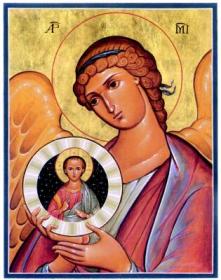
 It was around this same time that some new icons of Christ appeared, depicting him in death. Scavone suggests that these were inspired by the Mandylion in its partially and fully unfolded forms. Scavone further speculates that it was reported that Constantinople possessed a mysterious relic associated with Christ, which had collected his blood at the Passion, and which appeared in different forms. When these stories passed to the West, they took the form of the no less mysterious Holy Grail.
 The Mandylion disappeared from Constantinople when the city was sacked by Western crusaders in 1204. According to a recent Vatican announcement, the burial cloth now known as the Shroud of Turin was hidden and venerated by the Knights Templar from this point until about a century later, when the Templars were suppressed. Not long after that, the Shroud enters the historical record in the West.
 St. Joseph of Arimathea is first associated with Britain in a revision of William of Malmesbury's De Antiquitate Glastoniensis (Enquiry into the Antiquity of the Church of Glastonbury), published in 1247 by the monks of Glastonbury Abbey. According to this revised history, St. Philip, who was operating in Gaul, sent a delegation to Britain headed by his mission partner, St. Joseph. But William's original text, written about 1125, had mentioned Philip only in the most speculative way and had not mentioned Joseph at all! The monks apparently revised their history in an effort to claim an apostolic foundation, which would let them trump rival monasteries.
Moreover, William's speculation regarding Philip's presence in Gaul was based on a misunderstanding of his source, which actually related the traditional story that Philip preached in Galatia. The whole idea that Philip and Joseph preached in the West unravels under scrutiny. There is no reason to believe they ever left the Middle East.
The earlier origin story of the Church in Britain, related by the Venerable Bede, was that the 2nd-century British king Lucius had sent a letter to Pope Eleutherius asking to be made a Christian. Bede was apparently drawing from a line from the Liber Pontificalis (Book of the Popes). But it has been recognized for some time that this King Lucius was probably not a British king, but was the Edessan king, Lucius Abgar, whose citadel was known as Britium.
So the connections of Joseph and the Grail to Britain fall apart. Scavone leaves us, instead, with a connection between Joseph, the Mandylion, and Edessa. He sums up his conclusions thus:
In the apocryphal tradition about Joseph of Arimathea, then, before Joseph's Holy Grail as cup of Jesus' blood, there was Joseph's cloth in which he had captured the blood of Golgotha. Britium's face icon (Mandylion) was over time identified as a burial shroud icon of the body of crucified Jesus. The mysterious tenth-century ritual in Britium/Edessa and the new twelfth-century Byzantine Melismos service, inspired respectively by the presence of this reputed burial wrap, portrayed the infant Jesus becoming the adult Jesus, sacrificial victim of the Last Supper and Passion. The romance Holy Grail also revealed the mystery of the infant Jesus changing to the body of crucified Jesus.