Showing posts with label Reading Scripture. Show all posts

Friday, March 21, 2008

A River Runs Through Lent

Last week was the first week of Lent. (Those of us who follow the Julian Calendar are running five weeks behind the rest of the world this year.) All week, wherever I turned, I kept running into river imagery.

On the weekdays of Lent, the Byzantine lectionary gives us Genesis and Proverbs. On the first day of Lent, we begin with the first chapter of each, and we work our way through both over the next six weeks. I read Proverbs last year, so this year I’m reading Genesis. Once again I came upon Genesis 2:10: “A river flowed out of Eden to water the garden, and there it divided and became four rivers.” I lingered over the image, and it remained with me in the following days.

Last week’s tothesource column was a critique of Richard Dawkins’ condemnation of the politically incorrect God of the Old Testament. (Bottom line: Dawkins elsewhere describes the world as indifferent to good and evil; this leaves him no basis for condemning God or anything else.) The article cited Dawkins’ 1996 book, River Out of Eden, whose title is an obvious reference to the Old Testament he now so despises.

While doing some number crunching, I listened to The Turning, the 1987 album by Leslie Phillips (who later re-christened herself Sam Phillips). This album was her first collaboration with producer (and later husband) T Bone Burnett. The first song on the album is Burnett’s “River of Love,” which begins with the line, “There's a river of love that runs through all times.” The line itself winds through the song like a river, repeated before each verse and again at the end of the song. The song’s three verses are about different sorts of rivers – rivers of grief, tears, and fire, respectively. Each of these rivers is evoked in detail, unlike the river of love. Yet, when each verse ends, the river of love is still flowing. As if to reinforce the song in my mind, I heard it again the next day on Burnett’s own self-titled album of 1986.

The boom box on which I listened to these CDs at work is showing its age. Before I can play a CD, I need to hit the play button repeatedly for a minute or two. Recently, while waiting for a CD to start playing, I have been working my way through Stephen Mitchell’s translation of the Tao Te Ching. Chapter 34, which I read last week, begins with the image of the Tao as a flooding river. It flows everywhere, nourishing all, yet without exalting its own role.

Upon creating man, God placed him in Paradise, which was watered by the river. After our first ancestors’ expulsion from Paradise, their descendants clung to the river, eventually spreading south into Mesopotamia along two of the river’s branches. Though they were deprived of Paradise itself, they still had the river that had sustained their life in Eden. Though fallen, they were not deprived entirely of God’s love for them. Likewise, as we work our way through Lent, continually reminded of our fallen state, we are nourished by signs of God’s love, flowing through it all.

Sunday, June 3, 2007

Spiritual Discplines 1: Fasting

Now the serpent was more subtle than any other wild creature that the LORD God had made. He said to the woman, “Did God say, ‘You shall not eat of any tree of the garden’?” And the woman said to the serpent, “We may eat of the fruit of the trees of the garden; but God said, ‘You shall not eat of the fruit of the tree which is in the midst of the garden, neither shall you touch it, lest you die.’” – Genesis 3:1-3

In two recent interviews, Frederica Mathewes-Green talked about Orthodox spiritual disciplines. She concluded the first interview, with ExploreFaith.org’s Jon Sweeney, by sharing her own spiritual practices, including daily prayers and fasting. In the second interview, with Ryan Hamm of the Christian Vision Project, she once again discussed prayer – specifically, the Jesus Prayer – and fasting. The two interviews, despite the similarity of subject matter, are not redundant – there is much to say on these important subjects!

I also have been thinking about fasting and prayer in recent weeks. In this post I will start with fasting. A post or two on prayer will follow.

Tomorrow in the Orthodox Church we begin the third of our four fasting seasons. The Fast of the Apostles is a variable-length fast that begins immediately after the Octave of Pentecost and continues until the Feast of Saints Peter & Paul, on 29 June. It is somewhat more relaxed than Lent, with a number of days when fish, wine, and olive oil are permitted.

Today, in preparation for the fast, I read a short article, “The Meaning of Fasting in the Orthodox Church,” by Fr. Milan Savich, which explains why fasting is the first of spiritual disciplines for Orthodox Christians. Citing authorities from St. Basil the Great to Fr. Alexander Schmemann, Fr. Milan makes the point that man’s fallen state began with the breaking of a fast commanded by God – abstention from the fruit of the tree in the midst of the Garden of Eden. St. Basil wrote, “Because we did not fast, we were chased out of Paradise; let us fast now, so that some day we may return there.” Similarly, St. Isaac of Syria said, “The first commandment given to our nature in the beginning was the fasting from food, and in this the head of our race (Adam) fell. Those who wish to attain the fear of God, therefore, should begin to build where the building was first fallen. They should begin with the commandment to fast.”

This is where our Lord himself began. Just as Genesis opened with Adam’s breaking of the fast, the Gospel opens with Christ’s keeping of a fast for forty days in the wilderness, immediately following his baptism. Where Adam had succumbed to Satan’s temptation to eat, Christ, in facing the same temptation, gained his first victory over Satan. Thus began his campaign to dethrone Satan and reverse the effects of the fall. In fasting, we learn to participate with Christ in resisting the temptations of Satan.

There is, of course, more to fasting than simply abstaining from food and drink, and Fr. Milan’s article explores the many aspects of fasting. (Thanks to Kevin Burt of into the light for the tip on Fr. Milan’s article.)

Sunday, May 27, 2007

Strange Without Heresy

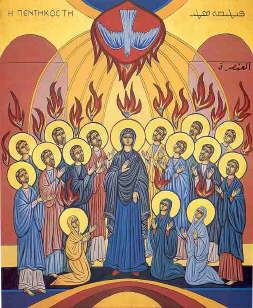
Today all nations in the City of David beheld wonders, when the Holy Spirit descended in fiery tongues, as the God-inspired Luke spake; for he said, "The disciples of Christ being gathered together, there was a sound as of a mighty wind, and it filled the whole house where they were sitting. And they began to speak strange doctrines and strange teachings with diverse tongues, to the Holy Trinity." – First Sticheron on Psalm 130 at Kneeling Vespers, on the evening of Pentecost

In recent years, I have attended the annual Shakespeare Free For All at DC's Carter Barron Amphitheatre. For two weeks every summer, the Shakespeare Theatre Company presents one of the bard's plays for free in order to share Shakespeare with the masses – and to publicize its upcoming season. This year's production sets the witty verbal combat of Love's Labor's Lost in India of the 1960s, where young people from the West flocked in search of enlightenment, just as the Beatles did. I saw it last Thursday with a few friends from my old parish. (If you live in the DC area you still have a week to see it!)

At the beginning of Act V, the curate Nathaniel compliments the pedantic Holofernes, "I praise God for you, sir: your reasons at dinner have been sharp and sententious; pleasant without scurrility, witty without affection, audacious without impudency, learned without opinion, and strange without heresy." I liked the sound of this description and tried it on to see how it might fit me (or my blog). I quickly decided the "without opinion" bit would trip me up, but I made a note to look up the passage when I got home. I still felt an affinity for the phrase, "strange without heresy," and I filed it away for further consideration. I did not expect to be reminded of it again so soon.

My first experience of Byzantine worship was sixteen years ago tonight, when I tagged along with my colleague Pat and his friend Mark to Kneeling Vespers at Holy Transfiguration Melkite Greek Catholic Church. In the Byzantine tradition, kneeling is forbidden from Pascha through Pentecost. At the first service where kneeling is again permitted, Vespers on the evening of Pentecost, we break our fifty-day fast from kneeling in a big way (much like we break the Lenten fast at 3 AM after the Pascha Liturgy)! The distinctive feature that gives the service its popular name is a series of three prayers – the first two long, and the third twice as long – said by the priest while he and everyone present kneel. (Sixteen years ago the practice involved full prostrations, but, at least in our archdiocese, this has been mitigated to simple kneeling. I miss the prostrations!)

Up until the kneeling prayers, the service follows the normal order of Vespers: Psalm 104; the Great Litany; Psalms 141, 142, 130, and 117; the hymn Phos Hilaron; and the Prokeimenon. The deacon censes the church during Ps. 141, and then at some point towards the end of Ps. 142 or the beginning of Ps. 130 the chanter begins to chant stichera between the psalm verses. A sticheron is a short thematic hymn that varies according to the church calendar. The stichera at Kneeling Vespers, which are repeated from Lauds earlier in the day, all concern the Holy Spirit, whose descent we celebrate at Pentecost (see Acts 2). The first sticheron ended with the provocative sentence, "And they began to speak strange doctrines and strange teachings with diverse tongues, to the Holy Trinity." Some translations enhance the strangeness even further by translating "diverse tongues" as "strange words."

For the conventionally minded – e.g., most of the Pharisees – it is hard to conceive of a teaching that could be "strange without heresy." It is practically familiarity that defines orthodoxy for this school of thought. This is what we see in today's Gospel reading (John 7:37-52). When the people respond to Jesus' strange teaching about the Holy Spirit, "This is really the prophet," the Pharisees reply, "Search and you will see that no prophet is to rise from Galilee." This dismissive attitude towards Galileans might also help to explain the amazement of the international Jewish visitors to Jerusalem, "Are not all these who are speaking Galileans?" No one expected yokels from the backwater of Galilee to be multilingual!

But it is less the Galilean origin of Jesus and his apostles than the strangeness of their teaching that fascinates the crowds and upsets the Pharisees. Jesus' talk of living water and his hints of a coming Comforter were bad enough, but at Pentecost his disciples got even stranger, proclaiming, "Let all the house of Israel therefore know assuredly that God has made him both Lord and Christ, this Jesus whom you crucified"; and, "Repent, and be baptized every one of you in the name of Jesus Christ for the forgiveness of your sins; and you shall receive the gift of the Holy Spirit." As the sticheron says, they were speaking of the Holy Trinity. In the Russian tradition, for this reason, today is often called Trinity Sunday, and the icon of the feast is that of Rublev's Trinity.

Too often Christianity, including Orthodoxy, can slip into Pharasaical conventionalism. It is natural for us to want to hold at bay whatever is strange and to take comfort in the familiar. But Orthodoxy counters this human tendency with its constant use of paradox to renew the strangeness of the too-familiar. For instance, the second sticheron tonight, in a different translation than we used, describes the Spirit as "Life and Giver of Life, Light and Bestower of Light, Goodness itself and Source of Goodness."

Today at Holy Cross we chrismated another catechumen. At a celebration afterwards, Khouria Frederica pointed out that until a few centuries ago light was always associated with fire, and therefore it had an element of risk and danger about it. The Holy Spirit's association with light, therefore, was also an association with fire and unpredictability ("The wind blows where it wills" – John 3:8). Not a flashlight, but a torch! The third and final sticheron from Kneeling Vespers concludes by summing up the experience of Pentecost: "A strange report, a strange sight, a fire divided for the distribution of gifts." This is no religion of play-it-safe conventionalism, but one of strangeness.

Thursday, April 5, 2007

Where the Vultures Are Gathered

And they asked him, "Where, Lord?" He said to them, "Where the body is, there the eagles will be gathered together." – Luke 17:37

Since November, when my institute moved to new quarters, I have had a view from the eighth floor of the second tallest building in Calverton, Maryland. For the most part, the view is disappointing – I can gaze down upon the rooftops of all the other buildings in the office park, which are not designed to be attractive from above. But it has also proved to be an excellent perch for watching birds. I have seen as many as 30 Canada geese gathered in and around the little pond in the middle of the office park, along with a few ducks. On other days I can watch big flocks of crows. Today I saw two big crows searching under rocks on the roof ledge just two offices down. Since that office is currently unoccupied, I was able to camp there and watch them up close. Their search turned up something interesting and they flew away, one of them doing some fancy aerobatics on its way to the ground.

But my favorite birds to watch from here are turkey vultures (or, as we used to call them back in Indiana, turkey buzzards). Most days I don't see them at all, but on a windy day like today they are out in force. At one point today I could see 10 of them in the air at once! I think the wind must interact with the tall building to create currents that the vultures find useful. One day they kept flying directly at my window, only to swoop straight upwards at the last second before impact. Vultures know how to use the currents to gain speed and elevation.

The sight of so many vultures reminded me of the verse from Luke quoted above. While translators invariably give eagles as the primary translation, interpreters prefer the alternative translation, relegated to a text footnote in the RSV: vultures. As scavengers, vultures will gather wherever they find a dead body to feed on.

The disciples are pestering Jesus, wanting to know the time and place when the Kingdom of God will appear. And the Lord, characteristically, gives an indirect answer that demands their deeper engagement with the question, rather than something they can write on their pocket calendars. Could he be telling his disciples that they should watch for some commotion that signals the Kingdom, just as a gathering of vultures signals the presence of a carcass? Probably not, since he had just told the Pharisees earlier in the chapter, "The kingdom of God is not coming with signs to be observed; nor will they say, 'Lo, here it is !' or 'There!' for behold, the kingdom of God is in the midst of you." Perhaps he is warning them to be prepared, because the Day of Judgment will find them just as vultures find a dead body.

Today was Holy Wednesday. According to tradition, this was the day when Judas agreed to betray his Master to the Jewish leaders. The vultures are already gathering, sensing that Jesus is vulnerable.

But this is also the day when the Orthodox Church commemorates Jesus' anointing by the sinful woman, who proceeded to wet his feet with her tears and wipe them with her hair. In contrast to Judas, she prepared herself for the coming of the Kingdom by repenting of her sins, and she thereby anointed the King himself before he was crowned with thorns and ascended the throne of the Cross to begin his reign.

Tuesday, March 20, 2007

The Fall of Man and the Neolithic Revolution

I posted this to the Faith and Theology blog's discussion of sin. It sums up ideas I've been working on for several years but never shared with anyone until about a month ago. It doesn't seem to be drawing any responses in its original context, so I'm re-posting it here in a slightly edited form.


I do not think the fall was a matter of mere disobedience. This would suggest that had Adam transgressed any arbitrary command of God it would have had the same effect. Rather, I think the nature of the fall must be found in the particular transgression – eating the fruit of the tree of knowledge of good and evil.

Until the fall, Adam and Eve were naive creatures living in paradise in accordance with their God-given nature (very good, created in the image and likeness of God). Upon eating the fruit, their eyes were opened. At this point, they began to substitute their own judgment, in accordance with their perceived, calculated interests, for the unconscious operation from their God-given nature.

I think the story of Genesis 2-4 can be tied loosely to a real, though not exactly historic (it was more prehistoric) setting. Scholars locate Eden in what is now northern Iraq, southeastern Turkey, or northwestern Iran. This was, not coincidentally, an early locus of the Neolithic Revolution – the shift from the hunter-gatherer mode of subsistence to the more "advanced" lifestyles of agriculture and herding (represented by Cain and Abel).

Evolution suited mankind to be hunter-gatherers – that is our nature. When humans began to manipulate their environments for survival advantages (more for groups than for individuals, as it turned out), they were on their way to adopting new lifestyles at odds with their hunter-gatherer nature.

So Adam and Eve, through their own choices, were forced out of the easy, natural, naive life of Eden, and they had to start working for their living. This complicated their relationships with God, one another, and all of Creation. To the extent that there was a fall within human history, I think this was it, and Genesis records it.

Now I don't really think Genesis 2-4 is about the Neolithic Revolution any more than I think Genesis 12-35 is about the nomadic herding culture of the early second millennium BC. The authors of Genesis were not recording history as an end in itself. But the ancient oral tales on which they based Genesis embodied memories of real settings as the background of their stories.

It would be simplistic to attribute the entire state of human fallenness to the abandonment of hunter-gatherer ways. But this was the "event" that, more than any other, set mankind on a new trajectory that has led to alienation from God, our fellow creatures, and our own nature. It is, then, not surprising that the author of Genesis 2-4 would set the story of the fall of man in that time and place.

Wednesday, March 14, 2007

Worship and Works

The current issue of Washington Window, the monthly newpaper of the Episcopal Diocese of Washington, includes a feature article on the Grate Patrol, a ministry of my old parish, St. Paul's, K Street. Every Saturday and Sunday, early in the morning, members and friends of St. Paul's distribute over 200 meals to homeless people on the streets of Washington, DC.

This sort of ministry is very much in keeping with Anglo-Catholic tradition. A religion rooted in the Incarnation cannot minister only to spiritual need while neglecting more worldly needs – or vice versa. The second generation of Anglo-Catholic priests in England often found themselves assigned to slum parishes by unsympathetic Protestant-minded bishops. So they made the best of it, and it turned out to be a pretty good fit. An elaborate liturgy in a beautiful church was a bright spot in otherwise drab working-class lives. And these priests worked to meet the needs of their parishioners by sponsoring basic education and distribution of charity, among other ministries.

Anglo-Catholics have often been criticized for maintaining this combination of worship and works. The religious and political establishments feared the implications of raising the expectations of the lower classes and empowering them to act. Reform-minded liberals, meanwhile, deplored the wasting of time and resources on worship and church maintenance. But to anyone who has participated in the Anglo-Catholic life, it is obvious that the liturgical life of the Church is the source of motivation and empowerment for ministry, while ministry is the necessary response to the encounter with God in worship. Worship and ministry are inseparable.

When Jesus was staying in Bethany a few days before the Passover, a woman from among his followers anointed him with expensive, fragrant ointment. Some reproached her, saying, "This ointment might have been sold for more than three hundred denarii, and given to the poor." But Jesus defended her: "She has done a beautiful thing for me. For you always have the poor with you, and whenever you will, you can do good to them; but you will not always have me. She has done what she could; she has anointed my body beforehand for burying." (Mark 14:3-9; John 12:1-8)

For those who love Jesus, there can be no conflict between worshiping him extravagantly and serving him in the persons of the poor. (Matt. 25:40)

Monday, January 15, 2007

Benedictine Cell

The Pharisee stood there and said this prayer to himself, "I thank you, God, that I am not grasping, unjust, adulterous like everyone else, and particularly that I am not like this tax collector here. I fast twice a week; I pay tithes on all I get." The tax collector stood some distance away, not daring even to raise his eyes to heaven; but he beat his breast and said, "God, be merciful to me, a sinner." - Luke 18:11-13 Thursday evening was my final Benedictine Cell meeting at St. Paul's. The cell has been meeting on the second Thursday of the month, eleven months a year, for four-and-a-half years now, and I've been a member since the beginning. Following Evening Prayer and Low Mass, we eat dinner, study a section of the Rule of St. Benedict (we're up to chapter 48), engage in a group form of lectio divina, and conclude with the office of Compline, after which everyone departs silently. We take turns providing food and drinks for supper, choosing the lectio passage, and leading Compline. Last night I brought the main dish for supper. As usual, I made something in my crock pot - in this instance brown rice and chicken. As at the last meeting, I had to field many questions about my upcoming move to Eastern Orthodoxy. I had to assure everyone I would still come back to visit St. Paul's on special occasions, like Candlemas and Advent Lessons and Carols. For lectio, Janet read Luke 18:9-14, the Parable of the Pharisee and the Tax Collector, which begins by providing the context: Jesus spoke this parable "to some people who prided themselves on being upright and despised everyone else." At an Anglo-Catholic shrine parish like St. Paul's, you can't swing a thurible without censing a dozen such upright people. "We thank thee, O God, that we are not like those Nonconformists, who lack the Prayerbook and decent church music. Or our fellow Anglicans of Latitudinarian churchmanship, who are lazy and indifferent in their practice of the faith." But, of course, one finds the same sort of thing in Orthodoxy. "Thanks be to God that we are not like those Romanists and Protestants, suffering the inevitable consequences of their Western heresies. Or our fellow Orthodox who use the wrong calendar." And now, by pointing out these instances of ecclesiastical pride in both the church I'm leaving and the one I'm joining, I am implicitly saying to myself, "Thank God I'm not like those immature, pride-besotted people praying next to me!" The tax collector shows us the way out of this never-ending circle of pride when he beats his breast and prays, "God, be merciful to me, a sinner." Perhaps the need to counter religious pride is one reason why Orthodoxy, a tradition with much to be rightly proud of, so often commends recitation of the Jesus Prayer: "Lord Jesus Christ, Son of God, have mercy upon me, a sinner." With lectio completed, our leader produced a gift-wrapped package with a bow on it and handed it to me. I quickly looked at the card, signed by my fellow cell members, and then opened the package to find . . . a Byzantine cross. I recalled Fr. Stephen's recounting of the Orthodox folklore that the proper way to collect icons is not to go looking for them, but to wait for them to come to us, and I thanked them for the thoughtful gift. We then concluded with Compline. About two times out of three, we actually follow our rule and depart, more or less, in silence. But other times there is an unspoken consensus that the need for speech outweighs the rule of silence, and this was one of those times, as everyone wanted to say goodbye again. In my remaining two weeks at St. Paul's, I'm sure this ritual will be repeated several more times.

Sunday, December 31, 2006

On the Road with Jesus

Then they came to Capernaum; and when he was in the house he asked them, "What were you arguing about on the road?" But they were silent, for on the way they had discussed with one another who was the greatest. - Mark 9:33-34

Two weeks ago it was my turn to choose the scripture passage for lectio divina at my monthly Benedictine Cell meeting. Looking for inspiration, I checked the Byzantine lectionary and found the Gospel readings for the week were mostly from Mark 9, and I settled on vv. 30-37. After the Transfiguration, as Jesus and his disciples were walking through Galilee to Capernaum, he told them of his upcoming death and resurrection, but they did not understand and were afraid to ask what he meant. The subsequent verses, quoted above, suggest they might not have been paying close attention because their thoughts were focused elsewhere.

This reminds me of too much on-line religious discussion. We are supposedly all following Jesus, but we waste our time and efforts in arguments that often boil down to questions of who is the greatest.

This is not, of course, to invalidate all argument! Sometimes disagreements must be clarified, and sometimes errors must be corrected. But arguments in the service of our own egos typically edify no one, least of all we who offer them. "If anyone would be first, he must be last of all and servant of all."


At the Benedictine Cell meeting, before I read the passage from Mark to begin the group lectio, my friends spontaneously interrupted the order of the meeting to begin peppering me with questions about my upcoming move from Anglicanism to Orthodoxy. It reminded me that even the friends who have accompanied me on the road with Jesus for several years have questions about this step I am preparing to take - and those who know me less well probably have even more questions. By the conclusion of lectio, I had resolved to start this blog and committed myself to doing so. But I also resolved not to let it become just another forum for arguing about who is the greatest.

I do not intend for this blog to be just an apologia for my becoming Orthodox, but that subject will probably dominate my first several entries. As I exhaust that topic, the subject matter of my posts will broaden to encompass more of my wide-ranging interests. I anticipate that a majority of my posts will remain broadly within the realm of religion and spirituality, but I might also stray into the areas of culture, history, science, and music, among other things.

If there is a single theme that runs through all of my thought, it is the Incarnation - specifically the perfect union of the two natures, divine and human, in the person of Jesus Christ, as defined by the Council of Chalcedon. This is my touchstone, and I hope it will always be implicit (when it is not explicit) in what I post here.

It is appropriate that this initial post will appear in the midst of Christmas season, as we celebrate Christ's nativity, and on the eve of the new year, a time for new beginnings.