Friday, October 17, 2003

Thoughts on the Daily Office

This article originally appeared in the November 2003 issue of The Epistle, the monthly newsletter of my St. Paul's, K Street. It was gleaned from more extensive notes for a lecture I gave on the subject some years earlier.

As Anglicans, we inherit a strong Benedictine influence from the medieval English church. When we observe silence in church before Mass, or when we bow at the Gloria patri, we demonstrate the persistence of the Benedictine ethos among 21st-century Anglo-Catholics. But the chief example of our Benedictine inheritance is the ongoing importance of the Daily Office. While it is not practical for those with families or full-time jobs to break for prayer seven or eight times a day, as monks do, the Prayerbook tradition has accommodated the necessities of life in the world by providing a two-fold pattern of morning and evening offices. The latest editions of Anglican Prayerbooks, including our own, have taken a step back towards the monastic tradition by providing additional offices for Noonday and Compline, along with flexible provisions for their use in parishes and homes. A brief look at the origins of the Daily Office might provide useful insights for our lives of common prayer as Anglo-Catholics.

Etymologies

Work. The various names for this daily round of services – Liturgy of the Hours, Daily Office, Divine Office, Opus Dei – all involve work. Liturgy, from the Greek leitourgia, means the work of the people, or a public work. Office means service or duty, and it is cognate with opus, which also means work.

The office is our work in two senses. First, it is work in the sense of a job – it is our job as the Church to serve God daily with our worship and prayers. Second, it is work in the sense of a work of art – a thing of beauty that we create or perform for God and offer to him.

Benedictine monastic life was built around the twin focuses of prayer and work – ora et labora. The desert fathers, in earlier times, had not divided these focuses: A hermit would recite the psalms while weaving baskets to support himself, approaching St. Paul's ideal of "prayer without ceasing." But when monks gathered in communities, the more strenuous demands of agricultural subsistence forced them to divide the day into set periods of work and prayer.

Hours. The offices are all associated with particular times of the day, and their names reflect this. The primary offices, often observed by the laity as well as the clergy and monks, were the morning and evening offices, Matins and Vespers, associated with the rising and setting of the sun. The name Matins comes from Matuta, goddess of the dawn. The name Vespers comes from the Latin for evening, and it is cognate with west, where the sun sets. These offices are sometimes described as successors to the twice-daily offering of incense at the temple: our prayers rise to God as a sweet-smelling offering.

The night office was originally called Vigils. In the earliest times, it was probably observed only on Saturday night/Sunday morning, as an anticipation of the Eucharist that would be celebrated at sunrise. For monks, it became part of the daily round of offices. The monks would rise at midnight to greet the new day with prayer and then return to their beds. (Sleeping through the night uninterrupted was thought to be decadent, and therefore improper for monks.) Vigils was divided into two parts (three on Sundays and feasts) called Nocturns. Each of the two Nocturns consisted of six psalms and a tripartite reading from the Scriptures or the Fathers. The number of psalms at Vigils was said to be set once and for all when an angel visiting the oratory for the office departed after the twelfth psalm: It was decided thereupon that twelve psalms were sufficient for monks as well as for angels.

St. Benedict scheduled the night office a bit later – 2 or 3 AM – so that his monks could rise for Vigils with their night's rest completed. (He thought it was decadent for monks to return to bed after rising.) In many places, Vigils came to be observed so late that it immediately preceded the morning office. Vigils was therefore renamed Matins, and the morning office was renamed Lauds, after the laudate psalms, 148-150, which are recited daily at the morning office. (This switch in the application of the name Matins from the morning office to the night office confuses nearly every non-expert who tries to write about the offices. Otherwise authoritative sources often bungle or bluff their definitions of Matins.)

The three short daytime offices were called simply by the hours when they were observed – Terce, Sext, and None – the third, sixth, and ninth of the twelve daylight hours. These hours were associated in the Gospels with Jesus' crucifixion and in Acts with events in the lives of the apostles.

This made six offices. Psalm 119 refers to prayer seven times a day, so there was a scriptural warrant for one more office. They settled for two additional offices, making a total of eight. The new offices, Prime and Compline, were, in their origins, private prayers of the monks, said in the dormitory rather than the oratory. Prime (the first daylight hour) was said to be invented by an abbot who wanted to keep his monks busy so that they could not return to bed after Lauds. (Early abbots seem to have put sleep deprivation right up there with fasting as a spiritual discipline.) Compline (the "completion" of the day) was the monks' bedtime prayer. Prime and Compline can be seen as parallel in much the same way that Lauds and Vespers are parallel. In the early 20th century, Prime was suppressed, and few in the West do it anymore, though it remains in the East.

By the time of the Reformation, the canons at secular cathedrals would often perform multiple offices in a single sitting. Matins, Lauds, and Prime would be sung together in the morning; Terce, Sext, and None during the day; and Vespers and Compline in the evening. In assembling the first Book of Common Prayer, Archbishop Cranmer carried this another step. He conflated the first three offices into Mattins and the last two into Evensong. The names of these office were later changed to Morning Prayer and Evening Prayer, but the older names persist in some places, especially in reference to choral services.

Approaches

Time. In the Eucharist, we step out of earthly time, into the timelessness of eternity. By contrast, the Liturgy of the Hours is rooted solidly in time. It is a way of sanctifying time, dedicating to God the time he has given us in this world, and channeling his grace into the world.

Psalms. The traditional heart of the office is recitation of the psalter. Benedictines traditionally recite all 150 psalms weekly. Some modern orders recite them bi-weekly, and Anglicans traditionally recite them monthly. At St. Paul's, we follow the schedule of psalms in the Daily Office Lectionary, which provides for the recitation of the entire psalter over a period of seven weeks.

The psalms can be difficult for modern readers. One tremendously helpful resource is a small book by Dietrich Bonhoeffer, Psalms: The Prayer Book of the Bible. One of Bonhoeffer's useful suggestions is to recall the traditional connection of the psalms to David.

Another helpful approach is to imagine Christ reciting the psalms with us – to understand them through the his eyes, interpreted in his light, remembering that we are members of his Body. This brings new or added meaning to psalms that otherwise might seem obscure or objectionable. It is particularly helpful when the psalmist proclaims his innocence or his guilt: We are not innocent, but we partake of Christ's innocence, and he bears our guilt. When the psalmist calls for vengeance against an enemy, we must be careful to understand this not as our personal enemy, but as the enemy of God – it might even be ourselves – and to remember that any vengeance or punishment has already been borne by Christ.

The psalms honestly express the entire range of human emotions. The expression of some of these emotions – anger, hatred, exultation in violence – is out of favor, and the psalms that express them are also out of favor in some places. But the psalms can be helpful precisely because they give voice to our emotions. When these emotions are suppressed, reciting the psalms can actually help us to bring them to the surface, where we can acknowledge them and begin to deal with them.

Dialogue. St. Isidore, a seventh-century Bishop of Seville, wrote, "When we pray, we talk to God. And when we read [the Scriptures], God talks to us." In the Daily Office, we hear God's word to us as the Scriptures are read, and we respond to God in prayer. In this way, the Church maintains a perpetual dialogue between heaven and earth.

At any given time, the prayers are always being offered somewhere in the world. When we participate, we pray not as lone individuals, but as members of the Church, praying with the Church, for the Church and for the world.

There was once a Byzantine monastery whose denizens were nicknamed "the sleepless monks." These monks were divided into three shifts, and one shift remained in choir, singing the offices, at all times. This is a big burden for a single monastery, but it is not too big a burden for the whole Church to share.

Saturday, May 31, 2003

Pilgrimage, Part 2: Walsingham

Continuing my photos of the 2003 Walsingham pilgrimage. See part 1 here.

Anglican Shrine
The 11th Station: Jesus is nailed to the cross
Pilgrims
Orthodox Chapel of St Seraphim
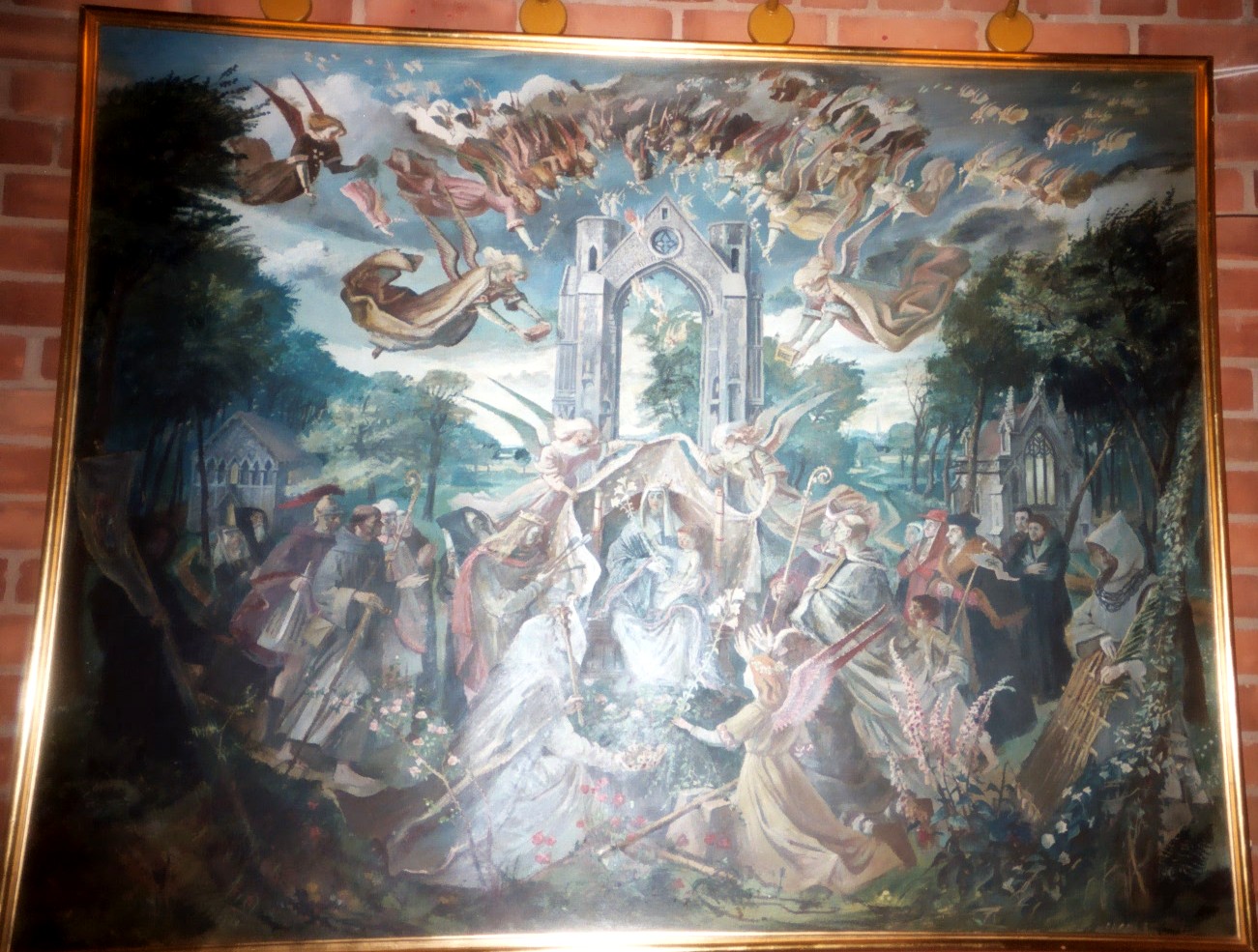
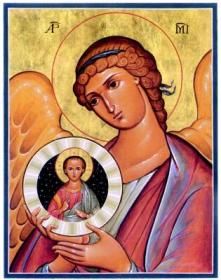
Icon of Our Lady of Walsingham
St Mary's, Little Walsingham
East window, designed by John Hayward in 1964
Walsingham Abbey
Bridge over pedestrian tunnel
Looking east
East window arch of priory church, with Anglican Shrine in background
Facing in opposite direction from last picture - southeast
Remains of priory church - base of west pillar and east windon arch
Court room
Chapel of Reconciliation
Icon of Our Lady of Walsingham
Saints of England
Slipper Chapel
West window, designed by Alfred Fisher in 1997
Friary Ruins
 
Assumption, West Barsham
Basket windows, 11th century or earlier
South porch
St Peter's, Great Walsingham
View from the east
The nave
Side altar
Pre-Reformation glass
Pre-Reformation glass depicting the Coronation of the Virgin
Holy Transfiguration Church
Russian Orthodox church in Great Walsingham
St Withburga & St Fursey
Anglican Shrine
Chapel of St Wilfrid & St Cuthbert
Annunciation window

Pilgrimage, Part 1: London, Canterbury, and Ely

The rector of my old Anglo-Catholic parish leads a pilgrimage to Walsingham every two or three years. In May 2003 I was among the pilgrims who visited London, Canterbury, Ely, Walsingham, and Oxford. All of these photos were taken with a 35mm camera and transferred to a CD as part of the film processing. I originally posted them on the Kodak website shortly after the pilgrimage, but they could only remain up there as long as someone purchased prints of the photos every six months, so they evaporated sometime in 2004. Anticipating that demise, I copied all of my photo captions to a file so that I could recreate it when the opportunity arose. This first post (of two) covers the pre-Walsingham portion of the pilgrimage. We stayed in London, made a day trip to Canterbury Cathedral, and stopped at Ely Cathedral on our way to Walsingham. The second post will cover our time in Walsingham. I don't seem to have taken any pictures in Oxford.

London Churches
St Paul's Knightsbridge: Chapel of St Luke
St Michael's Priory: London house of the Community of the Resurrection
Brompton Oratory: Chapel of Our Lady of Victories
Canterbury Cathedral
Jesus Chapel
Martyrdom shrine, through cloister door

Prior's stall in the Chapter House
Tomb of Edward, the Black Prince
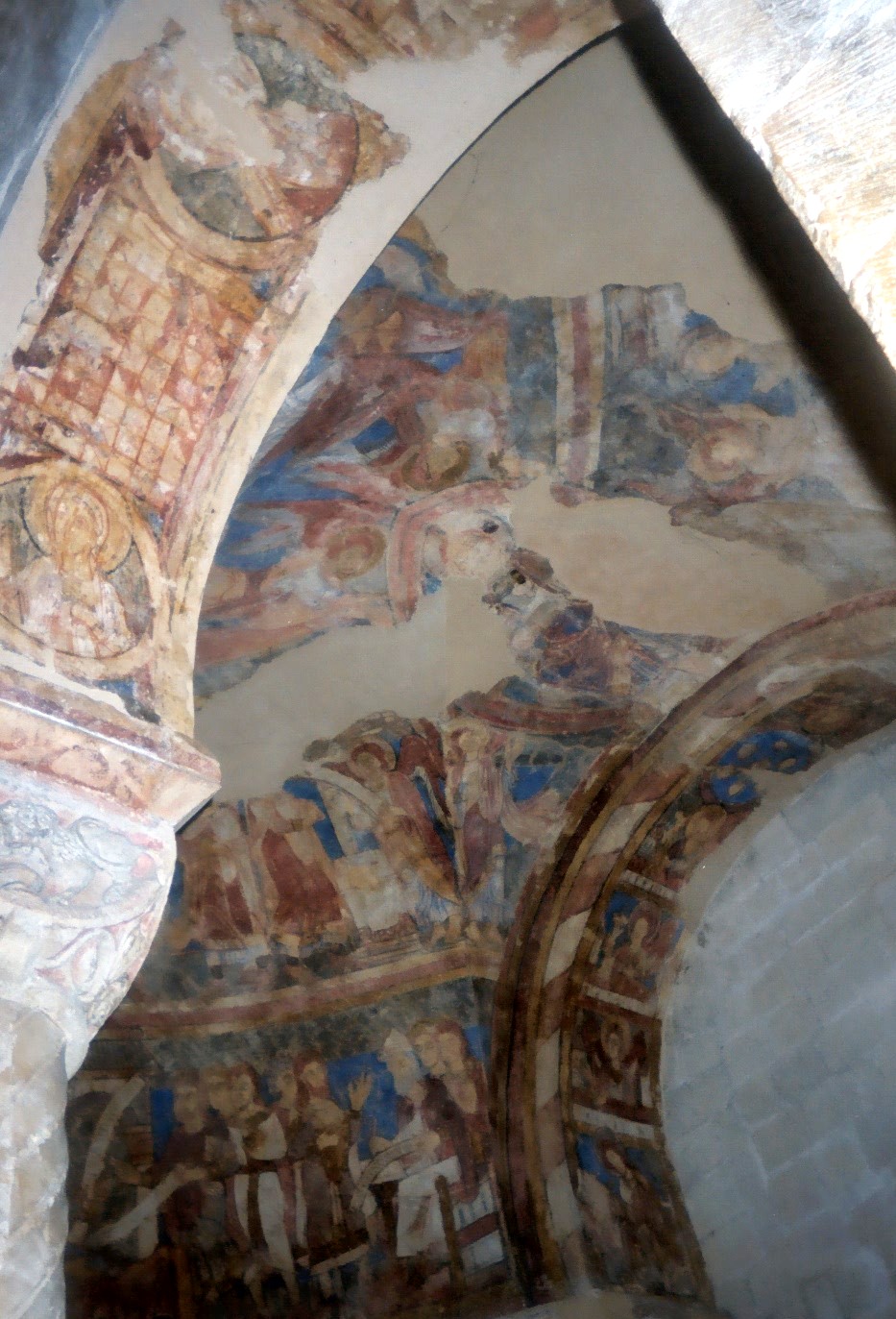
St Gabriel's Chapel
Romanesque painting in the apse of St Gabriel's Chapel
Holy Trinity, Sloane Street, London
North aisle window, designed by William Blake Richmond
North aisle window depicting English saints
Ely Cathedral
14th-century painting in St Edmund's Chapel
St Dunstan's Chapel (?)
Links
St Paul's, Knightsbridge
Community of the Resurrection
Brompton Oratory
Holy Trinity, Sloane Street
Ely Cathedral

Monday, March 25, 2002

Technology and Ethics in the 21st Century

On Monday 19 November 2001, I attended a panel discussion at Washington National Cathedral: "Are We Becoming an Endangered Species? Technology and Ethics in the 21st Century." I will attempt to capture the flow of the discussion between the four panelists and then offer some comments of my own on the important topics that were raised.

Judy Woodruff, anchor and senior correspondent at CNN, served as moderator. In addition to daily reporting, Woodruff anchors "Inside Politics," and she moderated several Republican presidential debates for CNN's Election 2000 coverage. She introduced the four panel members:

Bill Joy is co-founder of Sun Microsystems and a pioneer in development of the Internet. He entered this debate with his article, "Why the Future Doesn't Need Us," in the April 2000 issue of Wired.

Ray Kurzweil invented the first flatbed scanner, the first text-to-speech synthesizer, and "pattern recognition" designed to teach computers how to recognize the abstract patterns that dominate human thinking. He is the author of The Age of Spiritual Machines: When Computers Exceed Human Intelligence. Kurzweil came prepared with a briefing paper.

Anne Foerst is visiting professor for Theology and Computer Science at St. Bonaventure University. She recently served as a research scientist at the Artificial Intelligence Laboratory at MIT and a theological advisor on MIT's projects to develop embodied, autonomous robots.

Bill McKibben, a former staff writer for The New Yorker, is author of The End of Nature, the first book for a general audience about global warming, as well as The Age of Missing Information. (He also has the distinction of being classified as an "environmental wacko" by Rush Limbaugh.)

Woodruff introduced the topic by referring to Bill Joy's article: "It is most of all the power of destructive self-replication in genetics, nanotechnology, and robotics (GNR) that should give us pause." Such technology makes for cheap production of goods, but an accident could destroy the world. It could also be used for warfare. It does not reproduce by means of succeeding generations – its memory lives forever, making for an inhuman intelligence. Meanwhile, dangerous information is widely available on the internet – a boon to science, but also a threat through availability to terrorists. Are we an endangered species?

Bill Joy: Yes, we are becoming an endangered species. Technology poses the danger of catastrophe. For example, research is currently under way to combine genetic material from the AIDS and Ebola viruses. Can we construct technological fixes to technological dangers? Defense is difficult – for instance, bacteria are becoming resistant to antibiotics. We cannot look to technology to save us from technology.

Ray Kurzweil: Perhaps we should relinquish certain kinds of technology, on the grounds that we already have enough. If we had told people of the 18th century what the 20th century would look like, they would have said, "Let's not go there." But there were also advantages to technology – it has relieved suffering and extended life spans. There is still suffering that technology can relieve. And I cannot agree that defensive technology is necessarily weaker than the dangers.

Anne Foerst: We are created in God's image. When we are creative, we partake of God's mark in us. We cannot forbid technology. It is our nature to want to know things. Forbidding it would just push it underground, where it would no longer be subject to public scrutiny. Technology is often seen as "other" – as our opponent. But it is really an extension of us. The end of paradise came when man began judging what was good and evil – our knowledge is limited, unlike God's.

Bill McKibben: Are we at a moment that is in continuity with past development? Or are we, rather, at a special moment of discontinuity? [McKibben argues for the latter.] We have let technology grow too large, to the point where we can interfere with nature at the macro level. Theologians are now talking about a "trans-human" or "post-human" future. This marks the current moment as special – different from every moment since the world began.

(From here on, a paragraph might jump from one point to another, as a panelist responds in order to various comments by the other panelists, and my hurried notes do not provide much introductory and transitional material.)

Joy: If crazed individuals can determine the future, this is undemocratic – it gives us no say in our future. The Enlightenment had a moral basis in the relief of suffering, but now we have new gadgets just for convenience. The moral foundation of science is now absent.
Kurzweil: We cannot relinquish nanotechnology, without relinquishing all technology. Miniaturization is an ongoing trend in all technological fields, not a distinct field in itself. Banning technology would condemn billions to suffering. The fact that we have kept software viruses to a minor nuisance level shows that technological defense can work. We must increase the resources we devote to expansion of defensive technologies.

McKibben: Let's look at some concrete examples. Genetic manipulation can let us raise the intelligence or the height of our offspring. Nanotechnology that allows the construction of anything from carbon can produce technology more intelligent than humans. We are not philosophically equipped to come out on the other side of this looking anything like human beings – some tech advocates are quite candid about this. It is time for human beings to mature in a way that we have not done previously.

Kurzweil: The future will not be post-human, but post-biological.

Foerst: I bring perspectives from two fields – MIT robotics and theology. We as humans are part of nature – we eat, and drink, and die like all other animals. But we are distinct, in that we have cognition and intelligence. Experiments have shown that our cognition is embodied – that's what it means to be human. Our bodies are a means towards the end of community – we cannot download our intelligence and be disembodied humans. If we are in the image of God, we are relational – i.e., partners. We try to build machines that are partners, and they will be suitable partners, more like us than current machines, with built-in ("embedded") feelings and ethics. Even the most advanced current technology cannot match the embeddedness of insects. We cannot merge with technology, but we can interact with it, as we do with chimps and dolphins. In creating a new species of robots in our own image, we will fulfilling our own being in God's image.

Joy [citing as an example of hubris someone whose name I did not catch]: He wants to find that part of us that makes us believe in God – but only in order to decide whether to keep it or not. Why are we still doing research on anthrax? Vaccines already exist. (But malaria became worse as a result of having to resist vaccines.) We must see the world as it really is – not an idealized world of unlimited scientific progress.

Kurzweil: We are already close to breakthroughs versus disease. We need to have laws and ethics to limit and direct scientific research. We are seeing the next step of evolutionary progress – increasing complexity freeing thinking from the limitations of biological form is a spiritual quest. It would be immoral not to allow technological progress. We are the only species that uses language and whose technology progresses.

McKibben: The lust for technological development is a glib exercise in spiritual development. Humans have long tried to decide how to limit ourselves. Invention is not what makes us human, but the ability to decide not to do something that we are capable of.

After this, there was a period for questions from the audience.

A member of Friends of the Earth: We want to stop genetic engineering, cloning, and designer babies. Joy responds: The advice, "Think twice before doing something dangerous," is, unfortunately, not in the American spirit. Foerst responds: There was recently an ad in Ivy League magazines advertising for an egg from a woman who meets particular requirements for $50,000. The problem is that our society has an ideal type and punishes those who do not meet it.

Another environmentalist: Animals do not have the option of developing technological defenses to survive. Joy responds: Alfred Nobel wanted to improve the world, but killed his brother. We can't afford progress because we can't afford the budget for defense against it. We can't even fight antibiotic-resistant bacteria. Perhaps we need a market mechanism to make labs take out insurance against terrorist use of their experimental materials. Kurzweil responds: We are scared of the duality of our own nature. There are both good and bad sides of technology.

A progressive: Progress is not only technological development, but also improving equity in the social system – in this case, greater access to the benefits of technology. Foerst responds: The "world-wide web" is a misnomer – it is not world-wide. It promises a sort of Kingdom of God that it cannot deliver. Communities are more inclusive – we have learned to accept that people are different from us. People from other cultures are offended by the strength of Western values, which displace other value systems. Kurzweil responds: Technological advances reduce prices. The lagging edge of technology also moves ahead, even if it remains behind the leading edge.

A literature professor, whose class was reading Frankenstein: When humans begin to create life, is this the ultimate evil? Foerst responds: I interpret the story differently. It is not about hubris and a monster, but about denying a creature's personhood because of external criteria.

A questioner asked about the Kyoto Treaty. McKibben responds: It is not good that we were the only country to opt out of this and other treaties. There is no need to create of a race of robots to interact with – we have 6 million people to interact with. We are now breeding super-salmon that are four times as big as natural salmon, and they are already escaping and interbreeding with wild salmon. This is just one more example of our re-making the world according to our own self-serving criteria.

A final questioner: What needs to happen in the education system to bring about the moral decision-making required? Foerst responds: We need more interdisciplinarity. Science and the humanities need to learn from each other. We need to stop teaching current science as objective truth and teach the history and philosophy of science with it. This will make for more responsible citizens.


My comments

When Ray Kurzweil says, "The future will not be post-human, but post-biological," he reveals quite candidly the heresy that he is advocating: Gnosticism. The notion that our humanity is separable from our biology is irreconcilable with the incarnational principle that lies at the heart of Christianity – and of reality itself. A non-biological being, by definition, cannot be human (though perhaps it could be a person).

But others, with better semantic grounding than Kurzweil, are just as Gnostic in explicitly advocating a post-human future. Here is where hard technology meets the soft New Age – in the notion that we must "evolve" to a "higher level," shedding our obsolete humanity along the way. (This use of "evolve" has nothing to do with the more familiar use of the term in biology, but those who advocate post-humanity enjoy at least sounding like they are being scientific.) This is just another statement of Gnostic religion.

As always, Gnostic religion is opposed by Incarnational religion. For Christians, our humanity is not something to outgrow and discard, but something to fulfill, perfect, and glorify, by the grace of God. Gnosticism relies on the obvious but false premise that divinity and humanity are mutually exclusive and, moreover, mutually antagonistic. For the Gnostic, in order to become more divine one must become less human. But we look to the example of Christ, who was fully human and fully divine. In him, we see that it is only by fulfilling our God-given human nature that we can hope to become divine.

Kurzweil also expresses the modern notion that suffering is the ultimate (only?) evil, and that the alleviation of suffering trumps every other concern. I suppose that downloading our brains into machines would eliminate all physical suffering. But suffering is part of being human. While we ought to work to relieve the suffering of our brothers and sisters, we must not sacrifice our humanity or theirs in pursuit of this goal. Rather, we must remember that Christ, who shared our humanity, also shared our suffering.

The other panelists all opposed Kurzweil's gospel of technological salvation, at least some of the time in some ways. McKibben showed particular awareness of the importance of defending and preserving our humanity in the face of technological threats. Joy warned against the amorality and hubris that always seem to accompany modernity and technology. And Foerst emphasized the incarnate nature of our humanity and of community.

On the other hand, I think Foerst is naive in her vision of a future race of robot buddies for mankind. She says this creative urge is just evidence that we are made in God's image. I would suggest it is evidence that we are still falling for the serpent's lie that we can become like God by satisfying our curiosity.

Tuesday, September 25, 2001

Our Responsibility for 9/11

This was a response to Lori on the Christ Talk board not long after 9/11.


I am no pacifist or socialist. As a CIA analyst, I spent seven years as a professional anti-communist cold warrior. As an economist, I am a professional apologist for the market and the American way. If I were in the same room with Osama bin Laden, I might very well kill him with my bare hands and not feel very guilty about it. But I think Mr. Ghandi is more right than you are, and I think some of your criticisms of him are unfair, and others are un-Christian.

To acknowledge our responsibility for these evil acts in no way absolves the terrorists, as you seem to think it would. But neither does their guilt absolve us.

In the Liturgies of Holy Week, we take responsibility for Christ's death. The fact that the Pharisees and the Romans crucified him two millennia ago does not absolve us. We are not without sin. We must never imagine, just because we can find someone else to blame, that we are innocent.

As Christians, we must always try to assume the point of view of our enemies. The Golden Rule is not suspended just because we are at war. We must ask honestly what motivates our enemies. Only in this way can we get past self-serving propaganda and hope to discover the root causes of the problem and truly resolve it. And only in this way can we fulfill our Lord's command.

How might we be to blame in the recent terrorist acts? Most obviously and directly, we created the Taliban. The U.S. government provided massive funding to the Mujahedin who were fighting the Soviet-backed regime in Afghanistan. But we did not control where any of the money or arms went. The Pakistani military and intelligence services directed the arms to their favored factions of the Mujahedin – and they favored the radical Islamic factions we now know as the Taliban. We knew what they were doing (I remember reading about it in National Review at the time), but we thought ousting the Soviets was more important than the fate of Afghanistan. When the Soviets pulled out, we declared victory and walked away, leaving the country to the mercies of the victors. As always happens in the wake of revolutions, the most violent, amoral faction defeated its former allies to take control.

In the righteous cause of the war against communism, we often used and abused poor countries, discarding them when they were no longer of use to us. In the name of democracy, freedom, and prosperity, we supported governments that deprived their people of these things. In some places, we still do. It is not hard to understand why some citizens of those countries consider us hypocrites.

In other places, where our strategic interests are not at stake, we have tried to impose Western liberal values on countries that were not ready for them. Much of the suffering in Russia these days has resulted from attempts to impose a market economy prematurely, without first creating the cultural and institutional infrastructure required to make it work. We, through the IMF, essentially imposed a kleptocracy (government by criminals) on Russia.

We should not wallow in guilt over our mistakes of the past. But we should repent of them and stop making the same mistakes again. And we should try to clean up some of the messes we have made. Otherwise, new resentment will continue to create more terrorists, and we will never win the war against terrorism.

Monday, July 2, 2001

Bishop Kallistos on Primacy and Prayer

On Wednesday 20 June, I visited St. Mark's Coptic Orthodox Church, near Fairfax, VA, to hear Bishop Kallistos Ware speak. I will briefly describe the service of Vespers that preceded the bishop's talk and the iconography of the church, and then summarize both his formal address and his brief pastoral talk. Coptic Vespers. I arrived about a third of the way through Vespers, just as they were beginning a series of doxologies to the Virgin Mary, the angels, the apostles, St. Mark the Evangelist (founder of the Church in Egypt, according to local tradition), St. Athanasius, and St. Anthony. Each doxology consisted of a series of short verses recounting the histories of the saints and requesting their prayers. The cantor would sing a verse in Coptic, and then the choir and congregation would sing the next in English. The bulletin included each verse in both languages, making it easy to follow. (Coptic is surprisingly easy to follow, since it uses an expanded version of the Greek alphabet and borrows a lot of Greek vocabulary for liturgical use.) A proper psalm and gospel reading followed the doxologies, and the service concluded with a series of prayers (during which we recited the Lord's Prayer at least three times). They used the traditional monophysite interpolations in the Trisagion, including the line, "Holy mighty one, who was crucified for us," which once caused so much controversy (some feared that it implied Patripassianism). The only other thing that struck me as strange was the repeated application of the term Pantocrator to the Father, rather than the Son. The church is quite new – until recently, St. Mark's worshiped at a small, old church west of Tyson's Corner. There is a large central dome over the square nave and a smaller dome over the apse. The window treatment above the side aisles gives it a Middle Eastern feel. Where the royal doors and the deacon's doors would be in a Byzantine iconostasis, St. Mark's has heavy maroon curtains. The iconography is of mixed types. The central image of the Last Supper above the middle curtain was very Western and representational. The icons along the side aisles are somewhat more stylized, but less so than Byzantine icons. And all of the other icons at the front of the church, corresponding to a Byzantine iconostasis, were in a style I later heard described as "neo-Coptic." It appeared to have heavy Ethiopian influence, with round faces and large eyes. Icons of Christ Pantocrator and the Theotokos flanked the central curtain to the right and left. On the far right was the Baptism of Christ and on the far left St. Michael. Above the side curtains were panels with the twelve apostles. You can find links to neo-Coptic images on this page (you have to click twice to make the buttons work). Power, Authority, and Service. Bishop Kallistos was in town for the Orientale Lumen Conference, which he attends every year around this time at Catholic University. The theme for this year's conference was "Primacy and Conciliarity: Finding a Common Vision." A brief description of the conference, including a photo of Vespers at St. Mark's, can be found here. The bishop's address on Wednesday evening stuck to the theme of the conference, exploring the issues of power, authority, and service in the Church. (I did not take notes, so this will all be from memory. I hope I will represent Bp. Kallistos's thoughts accurately.) His first text came from the Synoptic Gospels: "You know that the rulers of the Gentiles lord it over them, and their great men exercise authority over them. It shall not be so among you; but whoever is great among you must be your servant, and whoever would be first among you must be your slave; even as the Son of Man came not to be served but to serve, and to give his life as a ransom for many" (Matt. 20:25-28). He also read the somewhat different version of this saying from Luke 22:25-27. In the Church, authority comes from diakonia and primacy from kenosis. Leadership in the Church is so different from the worldly political realm that it can only be misleading to compare them. Authority in the Church is, first, the authority of Christ. He shares his authority with his Bride, the Church. He does not delegate, but shares his authority. Bp. Kallistos singled out the title "Vicar of Christ" for special criticism. This title, usually applied to the Pope, has, in recent times, been applied to all bishops. But it is terribly inappropriate. A vicar is one who exercises authority on behalf of another who is absent. But Christ is not absent from the Church, as this title would imply. Bp. Kallistos pointed more favorably to another papal title that is a favorite of John Paul II: the Servant of the Servants of God. His second text came from John: "You are my friends if you do what I command you. No longer do I call you servants, for the servant does not know what his master is doing; but I have called you friends, for all that I have heard from my Father I have made known to you" (15:14-15). We are still to obey Christ's commands, but we now do so not blindly as servants, but in knowledge, as friends. And it is not only the bishops who are Christ's friends, but all Christians! That Christ's knowledge and authority are shared by all the faithful is embodied in the traditional formulation, sensus fidelium. It is not only the bishops who are responsible for defining and guarding the faith, but the entire Church. The pronouncements of councils of bishops must be received by the whole Church before they can be taken as final and definitive. There have been times when most of the bishops bowed to heresy, but the laity preserved the true faith. This, of course, is not to say that bishops have no special role to play in the Church, or that the Pope has no special role to play among the bishops. But the Pope's traditional primacy among the bishops is often misunderstood. This is demonstrated clearly by the recent ARCIC statement, "The Gift of Authority," which focuses on the primacy of the Pope and the authority of diocesan bishops. The document ignores the many intermediate levels of primacy – patriarchs, primates, metropolitans – in an effort to emphasize the special role of the Pope. But the Pope and other patriarchs have no special ontological status separate from the rest of the episcopacy. They do not receive a fourth ordination. Any special authority they have can only be understood as relative authority within the college of bishops. It is only within this context that Papal primacy can be properly understood. Pray Without Ceasing. The formal address of Bp. Kallistos was followed by a lively musical interlude by the parish choir, featuring chant and percussion. I took this opportunity to get a better look at the icons in the side aisles, all of which depicted Egyptian saints – some familiar (Anthony) and some not (Mina). The bishop then gave a brief pastoral talk to a much smaller audience, consisting mostly of members of the parish. His text was St. Paul's instruction, "Pray without ceasing." He offered practical advice on how to approach this goal more closely in our own lives. His suggestions included: 1) Upon awaking, begin the day by making the sign of the cross. And at the end of the day, make the sign of the cross again before going to bed. 2) During moments of free time say an "arrow prayer" – a prayer like the Jesus Prayer that is short and goes straight to the target. 3) Give thanks before eating. 4) Be conscious of God's presence in our daily activities – for example, to see our encounters with other people as opportunities to meet God. 5) When reading Scripture, read it as if it is God's word to you.

Friday, June 22, 2001

Expectation and Hope

I originally posted this essay to the Christ Talk board, which succeeded UCMPage after the latter board's implosion.


Perhaps I am too comfortably post-Constantinian in my churchmanship, but I'm not sure those early Christians who expected the imminent return of Christ were best examples of Christians in their generation – even if they were in the majority in some places at some times. It reminds me too much of the cults whose members sell all their worldly goods and retreat to await the end of the world.

Instead of forming expectations about Christ's return and then living our lives contingent upon our expectations, should we not be prepared for all possible contingencies? Christ has this habit of not conforming himself to our expectations . . . Perhaps the only thing we should count on is that he will surprise us.

I think St. Paul exemplified such an approach, in a different context, when he said, "Whether I live or whether I die, then, I am Christ's."

However, I think the key question is neither expectation nor preparation, but hope: Do we truly hope for Christ's return? Do we join the early Christians in crying, "Maranatha"? When we pray, "Thy kingdom come," do we mean it?

It is hard for us to wish for Christ's return. The prophets warned that the day of reckoning would not be what their hearers wished or expected – that they would suffer – that one has to be pretty bad off before he can count on his condition being improved by God's judgment. Christ himself often said, "The first shall be last, and the last shall be first." Given our comfortable American lives, we might reasonably fear Christ's coming, rather than hope for it.

But most Americans look to Christ's coming with neither hope nor fear. This is exactly the sort of question that our consumer culture does its best to keep us from facing. The Establishment wants to keep the drones on their treadmills, working and consuming without thinking too much about what it means (or should mean) to be human beings subject to divine judgment.

American business has mastered the tactic of transmuting our spiritual longings into new sales opportunities. This not only makes a buck for someone, it also cons us into thinking that we have "made a statement" by the way we have spent our money. Thus, every sector of our consumer economy now has a special niche where the adjective "Christian" precedes the name of every product. We can now practice our religion by simply buying products bearing our own union label.

Eventually, however, the commercial anesthetic will wear off, and American Christians might then realize that they no longer have a stake in this culture of spiritual death. Then perhaps they will wake up and take up the Revelator's cry, "Come, Lord Jesus."

Friday, April 27, 2001

Culture and Religion

I originally posted this essay to the old UCMPage message board. Most of the participants were United Methodist clergy of a high-church (i.e., sacramental and apostolic) orientation. Popular topics on the board included incarnational theology, eschatology, ecumenism, Calvinist-bashing, and baseball. My two favorite UCMPage participants have moved on, respectively, to the Byzantine Catholic Church and the Anglican Mission in America.


We have the misfortune, unique in human history, to live in a society totally devoid of culture – a post-cultural society. We throw around the term culture a lot, but we are always using it in a metaphoric sense (e.g., "corporate culture"), not in a literal sense (unless we are talking about times and places other than our own).

It is our nature as human beings to live in a culture. A culture ties together a people or nation in much the same way as a language. It provides norms that govern individual behavior, interpersonal relations, and collective action. It serves as a reservoir of common stories, images, and metaphors that make communication and community possible. We inherit a culture that embodies the wisdom of our ancestors, and we pass it on to our descendants. In a lot of ways, it similar to the concept of Tradition in Orthodox Christianity.

But our society has jettisoned culture. In the U.S., the ACLU seems to believe that every remnant of culture is an offense against the Constitution, to be stamped out. Each generation assumes as its birthright the privilege of rejecting everything bequeathed by the previous generation and reinventing everything from scratch. Madison Avenue does its best to squash any carry-over from the past in order to preclude competition for whatever it is selling this week. The establishment seeks to "free" us from culture in order to enslave us to its petty thrills and keep us on the treadmill. All of this is especially true of the Baby Boom generation.

A proper religion must be part of a functional culture. That's what real religion is – the part of culture that addresses the eternal part of our human nature. Some (not all) Protestant churches – and these days even some American Catholic churches – however, have yielded to the surrounding anti-culture. They offer a "religion" that is little more than a hobby or personal idiosyncracy, which does nothing to reconcile us to our ancestors and descendants, our neighbors and enemies, and our own human nature.

But many churches – especially the Orthodox, but also many ethnic Catholics, Lutherans, and Anglicans (not to mention the Amish and the Old Believers) – respond in a different way to the disappearance of their culture. Since they are no longer surrounded by a functional culture, to which their religion can become enculturated, they simply preserve the culture they inherited. This culture is, unfortunately, not consistent with the anti-culture that dominates the rest of their lives, so it requires a bit of double-think. But real religion must be embodied in a real culture, and a slightly old-fashioned or old-country culture is better than none.

This is not to say that there is one true (or best) Christian culture, and that Christianity must always take a given form. But Christianity must always take some particular cultural form – it must be incarnated in a particular way among each particular people. It should not be surprising if different peoples, with their different languages, histories, and economic/geographic milieus, would diverge in religious expression and practice as they do in other aspects of culture.

I think the Eastern Churches have, for the most part, done a good job of preserving the proper understanding of the relationship between religion and culture. When we of the West visit an Eastern church, therefore, we must overcome two hurdles: 1) We must suppress our perverse modern Western tendency towards anti-culturalism and accept the culture-laden religious expressions of Eastern liturgy and theology; and 2) we must learn to operate in the particular culture of the people whose church we are visiting.

I think the latter problem is perfectly understandable. It is only natural to feel more at home in one's own native culture, just as one prefers to speak one's own language. Until you learn through long practice to operate in another culture (or language), you must spend a lot of energy in translation, and then you still wonder if you aren't missing something important. But eventually, you do learn to function in the new culture, and the added perspective you bring from your native culture can even enrich the experience by suggesting parallels or contrasts to meditate on.

I suspect the former hurdle, however, is more problematic for most Americans – not the particular cultures of the Eastern churches (Greek, Arabic, Slavic, etc.), but the very fact of the importance of culture, which entails an implicit rejection of modern American anti-culture.

I am privileged to be part of an Anglo-Catholic parish that rivals the most ethnic of Orthodox parishes in its preservation of culture and customs from the Old Country. In our case, however, the Old Country is England, so we can have a full cultural embodiment of our religion without having to learn a totally foreign culture.

At the same time, as Orthodox Churches in the U.S. draw American converts and come to be dominated by American-born members rather than immigrants, they face both an opportunity and a danger. The opportunity is to preserve their traditional connection between culture and religion, while adapting to their new cultural environment. The danger is that, as they become Americanized, they will adapt to the anti-culture and forfeit the treasure they have preserved. I have seen examples of both tendencies among the Orthodox in this country.

Wednesday, January 31, 2001

For Sociobiology

This is a letter I submitted to First Things in 2001. They sent me a nice letter saying I had obviously thought long and hard about this issue, but they didn't publish the letter.


Dear Editor:

Tom Bethell's article, "Against Sociobiology" (January 2001), is wrong on so many points that I'm not sure where to begin. So, instead, I'll start with Edward T. Oakes' review of Phillip E. Johnson's new book in that same issue. Oakes cites J.H. Newman's description of a rhetorical trick favored by secular intellectuals: "They persuade the world of what is false by urging upon it what is true." In the particular instance addressed by both Oakes and Bethell, some biologists who proclaim the truth of naturalistic evolution proceed to infer therefrom that God does not exist and that religion is wrong or invalid or obsolete. Oakes is not taken in by this leap of logic, but I fear that Bethell is.

A false implicit assumption underlies the atheistic scientists' argument: That demonstrating a completely naturalistic explanation for a phenomenon is sufficient to preclude any role for the supernatural. For a Christian, however, this reasoning is not only illogical but heretical. If we begin by positing the mutual exclusivity of the natural and the supernatural, we must end by denying the Incarnation. Those of us who affirm that Christ's full divinity and full humanity coexist in him without confusion and without division should have no trouble seeing room for the hand of God behind the completely naturalistic world described by biologists. Likewise, if we can believe in both free will and predestination – that human beings, choosing freely within earthly constraints, unwittingly behave as if according to a divine script – then we should find it no stretch to suppose that a completely naturalistic process of evolution could fulfill a foreordained divine plan.

Bethell gets so sidetracked by his concern over the non-issue of naturalism that he misses the real issue at stake in the Sociobiology Wars: the reality of human nature. While Lewontin and Gould, on the one hand, and Dawkins and Wilson, on the other, agreed on the premise of naturalism, they disagreed – sometimes bitterly – on human nature. Bethell nicely exposes the political motivation of the former pair, whose prior commitment to Marxism demanded that they deny human nature in order to portray humans as blank slates who could be conformed to the revolutionary order. Therefore, Lewontin and Gould asserted an arbitrary limitation on the scope of evolution, requiring that it govern only physical development, but not trespass on the realms of mind and culture. (Ironically, this parallels the arbitrary limitation on the scope of evolution asserted by those creationists who concede the reality of "microevolution" but dispute the evolution of new species.)

Edward O. Wilson, on the other hand, carried evolutionary theory honestly to its logical conclusion. His theories do not, as Bethell contends, imply that human culture and behavior are, themselves, biologically hardwired. Rather, Wilson's theory of the coevolution of mind, culture, and environment implies that culture operates in the human mind much like language. The capacity for language is hardwired in the human brain, but the actual expression of this capacity in an individual depends on the what language(s) the individual is exposed to, particularly in childhood. The forms that human languages can take, however, are limited and defined by the linguistic structures of the mind. Likewise, the capacity for culture is an innate element of human nature. It is our nature to live in a culture as surely as it is our nature to speak. The particulars of culture will vary between different times and places, as culture adapts (evolves) to meet the demands of a given environment, but the functions that culture serves and the forms it takes are defined by the cultural structures of the human mind.

Where does this leave religion? I think Wilson would probably classify religion as a special element of culture that recurs in all human cultures because we have an innate capacity for it – and that this capacity is (or was at one time) adaptive. Wilson's charitable attitude towards religion, a marked contrast to that of Lewontin, is consistent with his sociobiological model of evolution. (And Wilson is not exactly an atheist, as Bethell seems to imply. He describes himself as a Deist, much like his heroes of the Enlightenment era.) So evolutionary biology, carried to its logical conclusion, suggests what Christianity and the other major religions have told us all along: that our religious longing for transcendence is an innate part of who we are as human beings.

Richard Dawkins, on the other hand, takes exception to this conclusion. He largely agrees with Wilson's sociobiology, but he bends over backwards to explain away the obvious implication that religion must be an adaptive characteristic of human nature. I think the vehemence of his attacks on religion reflects the feebleness of his argument. His attempts to reconcile his visceral disdain for religion with his science are utterly unconvincing.

Wednesday, December 13, 2000

Systematic Theology Final

The take-home final for my Foundations of Theology course at Washington Theological Union in the fall of 2000 consisted of four questions, of which I had to answer two.


1. Define faith for a Christian. Is faith also found outside Christianity? What, then, is faith in its most generic sense? Relate faith to God as ineffable mystery. Does faith have any content? Explain briefly. What is the relationship of beliefs to faith? Do beliefs exhaust faith? Adequately express it? Explain the corporate character of faith or why the Church is the Great Believer.

Faith can be viewed in two dimensions, passive and active. For a Christian, faith understood passively means trusting in and depending on God – being open to his revelation and guidance, and relying on his providence. This trust rests on an implicitly understood (or, perhaps, imagined), image of reality at whose center (or foundation) is a gracious, transcendent God. This passive dimension of faith is complemented by a more active dimension, which can be described as loyalty or fidelity – being faithful in one's relationship to God in living out one's life. This loyalty rests on commitment, an exercise of one's human freedom in which one freely binds oneself to one object (e.g., course of action, way of life, community) rather than to others. The particular commitment entailed by Christian faith is commitment to God, in his transcendence and mystery. When fully realized, faith becomes central to the Christian's identity, engaging his imagination and intellect, his heart and soul, in prayer and ministry, in life and death.

Faith is not exclusive to Christianity. It is, rather, a universal human phenomenon. The capacity for faith, like the capacity for language, is a part of human nature. But the fulfillment of one's capacity for faith, like that for language, will depend on the community in which one learns to exercise that capacity. Where Christian faith rests on one kind of implicit image of reality, faith in other religions or cultures might rest on different underlying images of reality. And, where the transcendent object of faith to which Christians commit themselves is envisioned as a unique, personal God, those in other religions or cultures might envision the transcendent object of faith as multiform or impersonal. But faith can also be directed towards lesser objects, such as nation, pleasure, or security, particularly in modern societies where cultural norms no longer guide their members' faith development (or where they misguide it). Some anti-religious forms of modern secularism, by actively avoiding anything that looks even slightly like religion, might even have established themselves as exceptions to the rule that faith is a universal human phenomenon. And while faith, like language, is a normal part of human life, its development can sometimes be impeded by abnormal circumstances. The rare child raised by wild animals will not learn human language, and a child raised in a chaotic environment without reliable caregivers will not learn the fundamental trust that serves as the foundation for faith development. But apart from these aberrations, the underlying human capacity for faith is the same, even if it is expressed differently by different communities and individuals.

As suggested above, faith, in its most generic sense, entails confidence in an object beyond the self, to which one submits freely. This commitment is expressed by dedicating one's life and energies to the object and the values it implies. While we say that God is the proper "object" of Christian faith, God is not just a finite object alongside other finite objects. God is infinite, complete in himself. God is not just another creature, but the foundation on which creation rests, and without whom creation could not exist. As such, God is that on which we implicitly rely, and that to which we explicitly commit. Faith draws us to transcend ourselves as we draw nearer to God. But, because God is infinite, we finite creatures cannot comprehend him. This is not to say that God is entirely unknowable – we may know him in his works and in revelation – but that God cannot be exhausted or transcended. This is what we mean by saying that God is ineffable mystery. We put our faith in God, knowing that we do not and cannot fully comprehend him. But if God were fully comprehensible, he probably would not be a worthy object of faith.

Even though the capacity for faith is universal, the actual forms it takes in different communities and individuals are not. While faith is not only or primarily a matter of knowledge, it does not exclude the cognitive dimension. The knowledge contained in faith is of the a priori kind. One cannot commit oneself to the transcendent God without having at least some implicit, unthematic knowledge of him based in revelation and/or imagination. When we move to a posteriori knowledge, however, we are on the way from faith to beliefs.

Beliefs are objective expressions that define and interpret faith and its object in order to mediate them to us. They aid believers in reflection, allowing them to bring their faith to greater consciousness. Beliefs also provide a common reservoir of terminology, doctrines, images, and stories that permit discussion of faith within the community and provide the potential for communication of the community's faith to those outside its boundaries, to the extent that the language is comprehensible without the underlying faith experience. Beliefs are always secondary to faith itself, and beliefs can never exhaust faith. Because faith, like its object, is inexhaustible, no set of beliefs can constitute a comprehensive expression of faith. Perhaps some beliefs may constitute an adequate expression of some aspect of faith for a given community at a given time. But, because the meanings of words and images can vary between different times and places, this adequacy is likely to be limited to a small, temporary audience. Moreover, adequacy is a standard that leaves room for further development, and cannot, therefore, be taken as an excuse to cease the enterprise of theology. As the community's understanding grows or changes, beliefs may have to be refined.

Faith has an inherent tendency to want to communicate itself. Jesus did not keep his faith to himself, nor did his apostles. The preaching of a sincere, profound faith tends to draw a community to share that faith. When new members join themselves to the community, and when even newer members are born into the community, they help to shape the community, and it, in turn shapes them. Beliefs and practices develop to express and embody the faith of the founders, so that it becomes the faith of the community. These beliefs and practices further develop in the process of transmission, becoming a tradition. Members of the community identify with the community and its tradition. This identification normally takes the form of a public commitment. In short, believers normally learn, express, and live their faith within a community of more-or-less like-minded believers.


2. Many theologians maintain that the category of symbol is our best approach to expressing revelation. Define and explain what a symbol is. What is a religious symbol, and how would you distinguish religious symbols? Take a symbol of your choosing and explain how it operates as a symbol. Now apply symbol theory to the concept of revelation, and explain how it does justice to revelation as transcendental and particular. [In my answer I reverse the order of the last two parts of the question.]

A symbol is that which mediates the knowledge or presence of something other than itself. The symbol is, itself, a finite reality of this world. But it points beyond itself to reveal another reality. It works by implicitly positing an analogy between the symbol and the symbolized. That which is symbolized is to be understood in terms of the symbol. Barbour suggests that the analogy consists of positive, negative, and neutral analogies. When we call Jesus the Good Shepherd, for instance, the positive analogy draws our attention to the ways in which Jesus cares for the Church like a shepherd cares for his flock. The negative analogy reminds us that the symbol is not to be identified with the symbolized completely or literally; thus, the Good Shepherd symbol is not to be taken to mean that Christ was literally a shepherd or (as some English cathedrals would apparently have it) that there is some sort of Christian virtue inherent in the wool trade. The neutral analogy consists of elements of the analogy not covered by the positive and negative analogies, which are open to further exploration. Because symbols have this element of neutral analogy, they are open-ended, encouraging extension through further reflection. The Good Shepherd symbol has been extended to picture the apostles and their successors, the bishops, as shepherds of Christ's flock in the world. At one time, it was further extended to picture the political establishment as sheepdogs, protecting the flock from worldly dangers in cooperation with the shepherds. The first extension of the shepherd symbol to bishops is still a living symbol, but the sheepdog extension is rarely heard today outside the context of medieval history.

The open-endedness of symbols suggests their potential richness and depth, in contrast to signs, which strive for a simple one-to-one correspondence with that which they signify. Symbols appeal to the unconscious mind as well as the conscious, and no conscious description or explanation can exhaust their meaning. Symbols mediate what the Eastern Orthodox sometimes call indirect knowledge. While direct knowledge might come from studying a catechism, indirect knowledge arises from immersion in a symbolic tradition. Symbolism engages the imagination (right brain) as well as the intellect (left brain), bringing the believer into a holistic relationship with what is symbolized.

A religious symbol is one that points to a proper object of religion – a transcendent reality. Because religious reality is transcendent, it can be difficult to mediate to believers. A religious symbol addresses this difficulty by making present, in a sense, the transcendent reality that it symbolizes. The symbol re-presents that reality in a way accessible to the religious subject. Or, alternatively, it might be understood as making the religious subject present to the symbolized reality by fully engaging him in the encounter mediated by the symbol.

Transcendental revelation is God's self-communication in the depths of a person. All revelation must be mediated. In a sense, in transcendental revelation, the person becomes the medium in which God reveals himself. But this becoming might involve the person's appropriation, or internalization, of various media through which such divine self-communication takes place. Symbolism is one such medium, and one particularly suited to transcendental revelation. Because of symbolism's appeal to both conscious and unconscious, to both imagination and intellect; because of its complexity and richness, as developed in tradition; and because of its open-endedness, which invites the participation of the subject, it has the potential to fully engage a person at the deepest internal level, where transcendental revelation takes place. A tradition's first-order symbols, in their concreteness, provide basic structure and content within which both community and individual encounter God. From these concrete symbols, the experienced divine encounters associated with them, and reflection on these, second-order symbols are consciously developed, such as terminology, formulations, and dogmas.

An example of a Christian symbol is the Assumption of the Blessed Virgin Mary. On the finite level, it can be expressed in a straightforward way: Mary died and went to heaven. (I will not address the question of whether the Assumption should be considered a first-order or second-order symbol. I would lean towards second-order, but I could not argue the point well enough to convince myself.) Mary, in addition to being a historical person, is a symbol of the Church. Her identification with the Church is not entirely a matter of symbolism, since the New Testament puts her in the company of the apostles after the Crucifixion (Acts 1:14); and, moreover, her being the first person to have a committed, faithful relationship with Jesus could arguably make her the first Christian. But Mary has come to symbolize the Church as more than just another member. This symbolism achieves it full realization in the tradition of her Assumption, in which we celebrate not only the glorification of our blessed Mother, but also our own hope of glory, as members of the Church that she symbolizes. The bridal references in the hymns of the Byzantine service known as the Epitaphios of the Theotokos (observed on August 14, the Eve of the Dormition) serve as a reminder that the Church, as the Bride of Christ, will one day be united with him as Mary is in her Assumption. Further reflection on the symbol of the Assumption has suggested to some Christians 1) parallels with Christ's Ascension, to which the Assumption can be understood as a logical sequel, and 2) Mary's coronation as Queen of Heaven. These extensions illustrate the open-endedness of the symbol and suggest the potential for the fruitfulness of further reflection on the symbol. At the same time, the contrast (some would say dissonance) between Mary's roles as mother and bride provides a paradoxical element of the symbol that is difficult to resolve in a straightforward way on a purely conscious level, suggesting a deeper symbolic complexity.