Wednesday, April 11, 2007

Recapping Holy Week: Great and Holy Friday

Today was the first day since Thursday 29 March that I have not attended at least one church service. I was so exhausted that I slept until 2 PM!

I'm pretty sure I have attended every Orthodox Holy Week service except the Palm Sunday Liturgy at least once before, but this was the first time I have done it all. I found the Lenten fast much easier than I expected, but remaining on my feet through most of 36 hours of liturgy in the past 11 days was a much more rigorous discipline. Trevor has already blogged on the relief that prostrations bring to an aching back, so I'll say no more on the subject.

I took Friday off work and spent the whole day at church. We began at 9 AM with the Royal Hours, which concatenates the offices of the First, Third, Sixth, and Ninth Hours. Each office consists of a few psalms, a hymn sung by the chanters, and three readings – Old Testament, Epistle, and Gospel. Compared to the Royal Hours of Christmas and Epiphany, the Gospel readings were longer and seemed more central. The Gospel reading at each office was a large part of the Passion story from a different Gospel, proceeding in canonical order through Matthew, Mark, Luke, and John.

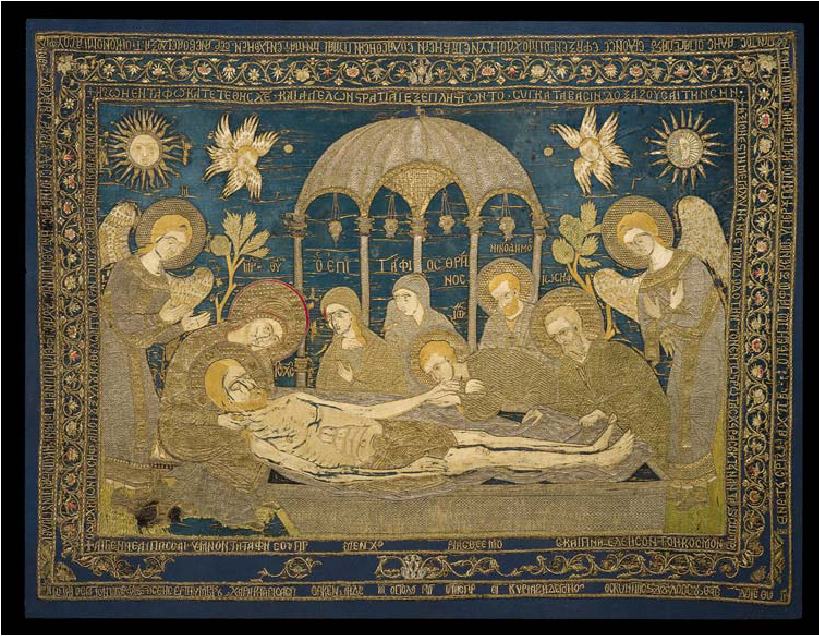
Shortly after the Royal Hours we began the decoration of the bier. It is customary to place an embroidered icon of Christ's preparation for burial, called the epitaphios, inside an elaborately flowered tomb or bier. About ten of us helped to place flowers and greenery into blocks of oasis, fastened to the top of the bier until it looked something like this:


Given that my patron saint is Joseph of Arimathea, I thought it was especially appropriate that I should participate in the decoration of the bier.

The next service, at 3 PM, was Vespers of the Removal from the Cross, also known as the Unnailing Service, since the nails holding the icon of Christ to the cross are removed. Two of my fellow bier-decorators were selected to remove the nails and place the near-life-size icon of Christ in a shroud before it was placed on the altar. Then the epitaphios was brought out and placed in the bier, where we venerated it, each in turn, by doing a double prostration, kissing it, and doing a third prostration.

The final service of the day, at 7 PM, was my favorite Byzantine service, the Lamentation service. We sang three long, beautiful hymns of lamentation for our Lord's death, also recounting the actions of Joseph, Nicodemus, and the myrrh-bearing women. Then we inserted poles into the bier and carried it in procession around the church as we sang the Trisagion. I served as one of the eight pall-bearers, who took turns carrying the heavy bier. When we returned to the church, we held up the bier above the door between the narthex and the church. After everyone had passed under it, we replaced it in its original position at the front of the church. At the conclusion of the service, after we venerated the epitaphios again, Fr. Gregory handed out flowers taken from the bier.

This service was followed by an all-night vigil, sponsored by the youth of the parish. The vigil began with the reading of Matthew. I stayed to listen to the gospel until I heard the verse, "My yoke is easy and my burden is light," at which point I decided it was time to loosen my yoke. So I venerated the epitaphios again, took another flower for my icon corner, and went home to get a few hours of sleep.

Saturday, April 7, 2007

Lyrics for Holy Saturday

I've spent so much time in church this week (22 hours so far, with about another 4 to go) that I haven't had a chance to listen to most of my usual Holy Week music, like "Jesus Christ Superstar" and Handel's "Messiah." Right now I finally found an hour to listen to Kate Campbell's album of hymns and gospel tunes, "Wandering Strange," while I catch up on my e-mail. But it doesn't look like I'll get to U2's "Achtung Baby."

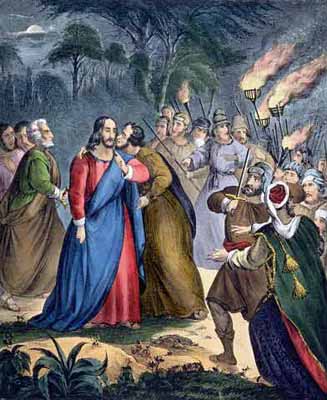
Yes, you read that right. While Bono's lyrics often draw on Christian terms and symbols, this album contains a song that is both subtle and explicit, "Until the End of the World." I had probably heard this song a dozen times, half-listening, and classified it as just another rock song about love, either unrequited or gone-bad. Then one time I popped the tape into my tape deck as I was leaving work for a Melkite Epitaphios service on Good Friday. With my mind focused on the events the Church was celebrating this day, I finally heard the real meaning of the song: During the Harrowing of Hell, Jesus encounters Judas, who sings this song.

Haven't seen you in quite a while
I was down the hold, just passing time
Last time we met it was a low-lit room
We were as close together as bride and groom
We ate the food, we drank the wine
Everybody having a good time
Except you
You were talking about the end of the world

I took the money, I spiked your drink
You miss too much these days if you stop to think
You led me on with those innocent eyes
And you know I love the element of surprise
In the garden I was playing the tart
I kissed your lips and broke your heart
You, you were acting like it was the end of the world

In my dream I was drowning my sorrows
But my sorrows they learned to swim
Surrounding me, going down on me
Spilling over the brim
Waves of regret, waves of joy
I reached out for the one I tried to destroy
You, you said you'd wait till the end of the world

Thursday, April 5, 2007

Where the Vultures Are Gathered

And they asked him, "Where, Lord?" He said to them, "Where the body is, there the eagles will be gathered together." – Luke 17:37

Since November, when my institute moved to new quarters, I have had a view from the eighth floor of the second tallest building in Calverton, Maryland. For the most part, the view is disappointing – I can gaze down upon the rooftops of all the other buildings in the office park, which are not designed to be attractive from above. But it has also proved to be an excellent perch for watching birds. I have seen as many as 30 Canada geese gathered in and around the little pond in the middle of the office park, along with a few ducks. On other days I can watch big flocks of crows. Today I saw two big crows searching under rocks on the roof ledge just two offices down. Since that office is currently unoccupied, I was able to camp there and watch them up close. Their search turned up something interesting and they flew away, one of them doing some fancy aerobatics on its way to the ground.

But my favorite birds to watch from here are turkey vultures (or, as we used to call them back in Indiana, turkey buzzards). Most days I don't see them at all, but on a windy day like today they are out in force. At one point today I could see 10 of them in the air at once! I think the wind must interact with the tall building to create currents that the vultures find useful. One day they kept flying directly at my window, only to swoop straight upwards at the last second before impact. Vultures know how to use the currents to gain speed and elevation.

The sight of so many vultures reminded me of the verse from Luke quoted above. While translators invariably give eagles as the primary translation, interpreters prefer the alternative translation, relegated to a text footnote in the RSV: vultures. As scavengers, vultures will gather wherever they find a dead body to feed on.

The disciples are pestering Jesus, wanting to know the time and place when the Kingdom of God will appear. And the Lord, characteristically, gives an indirect answer that demands their deeper engagement with the question, rather than something they can write on their pocket calendars. Could he be telling his disciples that they should watch for some commotion that signals the Kingdom, just as a gathering of vultures signals the presence of a carcass? Probably not, since he had just told the Pharisees earlier in the chapter, "The kingdom of God is not coming with signs to be observed; nor will they say, 'Lo, here it is !' or 'There!' for behold, the kingdom of God is in the midst of you." Perhaps he is warning them to be prepared, because the Day of Judgment will find them just as vultures find a dead body.

Today was Holy Wednesday. According to tradition, this was the day when Judas agreed to betray his Master to the Jewish leaders. The vultures are already gathering, sensing that Jesus is vulnerable.

But this is also the day when the Orthodox Church commemorates Jesus' anointing by the sinful woman, who proceeded to wet his feet with her tears and wipe them with her hair. In contrast to Judas, she prepared herself for the coming of the Kingdom by repenting of her sins, and she thereby anointed the King himself before he was crowned with thorns and ascended the throne of the Cross to begin his reign.

Saturday, March 31, 2007

Mass Chrismation

Tonight I attended a Service for the Chrismation of Converts into the Orthodox Faith in Warrenton, Virginia. Chrismation, which literally means anointing, is the Eastern equivalent of the Sacrament of Confirmation. In most Orthodox jurisdictions, it is the means by which already-baptized Christians are received into the Orthodox Church.

Tonight 45 people of all ages were chrismated. They are the initial members of St. Patrick's Western Rite Orthodox Mission. A year ago they were all members of the Charismatic Episcopal Church. The CEC's roots were in the charismatic movement. Through their study of the Bible they discovered that liturgical worship was biblical, so they adopted the 1979 Book of Common Prayer of the Episcopal Church. They received their holy orders, in apostolic succession, from an independent Catholic church headquartered in Brazil. They established contact with the Roman Catholic Church, which sent observers to all of their episcopal consecrations. It appeared that the CEC was on the road to convergence with the Catholic Church, but moving slowly so as not to lose anyone along the way.

That all changed last year. Amid various sorts of scandals, the CEC went into meltdown and abruptly changed course. Most members of the Warrenton parish were there because they were looking for apostolic Christianity. When the CEC veered from that course, most of the members left the CEC. Many went to Rome, but about half, including the priest, chose to start a Western Rite Orthodox parish. For the past several months, Fr. Nicholas, pastor of St. Gregory the Great, a Western Rite Orthodox mission in Washington, DC, has been traveling to Warrenton to teach the large flock of catechumens the Orthodox faith and to celebrate the occasional Mass for them. Tonight his labors came to fruition.

The service was originally scheduled for Christ Church, where the congregation usually meets, but when it became apparent that the expected crowd would be too big for that small church the location was changed to the local Episcopal Church, St. James'. The evening began with the clergy and acolytes processing to the rear of the nave to receive Bishop Thomas as the choir chanted the Benedictus Dominus (the Canticle of Zechariah). As they returned to the chancel the bishop sprinkled everyone with holy water. This was followed by Vespers, which was identical in form to Evensong in the Anglican tradition.

Then the bishop, who had been seated in the sanctuary, came down to the chancel steps. He made the clergy, choir, and acolytes move down to the nave before he began the homily – he wanted everyone to hear him! He joked that some of the locals apparently expected us to be a bunch of Greeks worshiping in a foreign language. But (except the Kyrie) the service was all in English! The bishop is from northern New Jersey, himself, not the old country. He told his new flock that, in being chrismated, they were being married to the Church. This is a bold move, perhaps even dangerous, because the purpose is nothing less than perfection.

The Chrismation began with the Trisagion Prayers, the Nicene Creed, and a Litany. Then Bishop Thomas called the priests forward and sent them to their stations – Father Nicholas in the middle, the two Fathers Gregory on either side, and Father Alban in the back. Catechumens lined up before each priest. Then the bishop said, in a loud voice, "The seal of the gift of the Holy Spirit," and each priest made the sign of the cross with chrism (blessed oil) on the forehead of the first catechumen in line, and the congregation responded, "Seal!" The bishop immediately repeated his line, and the priests made the sign of the cross on the eyes; then again, and they made the sign of the cross on the nostrils; and so on, the mouth, ears, breast, hands, and feet. Then the next person in line. And the congregation continued to respond, "Seal!" The bishop was repeating his line faster than the priests could anoint their catechumens, so the correspondence between the repetitions of "Seal!" and the anointings broke down, but the rapid-fire chrismations continued. Within five minutes the priests had completed the chrismations of all the catechumens. (It's amusing to contemplate how Anglo-Catholics would react if one of their bishops tried something like this!)

The service continued with the Liturgy of St. Gregory – a medieval form of the Latin Mass used by some Western Rite Orthodox parishes. Father Nicholas celebrated, and Bishop Thomas presided from the throne (to use the traditional Western terminology). The Mass setting, sung by the congregation, was Missa Deus Genitor alme, and the hymns incuded "Lift High the Cross" and "St. Patrick's Breastplate" (nine verses, including two I'd never sung before!).

The Mass was followed by a reception featuring a wide assortment of treats appropriate for Lent. And we were entertained by a priest who played the bishop's favorite instrument – the bagpipe! This photo shows Bishop Thomas (standing in the center) posing with the newly illumined members of his flock and Father Nicholas (seated in front).


Update: Here is the official story from the bishop's own web page, with photos better than mine! And here you can see his visit to my parish the following day.

Thursday, March 29, 2007

More Old E-mail

I have unearthed my best writings from the past decade and uploaded them to my blog. I took advantage of the blogger feature that lets you backdate posts in order to label them with the dates when I actually wrote them (or a close approximation when I could not determine the actual date). Several of these essays were originally posted to e-mail discussion lists (like Canon 1024 and OrthodoxAnglican) or on-line discussion boards (like UCMPage and its successor Christ Talk). But I also included my written-up notes from three interesting lectures, plus the book report and final exam from my systematic theology class. I have labeled them all Old E-mail because, even if they were not originally composed as e-mail, I used e-mail to distribute them to friends at the time.

I will probably continue to add older, backdated material in the future, but at a much slower pace than has been the case this month.

Tuesday, March 20, 2007

The Fall of Man and the Neolithic Revolution

I posted this to the Faith and Theology blog's discussion of sin. It sums up ideas I've been working on for several years but never shared with anyone until about a month ago. It doesn't seem to be drawing any responses in its original context, so I'm re-posting it here in a slightly edited form.


I do not think the fall was a matter of mere disobedience. This would suggest that had Adam transgressed any arbitrary command of God it would have had the same effect. Rather, I think the nature of the fall must be found in the particular transgression – eating the fruit of the tree of knowledge of good and evil.

Until the fall, Adam and Eve were naive creatures living in paradise in accordance with their God-given nature (very good, created in the image and likeness of God). Upon eating the fruit, their eyes were opened. At this point, they began to substitute their own judgment, in accordance with their perceived, calculated interests, for the unconscious operation from their God-given nature.

I think the story of Genesis 2-4 can be tied loosely to a real, though not exactly historic (it was more prehistoric) setting. Scholars locate Eden in what is now northern Iraq, southeastern Turkey, or northwestern Iran. This was, not coincidentally, an early locus of the Neolithic Revolution – the shift from the hunter-gatherer mode of subsistence to the more "advanced" lifestyles of agriculture and herding (represented by Cain and Abel).

Evolution suited mankind to be hunter-gatherers – that is our nature. When humans began to manipulate their environments for survival advantages (more for groups than for individuals, as it turned out), they were on their way to adopting new lifestyles at odds with their hunter-gatherer nature.

So Adam and Eve, through their own choices, were forced out of the easy, natural, naive life of Eden, and they had to start working for their living. This complicated their relationships with God, one another, and all of Creation. To the extent that there was a fall within human history, I think this was it, and Genesis records it.

Now I don't really think Genesis 2-4 is about the Neolithic Revolution any more than I think Genesis 12-35 is about the nomadic herding culture of the early second millennium BC. The authors of Genesis were not recording history as an end in itself. But the ancient oral tales on which they based Genesis embodied memories of real settings as the background of their stories.

It would be simplistic to attribute the entire state of human fallenness to the abandonment of hunter-gatherer ways. But this was the "event" that, more than any other, set mankind on a new trajectory that has led to alienation from God, our fellow creatures, and our own nature. It is, then, not surprising that the author of Genesis 2-4 would set the story of the fall of man in that time and place.

Wednesday, March 14, 2007

Worship and Works

The current issue of Washington Window, the monthly newpaper of the Episcopal Diocese of Washington, includes a feature article on the Grate Patrol, a ministry of my old parish, St. Paul's, K Street. Every Saturday and Sunday, early in the morning, members and friends of St. Paul's distribute over 200 meals to homeless people on the streets of Washington, DC.

This sort of ministry is very much in keeping with Anglo-Catholic tradition. A religion rooted in the Incarnation cannot minister only to spiritual need while neglecting more worldly needs – or vice versa. The second generation of Anglo-Catholic priests in England often found themselves assigned to slum parishes by unsympathetic Protestant-minded bishops. So they made the best of it, and it turned out to be a pretty good fit. An elaborate liturgy in a beautiful church was a bright spot in otherwise drab working-class lives. And these priests worked to meet the needs of their parishioners by sponsoring basic education and distribution of charity, among other ministries.

Anglo-Catholics have often been criticized for maintaining this combination of worship and works. The religious and political establishments feared the implications of raising the expectations of the lower classes and empowering them to act. Reform-minded liberals, meanwhile, deplored the wasting of time and resources on worship and church maintenance. But to anyone who has participated in the Anglo-Catholic life, it is obvious that the liturgical life of the Church is the source of motivation and empowerment for ministry, while ministry is the necessary response to the encounter with God in worship. Worship and ministry are inseparable.

When Jesus was staying in Bethany a few days before the Passover, a woman from among his followers anointed him with expensive, fragrant ointment. Some reproached her, saying, "This ointment might have been sold for more than three hundred denarii, and given to the poor." But Jesus defended her: "She has done a beautiful thing for me. For you always have the poor with you, and whenever you will, you can do good to them; but you will not always have me. She has done what she could; she has anointed my body beforehand for burying." (Mark 14:3-9; John 12:1-8)

For those who love Jesus, there can be no conflict between worshiping him extravagantly and serving him in the persons of the poor. (Matt. 25:40)

Friday, March 9, 2007

The Return of Judas

This week saw the publication of the new book by Elaine Pagels and Karen L. King, Reading Judas: The Gospel of Judas and the Shaping of Christianity. With predictable regularity, the media are revving up their annual round of sensationalistic stories calling into question the foundations of Christianity, just as we head into the holiest time of the year. Last year it was the last hurrah of The Da Vinci Code, combined with the unveiling of The Gospel of Judas. This year Judas is back, together with The Jesus Family Tomb.

In National Geographic's article on the Gospel of Judas, Stefan Lovgren wrote:

In the key passage Jesus tells Judas, "‘you will exceed all of them. For you will sacrifice the man that clothes me.'"

Kasser, the translation-project leader, offers an interpretation: "Jesus says it is necessary for someone to free him finally from his human body, and he prefers that this liberation be done by a friend rather than by an enemy."

This is indeed the key passage. It shows just how radically different is the Gnosticism of the Judas author from Christianity. The Gnostics believed that the material world was evil and the body was a prison from which the soul must be freed. Christianity, by contrast, affirms the goodness of material creation, as well as the essential unity of body and soul.

This passage from the Gospel of Judas reminds me of the Heaven's Gate UFO cult, which committed suicide en masse in 1997 to depart their bodies and "progress to the next level." The cult's leader said that human bodies are only "the temporary containers of the soul . . . The final act of metamorphosis or separation from the human kingdom is the ‘disconnect' or separation from the human physical container or body in order to be released from the human environment." More info on Heaven's Gate can be found here.

Not all Gnostic sects were as weird as UFO suicide cults, but many of them were. A sect that read the Gospel of Judas and then asked, "What would Jesus do?" might very well go the way of Heaven's Gate.

Old E-mail

Before I started this blog, most of my research and debate, theological and otherwise, took the form of e-mail, some to lists, some to individual correspondents or small groups of friends. Beginning with this post on the Second Council of Orange, I will dredge up some of my more interesting e-mails and post them here. I will backdate them to the date when I originally wrote them, so they won't show up at the top of page 1.

Saturday, March 3, 2007

Most Holy Theotokos, Save Us

In recent years, my primary formal role at St. Paul's was as the official proponent, instigator, and organizer of Marian devotion. I was secretary of both the parish ward of the Society of Mary and the parish cell of the Society of Our Lady of Walsingham. In the former role I organized the monthly meeting of the Society of Mary. On the third Saturday of the month, after Morning Prayer at 9:15 and Low Mass at 9:30, we would recite a Scriptural Rosary at the Lady Altar and then gather in the Common Room (or later the Guild Room) for brunch. Occasionally I would give a short talk or invite a speaker. Whenever I could not get a volunteer to lead the Rosary or provide brunch, I would do it myself.

In addition, I spent a lot of time on my knees at the Lady Altar. I went through a period where I found it difficult to engage in intercessory prayer except at places dedicated to Mary, so I got into the habit of always praying here and at other shrines of Our Lady, such as the Guadalupe Shrine at St. Luke's, Bladensburg.

As with most things in Anglo-Catholicism, Marian devotion requires a high degree of intentionality. It's not something you will find in most parishes of the Episcopal Church, and even in an Anglo-Catholic parish you might have to look for it. This points to one of the major differences I have found in Eastern Orthodoxy.

In the Orthodox Church, all of the things that Anglo-Catholics have had to work so hard to establish and maintain are just part of the base package, not optional extras. If you participate in any service at any Orthodox Church you're going to commemorate and request the intercession of "our all-holy, pure, most blessed, and glorious Lady Theotokos and Ever-Virgin Mary."

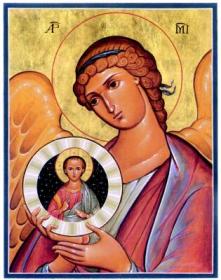
Theotokos is Mary's dogmatic title, which is most often translated as Mother of God, but might be rendered more precisely as Birthgiver of God or Godbearer. In honoring Mary as Theotokos we acknowledge both that her son is God and that he was born of a human mother, thus affirming the Church's teaching that Jesus is fully divine and fully human and that the divinity and humanity are perfectly joined in him. Those who refused to honor Mary as Theotokos were judged not to share the Church's understanding of the Incarnation, and they were excommunicated at the Council of Ephesus in AD 431. Conversely, my own devotion to Mary is tied closely to my commitment to the centrality of Christ's Incarnation.

Obviously, I am glad to be in a church where everyone joins in honoring Our Lady and begging her prayers. But no matter how extravagantly we honor her collectively, I am left feeling that I should do more. More generally: After cultivating a highly intentional devotional life as an Anglican, where is there room for that intentionality in my new Orthodox life?

As if to address my questions, Holy Cross just instituted a monthly Paraklesis service on the first Thursday of the month. This service is a supplication for the intercession of the Theotokos. Thus, it plays a role roughly equivalent to the Rosary for Anglo-Catholics. Naturally, I made a point of attending the first Paraklesis on Thursday evening, and I will try to do so regularly in the future.

From death and corruption he has saved
My nature, held by death and corruption;
For unto death
He himself has surrendered;
For which reason, O Virgin, please intercede
With him who is your Lord and Son,
From the enemies' evils deliver me.

Most Holy Theotokos, save us.