Friday, June 29, 2007

The Pontificator Says Farewell

Two days ago, Fr. Al Kimel ended his long-running blog, “Pontifications.” When he started the blog, he knew the time was approaching when he would not be able to remain an Episcopal priest. “Pontifications” served as an apologia for his departure from the Episcopal Church; a public exploration of the alternatives, Catholicism and Orthodoxy, in light of the Tradition of the Church; and an explanation of why, for an Anglo-Catholic, these were the only post-Anglican options.

I was slow to enter the world of blogging. I never read “Pontifications” regularly, but it was really the first blog I read at all. I discovered there the names of many others who have become more familiar to me in the years since, either from their regular comments in other blogs I read, or from their own blogs. Among these was Fr. Stephen Freeman, whose blog “Glory to God for All Things” might even be described as a spin-off from “Pontifications.”

Fr. Kimel titled his last post Namárië, which means farewell in Quenya, the classical language of the Elves of Middle Earth. “Namárië” is also the name of a poem, whose other name is “Galadriel’s Lament”:

Ah! like gold fall the leaves in the wind,
long years numberless as the wings of trees!
The long years have passed like swift draughts
of the sweet mead in lofty halls
beyond the West, beneath the blue vaults of Varda
wherein the stars tremble
in the song of her voice, holy and queenly.
Who now shall refill the cup for me?
For now the Kindler, Varda, the Queen of the stars,
from Mount Everwhite has uplifted her hands like clouds
and all paths are drowned deep in shadow;
and out of a grey country darkness lies
on the foaming waves between us,
and mist covers the jewels of Calacirya for ever.
Now lost, lost to those of the East is Valimar!
Farewell! Maybe thou shalt find Valimar!
Maybe even thou shalt find it! Farewell!

As it becomes apparent that there is no future for Anglo-Catholicism, this sense of melancholy is becoming all too familiar to those of us who knew and loved that tradition. Fr. Kimel wrote,

Becoming Catholic has brought many blessings, but it has not healed the sorrows of my heart. Indeed, in some ways it has intensified these sorrows. But this is all very private. All I need say is that I often find them overwhelming. God is silent. I am reduced to silence.

On “Stand Firm,” Sarah Hey posted this message of goodbye to Fr. Kimel and “Pontifications.” Following her lead, many readers, including me, shared our grief over the loss of this traditon we love. Meanwhile, the notice of the end of “Pontifications” on “The Confessing Reader” drew a response from Todd Granger, including this reflection on Tolkien:

. . . the weird thing is, the Anglican crisis has given me a deeper appreciation for the soul-piercing beauty and longing of LOTR and other of Tolkien’s writings (see particularly his poem on the journeys of St Brendan). I’ve thought for a couple of years now that there is something distinctly Numenorean about Anglicanism. And, I think, not only in the sense of The Faithful (Elendil et al) being analogous in some way to those Anglicans devoted to the apostles’ teachng and fellowship.

My lament for Anglicanism is sure to provide another layer of meaning the next time I read Tolkien’s Silmarillion.

Apostle to Indonesia 2

Father Daniel Byantoro will continue telling his conversion story at Holy Apostles Orthodox Church on Monday 2 July at 7 PM. This past Monday, he covered his conversion from Islam, which involved much discussion of the Qur'an and what Muslims believe – so much discussion, in fact, that he did not get any further. This coming Monday he will continue with his conversion from Protestantism to Orthodoxy.

Update: Reader Michael took photos at Fr. Daniel's first talk, on his conversion from Islam to Christianity, and his second talk, on his conversion to Orthodoxy. Holy Apostles recorded both talks.

Wednesday, June 20, 2007

Apostle to Indonesia 1

This past Sunday I had the great privilege of driving Father Daniel Byantoro to church. Fr. Daniel is the founder and leader of the Indonesian Orthodox Church. Born into a Muslim family, he joined the Reformed Church as a young man after Jesus came to him in a vision. But he became disillusioned with the vast array of Protestant sects and began looking for something more ancient and more liturgical. After he stumbled across Bishop Kallistos Ware's book The Orthodox Way in a seminary bookstore in South Korea, he started investigating Orthodoxy. Eventually he converted and was ordained a priest. He returned home and began his mission to bring Orthodox Christianity to Indonesia in a way that would be culturally relevant. Today, as a result of Fr. Daniel's missionary efforts, the Orthodox Church is a recognized body with 22 parishes and missions and over 2,000 members. Still, it must often struggle against bureaucratic and cultural obstacles. Here are some links for those who would like more information:


Fr. Daniel splits his time between Indonesia and the U.S., where he speaks and raises money. This week he is giving two talks right here in Maryland, sponsored by Holy Apostles Orthodox Church:


The Great Mandate of Evangelism
Friday 22 June, 7 PM, at Fr. George Johnson’s home,
13209 Bellevue Street, Silver Spring, MD 20904

Fr. Daniel will speak about fulfilling the Lord’s command to “Go and teach all nations, baptizing them in the name of the Father, and of the Son, and of the Holy Spirit.” This talk is a how-to presentation, aimed at Orthodox Christians who are interested in missionary work. Many people think of missionary work as a calling to go to a foreign country. However, the first missionaries, the Holy Apostles, went to their own people first (the Jews,) and then to others (the Gentiles).

Fr. Daniel will talk about how to go to the Mars Hill of our time to proclaim the good news of the Orthodox Faith. For us, our own people are right here in America, wherever our church is located. “Their sound hath gone forth into all the earth, and their words unto the ends of the world.” – even, for example, unto Beltsville, College Park, and Laurel, Maryland.

Christ Has Caught Me
Monday 25 June, 7 PM, at Holy Apostles Orthodox Church,
10760 Baltimore Ave, Beltsville, MD 20705

Fr. Daniel will speak about his conversion from the Muslim faith to Christianity. He went on to convert his whole family including his father, who was an imam, and to become an apostle to Indonesia, baptizing about 2000 people so far and founding 10 churches there. This talk is aimed at inquirers and Orthodox Christians alike, who would like to hear more about Fr. Daniel’s missionary adventures and his outreach to the Asian peoples. Come, see, hear, and “be caught” in his inspiration.

Monday, June 18, 2007

Potpourri

While you're waiting for more on spiritual disciplines, here are some things I've been reading, viewing, and thinking about since my last post.

I saw a pair of 1957 Ingmar Bergman films at the AFI Silver, where they're doing a Janus Films retrospective this summer. I had not seen either one since early in grad school. In The Seventh Seal, a knight returns from the Crusades to find Sweden ravaged by the plague. To defer his own demise, he challenges Death to a chess match. He spends his respite attempting to shore up his faith, worn down by a decade of crusading, but he and his cynical squire also right a few wrongs along the way to their final meeting with Death. In the meantime, an actor who has spiritual visions sees Death playing chess with the knight and flees with his wife and child in an effort to avoid sharing the knight's inevitable fate. In the second film, Wild Strawberries, an old doctor drives to Lund to receive an honorary degree. His daughter-in-law and a trio of hitchhikers tag along. Through a series of encounters, dreams, and memories, he re-evaluates his life, and at the end takes a few small steps towards redemption, pulling his family along with him. It's like A Christmas Carol without the Dickensian melodrama.

Both Bergman films were included in this list of 100 spiritually significant films. They ranked 12th and 32nd, respectively, with a later Bergman work, Winter Light, placing 14th.

In making my weekly SiteMeter check, I found that someone had been referred here from a blog I was not familiar with, NeoChalcedonian: Investigations in Ecclesiastical History, so I looked into it. The first post states the purpose of the blog – to explore the roots of the division between the Eastern and Western churches. The pattern appears to be that he posts one or two topics per month, leaving plenty of time to discuss each subject. I already posted my first response on a thread entitled, "Original Sin As Inherited Guilt?", which explores East-West differences on the understanding of original sin.

While I'm on that subject . . . I just finished reading "Christianity East and West: Some Philosophical Differences," by David Bradshaw, author of Aristotle East and West: Metaphysics and the Division of Christendom. He describes and differentiates the ways that man comes to know God in the philosophies of St. Augustine, St. Thomas Aquinas, and the Greek Fathers, particularly St. Maximus the Confessor. Whereas both Western approaches equate God's essence with his energies, the Eastern approach differentiates sharply between them, concluding that, while we cannot know the divine essence, we must strive to participate in the divine energies. (While looking for the link to the article, I came across this post on Orrologion with links to six of Bradshaw's articles.)

This past week saw new developments in the Anglican civil war. The Primate of Kenya announced that he will consecrate Canon Bill Atwood, General Secretary of the Ekklesia Society, as a suffragan bishop to oversee American congregations of the Anglican Church of Kenya. So yet another foreign primate – reportedly with the backing of still other primates – will join the scavengers tearing the flesh from the body of the Episcopal Church before it is even dead. Meanwhile, the Episcopal Church's Executive Council met to engage in self-serving, dishonest posturing that will do nothing either to fend off the scavengers or to prolong its own life. I'm glad my contributions will not be going to fund the litigation that is on the horizon.

This article from Crisis magazine looks at the Pastoral Provision and the Anglican Use, the twin programs in the Roman Catholic Church to facilitate the conversion of Anglo-Catholic priests and their congregations. Meanwhile, William Tighe writes that Pope Benedict has already decided to expand the Anglican Use, but has not yet promulgated the decision. Even the Catholics are looking to become scavengers, but maybe they will at least wait until the victim is dead before they join the feeding frenzy.

Finally, Orthodox blogger Papa Herman drew some interesting responses with this post about dreadlocks, Rastafari, Haile Selassie, Bob Marley, and the Ethiopian Orthodox Church.

Sunday, June 3, 2007

Spiritual Discplines 1: Fasting

Now the serpent was more subtle than any other wild creature that the LORD God had made. He said to the woman, “Did God say, ‘You shall not eat of any tree of the garden’?” And the woman said to the serpent, “We may eat of the fruit of the trees of the garden; but God said, ‘You shall not eat of the fruit of the tree which is in the midst of the garden, neither shall you touch it, lest you die.’” – Genesis 3:1-3

In two recent interviews, Frederica Mathewes-Green talked about Orthodox spiritual disciplines. She concluded the first interview, with ExploreFaith.org’s Jon Sweeney, by sharing her own spiritual practices, including daily prayers and fasting. In the second interview, with Ryan Hamm of the Christian Vision Project, she once again discussed prayer – specifically, the Jesus Prayer – and fasting. The two interviews, despite the similarity of subject matter, are not redundant – there is much to say on these important subjects!

I also have been thinking about fasting and prayer in recent weeks. In this post I will start with fasting. A post or two on prayer will follow.

Tomorrow in the Orthodox Church we begin the third of our four fasting seasons. The Fast of the Apostles is a variable-length fast that begins immediately after the Octave of Pentecost and continues until the Feast of Saints Peter & Paul, on 29 June. It is somewhat more relaxed than Lent, with a number of days when fish, wine, and olive oil are permitted.

Today, in preparation for the fast, I read a short article, “The Meaning of Fasting in the Orthodox Church,” by Fr. Milan Savich, which explains why fasting is the first of spiritual disciplines for Orthodox Christians. Citing authorities from St. Basil the Great to Fr. Alexander Schmemann, Fr. Milan makes the point that man’s fallen state began with the breaking of a fast commanded by God – abstention from the fruit of the tree in the midst of the Garden of Eden. St. Basil wrote, “Because we did not fast, we were chased out of Paradise; let us fast now, so that some day we may return there.” Similarly, St. Isaac of Syria said, “The first commandment given to our nature in the beginning was the fasting from food, and in this the head of our race (Adam) fell. Those who wish to attain the fear of God, therefore, should begin to build where the building was first fallen. They should begin with the commandment to fast.”

This is where our Lord himself began. Just as Genesis opened with Adam’s breaking of the fast, the Gospel opens with Christ’s keeping of a fast for forty days in the wilderness, immediately following his baptism. Where Adam had succumbed to Satan’s temptation to eat, Christ, in facing the same temptation, gained his first victory over Satan. Thus began his campaign to dethrone Satan and reverse the effects of the fall. In fasting, we learn to participate with Christ in resisting the temptations of Satan.

There is, of course, more to fasting than simply abstaining from food and drink, and Fr. Milan’s article explores the many aspects of fasting. (Thanks to Kevin Burt of into the light for the tip on Fr. Milan’s article.)

Sunday, May 27, 2007

Strange Without Heresy

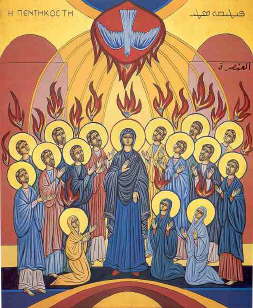
Today all nations in the City of David beheld wonders, when the Holy Spirit descended in fiery tongues, as the God-inspired Luke spake; for he said, "The disciples of Christ being gathered together, there was a sound as of a mighty wind, and it filled the whole house where they were sitting. And they began to speak strange doctrines and strange teachings with diverse tongues, to the Holy Trinity." – First Sticheron on Psalm 130 at Kneeling Vespers, on the evening of Pentecost

In recent years, I have attended the annual Shakespeare Free For All at DC's Carter Barron Amphitheatre. For two weeks every summer, the Shakespeare Theatre Company presents one of the bard's plays for free in order to share Shakespeare with the masses – and to publicize its upcoming season. This year's production sets the witty verbal combat of Love's Labor's Lost in India of the 1960s, where young people from the West flocked in search of enlightenment, just as the Beatles did. I saw it last Thursday with a few friends from my old parish. (If you live in the DC area you still have a week to see it!)

At the beginning of Act V, the curate Nathaniel compliments the pedantic Holofernes, "I praise God for you, sir: your reasons at dinner have been sharp and sententious; pleasant without scurrility, witty without affection, audacious without impudency, learned without opinion, and strange without heresy." I liked the sound of this description and tried it on to see how it might fit me (or my blog). I quickly decided the "without opinion" bit would trip me up, but I made a note to look up the passage when I got home. I still felt an affinity for the phrase, "strange without heresy," and I filed it away for further consideration. I did not expect to be reminded of it again so soon.

My first experience of Byzantine worship was sixteen years ago tonight, when I tagged along with my colleague Pat and his friend Mark to Kneeling Vespers at Holy Transfiguration Melkite Greek Catholic Church. In the Byzantine tradition, kneeling is forbidden from Pascha through Pentecost. At the first service where kneeling is again permitted, Vespers on the evening of Pentecost, we break our fifty-day fast from kneeling in a big way (much like we break the Lenten fast at 3 AM after the Pascha Liturgy)! The distinctive feature that gives the service its popular name is a series of three prayers – the first two long, and the third twice as long – said by the priest while he and everyone present kneel. (Sixteen years ago the practice involved full prostrations, but, at least in our archdiocese, this has been mitigated to simple kneeling. I miss the prostrations!)

Up until the kneeling prayers, the service follows the normal order of Vespers: Psalm 104; the Great Litany; Psalms 141, 142, 130, and 117; the hymn Phos Hilaron; and the Prokeimenon. The deacon censes the church during Ps. 141, and then at some point towards the end of Ps. 142 or the beginning of Ps. 130 the chanter begins to chant stichera between the psalm verses. A sticheron is a short thematic hymn that varies according to the church calendar. The stichera at Kneeling Vespers, which are repeated from Lauds earlier in the day, all concern the Holy Spirit, whose descent we celebrate at Pentecost (see Acts 2). The first sticheron ended with the provocative sentence, "And they began to speak strange doctrines and strange teachings with diverse tongues, to the Holy Trinity." Some translations enhance the strangeness even further by translating "diverse tongues" as "strange words."

For the conventionally minded – e.g., most of the Pharisees – it is hard to conceive of a teaching that could be "strange without heresy." It is practically familiarity that defines orthodoxy for this school of thought. This is what we see in today's Gospel reading (John 7:37-52). When the people respond to Jesus' strange teaching about the Holy Spirit, "This is really the prophet," the Pharisees reply, "Search and you will see that no prophet is to rise from Galilee." This dismissive attitude towards Galileans might also help to explain the amazement of the international Jewish visitors to Jerusalem, "Are not all these who are speaking Galileans?" No one expected yokels from the backwater of Galilee to be multilingual!

But it is less the Galilean origin of Jesus and his apostles than the strangeness of their teaching that fascinates the crowds and upsets the Pharisees. Jesus' talk of living water and his hints of a coming Comforter were bad enough, but at Pentecost his disciples got even stranger, proclaiming, "Let all the house of Israel therefore know assuredly that God has made him both Lord and Christ, this Jesus whom you crucified"; and, "Repent, and be baptized every one of you in the name of Jesus Christ for the forgiveness of your sins; and you shall receive the gift of the Holy Spirit." As the sticheron says, they were speaking of the Holy Trinity. In the Russian tradition, for this reason, today is often called Trinity Sunday, and the icon of the feast is that of Rublev's Trinity.

Too often Christianity, including Orthodoxy, can slip into Pharasaical conventionalism. It is natural for us to want to hold at bay whatever is strange and to take comfort in the familiar. But Orthodoxy counters this human tendency with its constant use of paradox to renew the strangeness of the too-familiar. For instance, the second sticheron tonight, in a different translation than we used, describes the Spirit as "Life and Giver of Life, Light and Bestower of Light, Goodness itself and Source of Goodness."

Today at Holy Cross we chrismated another catechumen. At a celebration afterwards, Khouria Frederica pointed out that until a few centuries ago light was always associated with fire, and therefore it had an element of risk and danger about it. The Holy Spirit's association with light, therefore, was also an association with fire and unpredictability ("The wind blows where it wills" – John 3:8). Not a flashlight, but a torch! The third and final sticheron from Kneeling Vespers concludes by summing up the experience of Pentecost: "A strange report, a strange sight, a fire divided for the distribution of gifts." This is no religion of play-it-safe conventionalism, but one of strangeness.

Monday, May 14, 2007

Relics to Kazan

Yesterday, an Italian noblewoman gave a fragment of Our Lady’s robe, along with relics of six other saints, to the Russian Orthodox Church in the city of Kazan, in the heart of Russia. His Eminence Anastasi, Archbishop of Kazan and Tatarstan, received the relics from the Marquise Immacolata Solaro del Borgo, 77, a member of Rome's historically powerful Colonna family, in a cermony at the Cathedral of Sts. Peter and Paul. The well attended ceremony was broadcast live throughout the country on Russia's main television channel, NTV.

The relics will eventually be housed in a new pilgrimage center along with the icon of Our Lady of Kazan, which was returned to Russia by Pope John Paul II in 2004.

The full article in English appears on Inside the Vatican. A short article in Russian with numerous photos appears on the website of the Kazan Diocese.

Wednesday, May 9, 2007

A Busy Weekend with Bishop Thomas, part 2

The bishop's next stop was at my parish, Holy Cross, in order to ordain a deacon and a subdeacon for St. Patrick's, the new Western Rite Orthodox mission in Warrenton, VA. (I previously wrote about the chrismation of the members of St. Patrick's here. This story about the chrismation later appeared on Bishop Thomas's own web page, with better photos than mine.)

I arrived 15 minutes before 6 PM, when the Liturgy was scheduled to begin, only to find a service already in progress. I stepped into the church just in time to see the bishop ordain Subdeacon Dayton and wondered if I had already missed half the service. I later learned that an unannounced Vespers service had begun at 5, followed by the subdiaconal ordination. (During my short time in the Antiochian Archdiocese, I have formed the impression that any event involving a bishop will come together at the last minute – or come apart, as suggested by one priest whom I will not name.) The actual Liturgy, during which Subdeacon Patrick was ordained to the diaconate, did start at 6.

I will let my blurry photos tell the story with just a bit of explanation. In the first picture, we see Bishop Thomas preaching, while the future deacon stands before the icon of Christ with a white towel over his head.


Since Vespers had already been sung, it was now Monday, liturgically. (The Orthodox liturgical day begins with Vespers, the evening office, following the ancient Jewish reckoning of time.) The Gospel, according to the weekday lectionary, was from John 8. The bishop reiterated Jesus' teaching that the devil is the father of lies, and those who tell lies are children of the devil. Some people will try to justify their lies by claiming they are just little lies, but that just makes them little children of the devil, rather than big children of the devil!

Subdeacon Patrick stood there like that in front of Christ from the beginning of the service through the Anaphora, except for a brief time during which he moved to the other side of the iconostasis and stood before the Theotokos. The ordination took place after the Anaphora and before the administration of Communion. Here the bishop lays his hand on the head of the ordinand.


After the service, the bishop brought out the newly ordained deacon and subdeacon and presented them to the assembly. Some of the women from St. Patrick's (gathered in a circle on the right side of the photo) then sang a beautiful setting of "St. Patrick's Breastplate," composed by the deacon's wife.


Then the bishop promptly put his new ordinands to work, Deacon Patrick holding the cross for veneration and Subdeacon Dayton holding the basket of antidoron.

Update: More photos available from Reader Michael Bishop.

Tuesday, May 8, 2007

A Busy Weekend with Bishop Thomas, part 1

The Right Rev'd Thomas, Bishop of Charleston, Oakland, and the Mid-Atlantic, was in the Baltimore-Washington area for the weekend. Charleston and Oakland are in West Virginia and Pennsylvania, respectively, and the diocese also includes parishes in Delaware, Maryland, and Virginia. It does not, however, include Washington, DC, which, along with New York City, is under the direct oversight of Metropolitan Philip. But the metropolitan asked Bishop Thomas to make this visitation on his behalf.

The occasion of the visitation was the dedication of a new church. St. Gregory the Great, the local Western Rite Orthodox Mission, at long last acquired its own building last year. It had begun its existence meeting in the chapel at the old Church of Saints Peter and Paul. But when that parish moved to its current location in Potomac, St. Gregory's found new quarters at Eldbrooke United Methodist Church, near Tenleytown, meeting first in the basement and later in the upper room at Eldbrooke. When Bp. Thomas visited St. Gregory's last year he challenged them to find a building of their own, but he did not dream they would meet the challenge so promptly! With the help of a couple from St. Sophia's who knew the local real estate market, they found a row house in the Columbia Heights neighborhood that was already in use as a church.

It took some effort to convert the church, whose previous owners were the Seventh Day Pentecostal Church of the Living God. (The "before" pictures showed drums at the front of the church and orange walls in the basement.) The Orthodox congregation began worshiping in their new church in November. In January the basement flooded, requiring another round of repairs and improvements. Now, after six months in use, the church was finally ready to be blessed.


The festivities began with Solemn Vespers on Saturday evening. The church was full for this service, and those present included the other two local Antiochian priests, from Ss. Peter and Paul and St. George's, respectively, as well as the bishop. Also present were former members and long-time friends of the parish. The service started with the Solemn Reception of a Bishop and the proceeded with Vespers. Western Rite Vespers is virtually identical to Evensong in the Anglican tradition – the biggest difference I noticed was that they remained standing for the Psalms instead of sitting. Immediately following Vespers, the bishop formally elevated the pastor of St. Gregory's, Fr. Nicholas, to the rank of archpriest.

The service was followed by dinner, downstairs in the parish hall. I sat at the table with the couple who had helped parishioners to acquire the church. On this occasion, they also gave the parish a beautiful new icon as a gift – the image known in the East as Our Lady of the Passion and in the West as Our Lady of Perpetual Help.

I returned on Sunday. Morning Prayer followed the traditional Anglican form. Fr. Nicholas was flanked by deacon and subdeacon, as is customary for the solemn form of a service, but the bishop was not visible. Following Morning Prayer, we all filed outside, the clergy and acolytes assembling on the porch and everyone else in the front yard.


The bishop was vested with his dark red epitrachelion (stole) and omophorion (the short, wide bishop's stole, perhaps equivalent to the Western pallium) over his riassa (cassock). We sang the Asperges as an antiphon, and the clergy sang Psalm 51 as the bishop sprinkled the exterior of the church with holy water. Then we began singing the Litany of Saints and all processed into the church, where the blessing and sprinkling continued. As we took our seats, the clergy and acolytes processed around the nave three times, while the bishop sprinkled the walls, the floor, and the ceiling. We concluded the blessing with Psalms 120-122.


This was followed by the Liturgy of St. Gregory – the medieval form of the Western Mass. The opening hymn was "Hail Thee, Festival Day," and the ordinary was chanted to the setting Missa de Angelis. In his sermon, Bp. Thomas revealed that he had listened to us singing Morning Prayer from upstairs while watching people walk past the church. He noticed one lady who looked at the church as she walked by, apparently wondering who we were. While the neighbors are no doubt relieved that they are no longer awakened every Saturday morning by drums and loudspeakers, they don't know who we are. Since the parish had answered his last challenge, he issued a new one – to reach out to the neighborhood, invite people in, and make sure they know who worships here. The Mass concluded with the pontifical blessing, which was followed by the singing of the Marian antiphon Regina Coeli and the closing hymn, "Alleluia, Sing to Jesus!"

Mass was followed by a festive coffee hour. Then everyone returned to the church for a group photo. I was appointed as photographer and was handed two cameras in addition to my own. As I was lining up the shot and waiting for everyone to hold still and smile, the bishop left his place in the line-up and walked toward me. He took the camera from me and told me to act like I was taking my place for the photo. No one seemed to notice until he asked if everyone was ready! He said he had never done that before but had always wanted to. Everyone was duly amused, but also a bit relieved when Bp. Thomas returned to his place for the group pictures.


(I know my pictures are blurry. The ones for part 2 will be even worse! As soon as they come out with those newfangled cameras that compensate for camera movement at a reasonable price, I need to get one.)

Update: More pictures are available on the diocesan website.

Thursday, April 26, 2007

Archbishop Rowan on Moral Vision and Politics

On Tuesday, the Most Rev’d Rowan Williams, Archbishop of Canterbury, delivered the William Wilberforce Lecture in the city of Hull, the birthplace of the English reformer whose efforts led to the abolition of the slave trade. Websites that one would normally expect to be authoritative anticipated his subject variously as “Wilberforce and His Legacy”; “Moral vision should be at the heart of politics”; and “Freedom and Slavery.” The Telegraph titled its preview of the lecture, “Archbishop attacks 'erosion of Christian values',” while The Sunday Times called its extract of the speech, “Down with godless government.”

When the full lecture was published on the official website of the Archbishop of Canterbury, the title was “Freedom and Slavery.”

Archbishop Rowan is often described as a “liberal” — in fact he describes himself as such. But in this age when the terms liberal and conservative are used in numerous, mutually inconsistent ways, that label alone tells us little. Two short passages from the Times extract of his lecture should make it clear that, as an outspoken opponent of both individualism and relativism, he's the sort of liberal who often upsets other self-described liberals.

Wilberforce and his circle believed that if a sinful system existed and its sinfulness implicated them as well as others, they were under an obligation to end it. There is no simple gulf between personal and public morality; and Christian morality is not about “keeping yourself unspotted from the world” in any sense that implies withdrawing or ignoring public wrongs.

But if the state enacts or perpetuates in the corporate life of the nation what is directly contrary to the Christian understanding of God’s purpose, then Christian activism in respect of changing the law is justified, primarily when the state is responsible for — so to speak — compromising the morality of all its citizens.

This is at the heart of what Wilberforce was concerned about. He is not campaigning for the state to impose a personal morality, and would probably have agreed that such a policy would take away the essential aspect of personal liberty in choices about one’s own life. But he is campaigning for a moral state — that is, for a state that does not compromise its citizens, and that recognises wider considerations than those of immediate profit and security.

This makes sense, though, only if it is possible to convince those who run things in the public sphere that there are human values and ethical norms to which an entire society is answerable. In our relativist climate, this is very difficult. What tends to happen is that nothing much is left as a substantive moral basis for public life except a poorly defined principle of tolerance or avoidance of mutual harm. The idea that you can give substance to a common social ethic, something to which society as a whole can be held accountable, is unfashionable and unwelcome. Even from the point of view of many who have no religious commitment, there is a recognition that this is a thin diet.

I believe that it is possible for a state to have a moral basis without thereby becoming confessional or theocratic. It involves a state being ready to recognise its own history; to say that its horizons and assumptions are indeed grounded in a set of particular beliefs, and to embody in its political practice ways of allowing those foundational commitments to be heard in public debate.

The establishment of the Church of England, as it has evolved in the past century or so, has turned out to be such a mechanism — a rather awkward one. But if the church were to be disestablished, the question would still be there in an acute form: how does the state properly expose itself to argument about its collective moral status?

One important point came through more clearly in the full lecture than in the Times extract: Criticism of slavery and the slave trade in the 18th century came only from Christians who were motivated by their religion; the theoretical egalitarianism of Enlightenment rationalism, for instance, was never translated into opposition to slavery.

Towards the end of his speech, Archbishop Rowan raised the issue of reparations for slavery, and, in the academic way he is known for, he hashed through various aspects of the issue without coming to a clear conclusion, bringing the speech to a rather weak and muddled ending. I can only hope it will not obscure his overarching theme of restoring moral vision to the vocation of politics.