Since November, when my institute moved to new quarters, I have had a view from the eighth floor of the second tallest building in Calverton, Maryland. For the most part, the view is disappointing – I can gaze down upon the rooftops of all the other buildings in the office park, which are not designed to be attractive from above. But it has also proved to be an excellent perch for watching birds. I have seen as many as 30 Canada geese gathered in and around the little pond in the middle of the office park, along with a few ducks. On other days I can watch big flocks of crows. Today I saw two big crows searching under rocks on the roof ledge just two offices down. Since that office is currently unoccupied, I was able to camp there and watch them up close. Their search turned up something interesting and they flew away, one of them doing some fancy aerobatics on its way to the ground.
 But my favorite birds to watch from here are turkey vultures (or, as we used to call them back in Indiana, turkey buzzards). Most days I don't see them at all, but on a windy day like today they are out in force. At one point today I could see 10 of them in the air at once! I think the wind must interact with the tall building to create currents that the vultures find useful. One day they kept flying directly at my window, only to swoop straight upwards at the last second before impact. Vultures know how to use the currents to gain speed and elevation.
The sight of so many vultures reminded me of the verse from Luke quoted above. While translators invariably give eagles as the primary translation, interpreters prefer the alternative translation, relegated to a text footnote in the RSV: vultures. As scavengers, vultures will gather wherever they find a dead body to feed on.
The disciples are pestering Jesus, wanting to know the time and place when the Kingdom of God will appear. And the Lord, characteristically, gives an indirect answer that demands their deeper engagement with the question, rather than something they can write on their pocket calendars. Could he be telling his disciples that they should watch for some commotion that signals the Kingdom, just as a gathering of vultures signals the presence of a carcass? Probably not, since he had just told the Pharisees earlier in the chapter, "The kingdom of God is not coming with signs to be observed; nor will they say, 'Lo, here it is !' or 'There!' for behold, the kingdom of God is in the midst of you." Perhaps he is warning them to be prepared, because the Day of Judgment will find them just as vultures find a dead body.
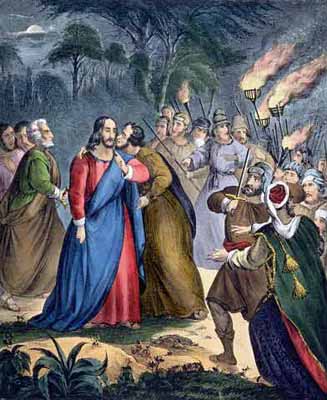
Today was Holy Wednesday. According to tradition, this was the day when Judas agreed to betray his Master to the Jewish leaders. The vultures are already gathering, sensing that Jesus is vulnerable.
 But this is also the day when the Orthodox Church commemorates Jesus' anointing by the sinful woman, who proceeded to wet his feet with her tears and wipe them with her hair. In contrast to Judas, she prepared herself for the coming of the Kingdom by repenting of her sins, and she thereby anointed the King himself before he was crowned with thorns and ascended the throne of the Cross to begin his reign.