Thursday, August 9, 2007

Joy of All Joys

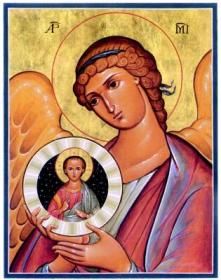
In my recent post on prayer, I mentioned St. Seraphim of Sarov, a 19th-century Russian monk who is said to have practiced a devotion nearly identical to the Rosary. As depicted in the icon accompanying that post, St. Seraphim would pray this devotion daily, kneeling in his cell before an icon of the Theotokos. This Umilenie (Tenderness) icon is very unusual, in that it depicts the Blessed Virgin alone, without her son. In fact, it was possibly not a traditional Orthodox icon at all, but a Western image of Our Lady. This image, which St. Seraphim called "Joy of All Joys," represents Mary's feelings of tenderness at the Annunciation.

With oil from the lampada that burned before this holy icon, St. Seraphim would anoint the sick and they would be healed. He was praying in front of this icon when he died on 2 January 1833. After his death, the abbot gave the holy icon to the sisters of the monastery at Diveyevo. The icon is sometimes known as the Seraphim-Diveyevo icon of the Theotokos, after the convent where it now resides.

While searching on-line for an icon of St. Seraphim to use with my post, I frequently encountered a very different icon of the Theotokos that was said incorrectly to be this icon of St. Seraphim's. One might think that a particular icon that is often depicted in the icons of a popular saint, and which is still in existence in a known location, would be immune to problems of mistaken identity. But in thinking this, one would be seriously underestimating the Orthodox penchant for uncritically believing and repeating misinformation.

This beautiful icon is of the Eleousa type. While Eleousa is sometimes translated, like Umilenie, as "Tenderness," more strictly it means "Merciful." I would conjecture that someone, reading that St. Serphim's icon was of the "Tenderness" type found the most beautiful "Tenderness" icon he could find and assumed St. Seraphim's must be similar. This surprisingly popular misidentification has been appearing in some pretty authoritative places on-line, such as the Website of the Orthodox Church in America (here). But the OCA displays the very same icon here, where it is labeled as the Mother of God of the Pskov Caves Monastery. I think this latter identification is probably correct – I have seen it in other places, as well.

Meanwhile, the only other image of Our Lady I have seen that is similar to St. Seraphim's Umilenie is the wonder-working image of Our Lady of Ostrobrama, which resides in Vilnius, Lithuania, where it is venerated by Catholics and Orthodox alike.

Sunday, August 5, 2007

On My Father's Side

Unless you are both a bluegrass fan and a resident of the Washington, DC, area, you might not know that this region has a strong bluegrass tradition. In the 1950s, in fact, Washington was known as the “Bluegrass Capital of America.” Perhaps that would be less surprising if you recall that DC is right across the Potomac from Virginia.

One of our local public radio stations, WAMU, has been playing bluegrass for 40 years! At one point its bluegrass programming dominated weekday afternoons, but today it is relegated to Sundays.* Still, they manage to get in a lot of bluegrass on that one day! It starts at 1 AM with “Bluegrass Overnight,” and continues with “Stained Glass Bluegrass” at 6 AM. After a two-hour break for NPR news from 10 to 12, they return to bluegrass with “The Ray Davis Show” and “The Dick Spottswood Show.” On a typical Sunday I catch at least a little of each of these shows. (I'm listening to “Bluegrass Overnight” as I finish composing this post, late on Saturday night.)

Last Sunday I was listening to “Stained Glass Bluegrass” as I was getting dressed for church, and I heard a bluegrass gospel song I had not heard before. It was Felecia Shiflett’s song, “On My Father’s Side,” performed by the Village Singers.† The song continued to run through my head for the next few days. With the help of Google, I tracked down the lyrics, the name of the songwriter, and this 30-second preview of the song by another performer. You will see that the lyrics are eminently appropriate to a blog called TWO NATURES.


On My Father’s Side
Felecia Shiflett

Just a young boy in the temple one day
Shared with the doctors, they were so amazed
Never had they seen one so young speak so swift
They asked him many questions, the conversation went like this

CHORUS:
What’s your name, son?
On my mother’s side, my name is Jesus
But on my Father’s side, they call me Emmanuel
How old are you?
On my mother’s side, now I’m twelve years
But on my Father’s side, I’ve just always been
Where you from?
On my mother’s side, I’m from Bethlehem
But on my Father’s side, it’s New Jerusalem
What’s your plan?
On my mother’s side, I’ll be crucified
But on my Father’s side, in three days I’ll arise
And I’ll sit at my Father’s side

He was the Son of God, yet the son of man
And I can’t help but wonder how Joseph must have felt
Through an open door that day, he heard his son reply
He said: You see, I’m the King of Kings, that’s on my Father’s side

CHORUS


*Unless you have a digital radio, that is. WAMU’s digital channel 3 calls itself “Bluegrass Country.”

†Thanks to “Stained Glass Bluegrass” host Red Shipley for providing the name of the group in response to my query.

Thursday, August 2, 2007

Spiritual Discplines 2: Prayer

Two months ago, as the Fast of the Apostles was beginning, I posted an entry on fasting. Now, as we begin the Fast of the Theotokos, it seems an appropriate occasion for the sequel on prayer. NOTE: The first three links will take you to some of my old articles that I have not previously publicized.


Anglo-Catholicism has traditionally emphasized the importance of maintaining a Rule of Life – essentially, a personal commitment to a discipline of regular prayer, worked out in conjunction with one's pastor, confessor, or spiritual director. While a rule might involve other elements, such as fasting, study, and volunteer work, its heart is always prayer. There are different ways to organize one's prayer commitments, but here I will use the scheme of Eucharist, Daily Office, and personal prayer.

I was probably typical of Anglo-Catholics in being strong on the first two and weaker on the third. My rule was to attend Mass on all Sundays and Prayerbook holy days, and always at least twice a week; and to say Morning and Evening Prayer daily. As a member of a parish that offered Morning Prayer, Evening Prayer, and two Masses every day, I had community support for this discipline. Even when, as usual, I was reciting the offices at home in my icon corner, I knew that other parishioners were reciting the offices in the Angel Chapel at church or in their own homes. Anglicanism has, from the publication of the first Book of Common Prayer in 1549, offered versions of Morning and Evening Prayer that are practical for the laity, requiring nothing more than a Bible and a Prayerbook, which can be recited without hurry in about 20 minutes. Recent Prayerbooks include rubrics permitting the omission or shortening of some parts of the offices in order to allow them to be tailored to the needs, constraints, and preferences of parishes and individuals. And, if that is not enough, there are also "Daily Devotions for Individuals and Families" – abbreviated, one-page versions of the offices for home use. In short, one should be able to find an official form of the Anglican Daily Office that can be easily adapted to one's own Rule of Life, no matter where one is in the development of one's prayer life.

Anglo-Catholics often adopt additional prayer disciplines from unofficial Anglican sources, such as St. Augustine's Prayer Book, or from Roman Catholic sources. Official Anglican sources tend to be weak on devotion to the Blessed Virgin Mary, so Anglo-Catholics often supplement their worship and prayer with traditional Catholic prayers, such as the Angelus and the Rosary. With these being well integrated into Anglo-Catholic culture, it is easy to find both in Anglo-Catholic devotional books.

In Orthodoxy, I am finding that nothing is this easy. While there is a strong tradition of daily prayers at home, the usual forms tend to be short and without day-to-day variation. From December through February, I followed one of these forms. Every day I recited the Morning Prayers from the Antiochian Archdiocese's red Pocket Prayer Book, which Father Gregory gave me the first time we met to talk about my move to Orthodoxy. Following the morning prayers I would read the Gospel of the day from the Greek lectionary. It was a useful exercise for learning the standard Orthodox prayers I would encounter in various contexts, such as the ubiquitous Trisagion Prayers. I also found the short prayers practical during these busy months when I was in transition from Anglican to Orthodox and trying to participate in the lives of two parishes.

But, as Lent was beginning, I decided I needed something more. I especially missed the daily recitation of the Psalms, the central feature of the traditional Daily Office. Orthodoxy does not have a tradition of individual recitation of the offices, but Ruthenian Catholicism does. (My theory: The Ruthenians learned about the Breviary used by their fellow Catholics and decided to create a Byzantine equivalent.) I found a small Ruthenian book with versions of most of the offices for home use – only Prime and Compline were missing from its pages. I have settled into a pattern of praying Matins from this book before breakfast Monday–Friday. Instead of reciting Psalm 51 every day, I substitute a section of the Psalter according to the traditional Anglican scheme, which divides the Psalter into 60 sections for use over the course of the month at Morning and Evening Prayer. The traditional Byzantine canticles are divided over the days of the week, and propers for each day follow the traditional Byzantine weekly scheme:

MONDAY: The Holy Angels
TUESDAY: Saint John the Forerunner
WEDNESDAY: The Holy Cross and the Holy Theotokos
THURSDAY: The Holy Apostles and Saint Nicholas
FRIDAY: The Holy Cross

On Saturdays and Sundays I typically attend Vespers and Matins, respectively. On weekend days when I don't make to church for the offices, I'll pray Vespers from the Ruthenian book.

I am working on translating the book's idiosyncratic, often paraphrased, modern English into the traditional English that is standard in Antiochian usage. But this is not an easy process. Orthodoxy simply does not have official, universal, standard liturgical books like Anglican Prayerbooks. Every jurisdiction has its own books, not all of which are consistent, and parishes often do their own thing anyway. Moreover, most of the translations read as if they were created by someone who knew Greek or Slavonic better than English – which was, in fact, often the case.

Now that I have this pattern down, I am exploring ways to fill other prayer niches. Since I live less than a mile from my office, I typically walk to work once a week. I have gotten into the habit of repeating prayers as I walk. As I leave home I say the Lord's Prayer three times. Then, for the first half of the trip I recite the Orthodox equivalent of the "Hail Mary":

Rejoice, O Virgin Theotokos, O Mary full of grace,
the Lord is with thee.
Blessed art thou among women,
and blessed is the fruit of thy womb,
for thou hast borne the savior of our souls.

The first obvious difference from the Catholic version is that it translates the angel's greeting as "Rejoice," rather than "Hail." The Greek Khaire and Latin Ave convey both meanings, but there is no exact English equivalent. In both the Catholic and Orthodox Churches, one can find instances where the word is translated either way. In their book, Mary: The Church at the Source (1997), for instance, Joseph Cardinal Ratzinger and Hans Urs von Balthasar favored "Rejoice," even though "Hail" is more familiar to English-speaking Catholics. The second obvious difference is the concluding clause. The modern Catholic version concludes, "Pray for us sinners now and at the hour of our death." While the first two lines come straight from Luke (1:28, 42), neither concluding line comes from the Bible. The Catholic conclusion had its origin in Trent and was still not in universal use as late as the 19th century. I would not be surprised if the Orthodox conclusion had a similarly late origin.

When I turn the corner on my walk to work, I switch to reciting the Jesus Prayer:

Lord Jesus Christ, Son of God, have mercy upon me, a sinner.

This is an elaboration of the prayer of the publican (Luke 10:13). On my way home I reverse the order, beginning with the Jesus Prayer, switching to "Rejoice, O Virgin Theotokos," and concluding with the Lord's Prayer as I arrive back at home.

I am currently considering how I might work an Orthodox version of the Rosary into my prayer life. While use of the Rosary is not widespread or well known in Orthodox circles, neither is it entirely unheard of. St. Seraphim of Sarov, for instance, was known for his devotion to the Rosary. In Orthodox contexts, the discipline of the Rosary is sometimes known as the Rule of the Mother of God. I have located a few Orthodox Rosaries on-line, such as this one. The prayers are slightly different and some of the mysteries are also different, but it retains the familiar structure of the Dominican Rosary, with fifteen decades, each dedicated to a different mystery from the lives of Christ and his blessed mother.

Earlier this evening, when a few of us were talking outside the church following a Paraklesis service, one friend asked another about developing a rule of prayer. One key piece of advice he offered, which I heard (and repeated) many times as an Anglican, is that the most important thing about a rule is that you will actually do it every day. The most elaborate rule of prayer won't do you any good if you can't keep it. But following even the simplest rule can begin to form the discipline of prayer, which can serve as God's foothold in one's daily life.

Tuesday, July 31, 2007

The Noble Joseph

Today is the feast of my patron saint, Joseph of Arimathea. The cover of this past Sunday's bulletin featured an icon of St. Joseph that I had never seen before. He stands before Pilate, requesting the body of Christ, while a soldier looks on. (I could not find this icon on-line, but fortunately I have my digital camera handy!) Here is the story from the back of the bulletin:

While we usually think of him mainly when we observe our Lord's Passion, JOSEPH OF ARIMATHEA is actually remembered by our Holy Orthodox Church on July 31. During the time of Christ, he was a prominent member of the Sanhedrin – the supreme religious court for the Jews of that era. Yet he was much more than this: he was a secret follower of Jesus who ". . . was searching for the kingdom of God." (Mark 15:43) A man of great material means, Joseph was a well-respected man in the community. His repuation, no doubt, enabled him to boldly approach Pilate and ask for the body of Christ, so that the Crucified Savior could be given a proper burial, according to the prescriptions of the Hebrew Law. Yes, he would have it buried in his own new tomb, hewn out of a rock. It is said that this act of kindness infuriated the Jews, who had him cast into prison. Tradition tells us that the Risen Lord appeared to him so that he would have first-hand knowledge of the Resurrection.

Upon his release from prison, Joseph was exiled from his homeland of Judea. He dedicated the rest of his life to preaching the Gospel, joining the Apostle Philip on a missionary journey that took them to the coast of Europe. Joseph is thought to have been responsible for bringing the Good News about Christ to the inhabitants of present-day England, winning many converts there. Joseph of Arimathea is considered to be a saint by both the Orthodox and Roman Catholic Churches. Legends and myths abound concerning this saintly man, including connections with the Holy Grail and King Arthur! We remember him, however, primarily for his pious gesture of burying Christ, for which we will forever ascribe the word "noble" to his name.


When Joseph went before Pilate to ask for the body, Pilate promptly granted his request. Pilate, who had not wanted to execute Jesus in the first place, had no reason to withhold the body. He might even have taken pleasure in the thought that it would annoy the Jews! But what about Joseph – did he guess the punishment that would follow from his pious duty?

This telling of the story of Joseph reminded me of Sophocles' play, Antigone. The heroine's brothers, joint heirs to the throne of Thebes, had quarreled, and one had expelled the other, who then returned at the head of an Argive army to regain the throne. They both fell in the ensuing battle. As the play begins, King Creon has decreed that Eteocles, who died defending Thebes, should receive full honors, while his brother Polynices was not to be buried – upon pain of death. Antigone promptly defied the king's command, covering Polynices with a layer of dirt. Knowing the penalty under earthly law, she yet obeyed the unwritten law of heaven, showing her brother the honor due to the dead. For her choice, she was sentenced to be buried alive – sealed in a cave. The citizens secretly honored Antigone for doing what was right and customary, but they would not contradict the king in public. The blind prophet Tiresias ultimately persuaded Creon of his sin, but it was too late: Antigone had already committed suicide. Upon finding her dead, her lover Haemon, Creon's son, also killed himself, followed by his mother Eurydice. (This is a tragedy, after all.)

Euripides' earlier version of the story, now lost, is said to have had a happy ending: the calamity was averted by the intercession of Dionysus and was followed by the marriage of Antigone and Haemon.

According to legend, Joseph was a well-traveled merchant. It is possible that he could have heard a version of the Greek legend in his travels. If so, he might have imagined the risk he was taking in defying the consensus of the Jewish rulers in order to obey the Jewish law regarding burial of the dead. Just as Antigone was sealed in the cave, Joseph was sealed in a prison cell.

Unlike Antigone, however, Joseph did not yield to despair. When the gods intervened for Antigone, in the person of Tiresias, she had already given up hope. According to Robert de Boron's Joseph d'Arimathe, Joseph was fed during his imprisonment by daily appearances of the Holy Grail, which sustained his life and his hope. But according to the Gospel of Nicodemus (which was probably the source of elements of Joseph's story related in Sunday's bulletin), during his first night in prison Joseph was visited by Christ himself, who transported him home to Arimathea.

Joseph had already proven himself the sort of person who does not give in to despair. When all of the disciples besides John were in hiding, Joseph of Arimathea was the one who retained the presence of mind and the courage to attend to the immediate need of Jesus' burial.

Thursday, July 26, 2007

A Visit from St. Anna

In her latest podcast, Frederica talks with Father Athanasy, a Russian Orthodox priest who is the custodian of the myrrh-streaming icon of St. Anna, the grandmother of Christ, whose feast was today in the West, yesterday in the East.

In Orthodoxy, a frequent sort of miracle these days is when an icon "weeps" with oil infused with myrrh. Such icons and the oil that comes from them are often associated with healing miracles. Even apart from the miraculous origin of this oil, the Church has long used blessed oil for anointing the sick, and myrrh has been used medicinally for centuries, as well as for incense, perfume, and embalming.

Father Athanasy, with the blessing of his bishop, travels to visit parishes all over the country with the miraculous icon, leaving peace and healing in his wake. Earlier this month, he brought the icon to Holy Apostles Orthodox Church, right here in Beltsville, for the parish's patronal feast. Frederica recorded her talk with Father Athanasy after the Vigil service on 12 July, the eve of the feast. The next morning I attended the Liturgy at Holy Apostles, where I also had the privilege of venerating the icon and being anointed with its myrrh. The sweet fragrance of the myrrh on my forehead lasted all day!

At lunch after the Liturgy, I sat at Father Athanasy's table. He currently lives in Philadelphia, but he said the one thing that might make him consider relocating himself and the icon was if a church dedicated to St. Anna were to be founded in Annapolis, Maryland – literally, the City of Anna!

Tuesday, July 17, 2007

Chrismation Date

It's now official: God willing, I will be chrismated as a member of the Holy Orthodox Church on Sunday 7 October! The chrismation will take place at 9 AM, immediately before the 9:30 Liturgy, at Holy Cross.

As some of you know, arranging the date was not easy. With my uneventful life, I can be available any Sunday this year, but my sponsor, the other catechumen, and his sponsor all have extensive travel plans in late summer and early fall. The scheduling process was complicated by the fact that we were all distracted with planning, executing, and recovering from the Parish Life Conference of the Eastern Dioceses, which was hosted by Holy Cross this year.

Shortly before the PLC, three of my fellow catechumens were chrismated. I was watching closely, knowing that I'll be next! In the first photo, as all three catechumens kneel before the iconostasis, Jack receives absolution from Fr. Gregory (they're both hidden by Jack's sponsor, Cal). In the second photo, Doane gets her tonsure.


After the Liturgy, Brandon's sponsor Keith hosted a party to celebrate the chrismations. Reader Michael took these photos at the party.

Monday, July 9, 2007

Unity vs. Truth?

I just finished reading the article "Anti-Patristic: The Stance of the Zealot Old Calendarists" (hat tip to Christopher at Orrologion for calling my attention to the article). The author of the article, Monk Basil, largely shares the underlying Old Calendarist and anti-ecumenist stances of those he argues against. Yet, citing Church history and the writings of the Fathers, he disputes and refutes their rationalizations for initiating and maintaining a schism from canonical Orthodoxy. He finds that the Fathers were reluctant to break communion over anything short of a conciliarly defined heresy. And even in those instances they were ready to apply economy (pastoral discretion) generously in order to regain their excommunicated brothers.

The article concludes with a case study, the life of St. Sophronius, which illustrates patristic forebearance toward heretical opponents for the sake of avoiding provocation of an unnecessary schism. In the early 7th century, the Monophysite schism, which had resulted from the Council of Chalcedon, was nearly two centuries old. Sergius, the Patriarch of Constantinople, was promoting Monothelitism, which was intended as a compromise that would bring together those who accepted the Council of Chalcedon and those who rejected it. In 633, St. Sophronius traveled to Constantinople and Alexandria in an effort to persuade Patriarchs Sergius and Cyrus, respectively, of their errors in teaching Monothelitism. The following year, St. Sophronius became Patriarch of Jerusalem. In his enthronement epistle to his fellow patriarchs, all of whom favored the Monothelite heresy (including Pope Honorius), he boldly proclaimed the Orthodox belief in Christ's two natures and two wills. "Nevertheless," writes Monk Basil, "he refers to Sergius as 'the most holy of all bishops, and most blessed brother and concelebrant Sergius'. He asked him to acept his dogmatic epistle and to send the 'longed for letters', which will clearly express the correct faith." By this point, Sergius had already been teaching the Monothelite heresy for nearly two decades, yet St. Sophronius did not break communion with him, as indicated by his reference to Sergius as concelebrant, in the faint hope that Sergius would repent. There is no evidence that St. Sophronius broke communion with Sergius and Honorius before they all died in 638.

St. Sophronius would neither compromise the truth for the sake of unity, as the Monothelites desired, nor would he sacrifice unity for the cause of truth, as modern zealots demand. In short, he rejected the false choice between unity and truth.

In this era, when nearly every church has its purist-zealots who are eager to separate over the pettiest of differences, it is heartening to read of the Fathers' extreme hesistation to break communion. I think history shows that the Fathers were correct. Heresies often fade with the deaths of their respective heresiarchs, but schisms can persist long after their intial justifications become moot. Schism should always be a long-delayed last-resort response to persistent, documented, unrepented heresy, not a knee-jerk reaction to a passing fad or weak theology.

In the ongoing disintegration of Anglicanism, we see the spectacle of impatient bishops on both sides demonstrating their contempt for the Anglican Communion – and, indeed, for the Body of Christ – by instituting hasty, ad hoc schisms, ignoring the documents they signed and the procedures they initiated to strengthen the communion and bring to account those who cannot abide by the Anglican consensus.

Meanwhile, Pope Benedict XVI this weekend, in the explanatory letter accompanying his apostolic letter Summorum Pontificum, showed great concern for unity:
I now come to the positive reason which motivated my decision to issue this Motu Proprio updating that of 1988. It is a matter of coming to an interior reconciliation in the heart of the Church. Looking back over the past, to the divisions which in the course of the centuries have rent the Body of Christ, one continually has the impression that, at critical moments when divisions were coming about, not enough was done by the Church’s leaders to maintain or regain reconciliation and unity. One has the impression that omissions on the part of the Church have had their share of blame for the fact that these divisions were able to harden. This glance at the past imposes an obligation on us today: to make every effort to enable all those who truly desire unity to remain in that unity or to attain it anew. I think of a sentence in the Second Letter to the Corinthians, where Paul writes: "Our mouth is open to you, Corinthians; our heart is wide. You are not restricted by us, but you are restricted in your own affections. In return . . . widen your hearts also!" (2 Cor 6:11-13). Paul was certainly speaking in another context, but his exhortation can and must touch us too, precisely on this subject. Let us generously open our hearts and make room for everything that the faith itself allows.

Friday, June 29, 2007

The Pontificator Says Farewell

Two days ago, Fr. Al Kimel ended his long-running blog, “Pontifications.” When he started the blog, he knew the time was approaching when he would not be able to remain an Episcopal priest. “Pontifications” served as an apologia for his departure from the Episcopal Church; a public exploration of the alternatives, Catholicism and Orthodoxy, in light of the Tradition of the Church; and an explanation of why, for an Anglo-Catholic, these were the only post-Anglican options.

I was slow to enter the world of blogging. I never read “Pontifications” regularly, but it was really the first blog I read at all. I discovered there the names of many others who have become more familiar to me in the years since, either from their regular comments in other blogs I read, or from their own blogs. Among these was Fr. Stephen Freeman, whose blog “Glory to God for All Things” might even be described as a spin-off from “Pontifications.”

Fr. Kimel titled his last post Namárië, which means farewell in Quenya, the classical language of the Elves of Middle Earth. “Namárië” is also the name of a poem, whose other name is “Galadriel’s Lament”:

Ah! like gold fall the leaves in the wind,
long years numberless as the wings of trees!
The long years have passed like swift draughts
of the sweet mead in lofty halls
beyond the West, beneath the blue vaults of Varda
wherein the stars tremble
in the song of her voice, holy and queenly.
Who now shall refill the cup for me?
For now the Kindler, Varda, the Queen of the stars,
from Mount Everwhite has uplifted her hands like clouds
and all paths are drowned deep in shadow;
and out of a grey country darkness lies
on the foaming waves between us,
and mist covers the jewels of Calacirya for ever.
Now lost, lost to those of the East is Valimar!
Farewell! Maybe thou shalt find Valimar!
Maybe even thou shalt find it! Farewell!

As it becomes apparent that there is no future for Anglo-Catholicism, this sense of melancholy is becoming all too familiar to those of us who knew and loved that tradition. Fr. Kimel wrote,

Becoming Catholic has brought many blessings, but it has not healed the sorrows of my heart. Indeed, in some ways it has intensified these sorrows. But this is all very private. All I need say is that I often find them overwhelming. God is silent. I am reduced to silence.

On “Stand Firm,” Sarah Hey posted this message of goodbye to Fr. Kimel and “Pontifications.” Following her lead, many readers, including me, shared our grief over the loss of this traditon we love. Meanwhile, the notice of the end of “Pontifications” on “The Confessing Reader” drew a response from Todd Granger, including this reflection on Tolkien:

. . . the weird thing is, the Anglican crisis has given me a deeper appreciation for the soul-piercing beauty and longing of LOTR and other of Tolkien’s writings (see particularly his poem on the journeys of St Brendan). I’ve thought for a couple of years now that there is something distinctly Numenorean about Anglicanism. And, I think, not only in the sense of The Faithful (Elendil et al) being analogous in some way to those Anglicans devoted to the apostles’ teachng and fellowship.

My lament for Anglicanism is sure to provide another layer of meaning the next time I read Tolkien’s Silmarillion.

Apostle to Indonesia 2

Father Daniel Byantoro will continue telling his conversion story at Holy Apostles Orthodox Church on Monday 2 July at 7 PM. This past Monday, he covered his conversion from Islam, which involved much discussion of the Qur'an and what Muslims believe – so much discussion, in fact, that he did not get any further. This coming Monday he will continue with his conversion from Protestantism to Orthodoxy.

Update: Reader Michael took photos at Fr. Daniel's first talk, on his conversion from Islam to Christianity, and his second talk, on his conversion to Orthodoxy. Holy Apostles recorded both talks.

Wednesday, June 20, 2007

Apostle to Indonesia 1

This past Sunday I had the great privilege of driving Father Daniel Byantoro to church. Fr. Daniel is the founder and leader of the Indonesian Orthodox Church. Born into a Muslim family, he joined the Reformed Church as a young man after Jesus came to him in a vision. But he became disillusioned with the vast array of Protestant sects and began looking for something more ancient and more liturgical. After he stumbled across Bishop Kallistos Ware's book The Orthodox Way in a seminary bookstore in South Korea, he started investigating Orthodoxy. Eventually he converted and was ordained a priest. He returned home and began his mission to bring Orthodox Christianity to Indonesia in a way that would be culturally relevant. Today, as a result of Fr. Daniel's missionary efforts, the Orthodox Church is a recognized body with 22 parishes and missions and over 2,000 members. Still, it must often struggle against bureaucratic and cultural obstacles. Here are some links for those who would like more information:


Fr. Daniel splits his time between Indonesia and the U.S., where he speaks and raises money. This week he is giving two talks right here in Maryland, sponsored by Holy Apostles Orthodox Church:


The Great Mandate of Evangelism
Friday 22 June, 7 PM, at Fr. George Johnson’s home,
13209 Bellevue Street, Silver Spring, MD 20904

Fr. Daniel will speak about fulfilling the Lord’s command to “Go and teach all nations, baptizing them in the name of the Father, and of the Son, and of the Holy Spirit.” This talk is a how-to presentation, aimed at Orthodox Christians who are interested in missionary work. Many people think of missionary work as a calling to go to a foreign country. However, the first missionaries, the Holy Apostles, went to their own people first (the Jews,) and then to others (the Gentiles).

Fr. Daniel will talk about how to go to the Mars Hill of our time to proclaim the good news of the Orthodox Faith. For us, our own people are right here in America, wherever our church is located. “Their sound hath gone forth into all the earth, and their words unto the ends of the world.” – even, for example, unto Beltsville, College Park, and Laurel, Maryland.

Christ Has Caught Me
Monday 25 June, 7 PM, at Holy Apostles Orthodox Church,
10760 Baltimore Ave, Beltsville, MD 20705

Fr. Daniel will speak about his conversion from the Muslim faith to Christianity. He went on to convert his whole family including his father, who was an imam, and to become an apostle to Indonesia, baptizing about 2000 people so far and founding 10 churches there. This talk is aimed at inquirers and Orthodox Christians alike, who would like to hear more about Fr. Daniel’s missionary adventures and his outreach to the Asian peoples. Come, see, hear, and “be caught” in his inspiration.