Sunday, February 14, 2010

The Head of John Chrysostom

On Friday I joined a few fellow seminarians on an expedition to St. Nicholas Cathedral in Manhattan, where they celebrated the Feast of the Three Hierarchs (Old Calendar) with a Divine Liturgy and Molieben in the presence of the head of St. John Chrysostom. The head, which has been in Russia since 1655, was brought from Moscow to New York City last week for a short visit. It spent most of the week at the Cathedral of Our Lady of the Sign and was then brought to St. Nicholas on Thursday evening.

St. John Chrysostom's second exile resulted from the empress Eudoxia's opposition to his efforts to curb the decadence of the clergy and nobility of Constantinople. After the empress had a silver statue of herself erected near the cathedral, Chrysostom boldly preached against her: "Again Herodias dances. Again she seeks the head of John." I mused on the irony that we were once again seeking the head of John.

The relic is stored in a cubical gold reliquary, with a bit of the skull protruding through a four-inch circular opening on the top. We were able to venerate (i.e., kiss) the skull before the Liturgy and again after the Molieben.

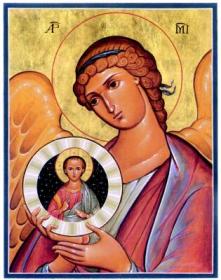
The services were almost entirely in Slavonic (I heard one litany and one prayer in English). So I spent a good deal of the time looking at the iconography, applying some skills from the iconography class I'm auditing. The iconography, mostly in pastel colors, shows clear Art Nouveau influence. It would have been right at home in a Roman Catholic cathedral of its era (the early 20th century).

On the south side of the nave is a large relic case containing 50 or so relics. If you've ever wondered how to spell St. Raphael of Brooklyn in Slavonic, this is the place to look.

Sunday, January 31, 2010

Schmemann on Fundamentalism and Secularism

In his essay, "Worship in a Secular Age," Father Alexander Schmemann traces the origin of secularism to a medieval Western theological error. In condemning Berengarius of Tours for his teaching that "because the presence of Christ in the eucharistic elements is 'mystical' or 'symbolic,' it is not real," the Lateran Council simply reversed the formula and proclaimed that because Christ's presence in the Eucharist is real, it is not mystical or symbolic. Both sides in the debate accepted the mutual exclusivity of verum and mystice, which undermined "the fundamental Christian understanding of creation in terms of its ontological sacramentality." Schmemann continues:

Let us not be mistaken, however. This Western theological framework was in fact accepted by the Orthodox East also, and since the end of the patristic age our theology has been indeed much more "Western" than "Eastern." If secularism can be properly termed a Western Heresy, the very fruit of the basic Western "deviation," our own scholastic theology has also been permeated with it for centuries, and this in spite of violent denunciations of Rome and papism. And it is indeed ironic, but not at all accidental, that psychologically the most "Western" among the Orthodox today are precisely the ultra-conservative "Super-Orthodox," whose whole frame of mind is legalistic and syllogistic on the one hand, and is made up, on the other hand, of those very "dichotomies" whose introduction into Christian thought is the "original sin" of the West. Once these dichotomies are accepted, it does not matter, theologically speaking, whether one "accepts" the world, as in the case of the Western enthusiast of "secular Christianity," or "rejects" it, as in the case of the "Super-Orthodox" prophet of apocalyptic doom. The optimistic positivism of the one, and the pessimistic negativism of the other are, in fact, two sides of the same coin. Both, by denying the world its natural "sacramentality" and radically opposing the "natural" to the "supernatural," make the world grace-proof, and ultimately lead to secularism.


From For the Life of the World, by Alexander Schmemann, pp. 128-130.

Sunday, January 3, 2010

Vacation Reading

I am free for a whole month between semesters – my longest period without work or classes in 15 years. While I have been spending quite a bit of time with my family, especially playing with my nephews and niece, I have managed to get in some reading, as well.

I wanted to get a jump on my reading for next semester without over-exerting my brain while recovering from final exams and relaxing with my family. So I started with Orthodox Christians in America, by John H. Erickson. It is written at a junior high level, but it will be required reading for Church History this coming semester, as it is the only book ever written on American Orthodox History. It gives a solid overview of the subject, but leaves a lot of details to be filled in.

An excellent place to begin filling in those details is my favorite podcast, Matthew Namee’s "American Orthodox History" on Ancient Faith Radio. Before I left campus, I loaded up my MP3 player with podcasts from AFR to listen to on the road, including the two most recent episodes of "American Orthodox History." The last episode was especially interesting. Namee interviewed Nicholas Chapman about his research on members of the Ludwell and Paradise families of Virginia and Britain, who were secretly Orthodox in the 18th century. Members of these families were tied to the founding fathers of the United States, the governments of Russia and the UK, the Non-Jurors, and the Jacobites.

Next on my reading list was the children's novelette Odd and the Frost Giants, Neil Gaiman’s take on the world of Norse myth: "In a village in ancient Norway lives a boy named Odd, and he's had some very bad luck: His father perished in a Viking expedition; a tree fell on and shattered his leg; the endless freezing winter is making villagers dangerously grumpy. Out in the forest Odd encounters a bear, a fox, and an eagle – three creatures with a strange story to tell. Now Odd is forced on a stranger journey than he had imagined."

Having recovered from final exams, I was ready to tackle something a bit more challenging. A few days ago I began reading Dragon’s Wine and Angel’s Bread: The Teaching of Evagrius Ponticus on Anger and Meekness. The subtitle says it all. Since anger is a recurring theme of my confessions, this book went to the top of my reading list even before it was published. I plan to read this one slowly in order to digest it all.

Other books I am carrying around in my book bag include The Orthodox Church in the Byzantine Empire, by J. M. Hussey, another book on the syllabus for Church History in the spring semester; Mary for Time and Eternity: Essays on Mary and Ecumenism, which includes an article by my friend Virginia M. Kimball that she has been pushing me to read for a couple of years; The Challenge of Our Past: Studies in Orthodox Canon Law and Church History, another book by John H. Erickson, which is on the syllabus for Liturgical Theology; The Cappadocians, by Anthony Meredith; and finally, another book for fun: Arabian Fairy Tales, by Amina Shah. I hope to get to a couple of these before I return to campus.

Monday, December 28, 2009

As We Come Out of Darkness

Having been raised Methodist, I think of singing as an essential part of church. The biggest thing that initially drew me to both Anglo-Catholicism and Orthodoxy was the principle of a liturgy that is mostly sung. During my Anglo-Catholic years, it took me a long time to get used to the Low Mass, a service with no singing at all (though I eventually grew to love serving at Low Mass more than any other service).

Nearly all of my pre-Orthodox singing, however, was done as a member of the congregation. I chose both my Anglo-Catholic parish and my Orthodox parish mostly because their respective congregations were participants in the singing, not just an audience for the choir. (One might argue that I was a member of the choir when I was chanting psalms as a vocationer with the Benedictines, but in a monastery the monks are really both choir and congregation.) I have written previously about how I got into chanting after I became Orthodox, so I won't repeat that story here.

Singing at Seminary

After patristics, my most demanding class in my first semester at St. Vlad's was liturgical music. It was an easy class for the OCA students with choir experience, but not so easy for the rest of us, especially the Antiochians. I've never been much of a choral singer - I have trouble hearing parts other than the melody. And, to the extent that I have sung in choir at all, it has been as a tenor. (When I was a freshman, my music major friends told me I was a tenor, and I always assumed they knew what they were talking about.) But in my voice test at St. Vlad's, I learned that I am actually a baritone. And then I was assigned to the mixed choir, where the only parts for men are tenor and bass, so I struggled to sing bass. In addition to singing at Matins or Vespers four days a week, plus Vigil every other Saturday and Liturgy most Sundays, I had to attend two choir practices and a music lecture each week. All together, that came to about ten hours a week, not counting the biweekly music quizzes, which were held outside of class time and required a lot of preparation.

During my first semester at St. Vlad's, the thing I missed most was chanting at Matins every week at my home parish. So I was really looking forward to being back for Matins on Christmas Eve and the Sundays before and after, chanting familiar Byzantine music. The two Sundays were to be tones 3 and 4, no less - my two favorite tones!

But I learned a few weeks ago that Matins on the Sunday after Christmas would be displaced by a baptism, and Christmas Eve would be complicated by the presence of the bishop. So I placed most of my hopes on the Sunday before Christmas. Unfortunately, thanks to last weekend's big snow storm, Matins was cancelled and I was snowed in at my brother's house (the first of several weather-related complications of my Christmas vacation). So Christmas Eve would be my only opportunity to chant.

The Stolen Canon

At Holy Cross, our normal schedule on December 24 is Royal Hours at 9 AM and Matins at 10 PM, followed by the Divine Liturgy. This year we added Vespers following the Royal Hours. When I arrived I found the largest congregation I've ever seen for Royal Hours - a good turn-out for our bishop's visit. The service moved a bit quicker than usual, as it often does when Bishop Thomas is present. When it ended, and I moved up to the chanters' stand for Vespers, I was disappointed to learn that our protopsalti, Emily, would not be joining us. Her absence left us in disarray, but we managed to get through the service. The bishop jumped in a few times and unexpectedly sang hymns that chanters were expecting to do. This was actually something of a relief at the aposticha, which we were not completely ready for.

When I checked my e-mail a few hours later, I learned that Emily was out with the flu and would not be joining us for Matins either, and my Matins assignment had been expanded to include the stichera on the Praises, as well as the kathisma hymns. My only other major parts were ones I knew about - the First Nativity Canon and the odd verses of the Great Doxology, both to be sung with Garth. I had been practicing the Nativity Canon for nearly a month - and it was challenging enough that I really needed that much time to learn it. I spent a couple of hours at my office printing music, marking up the kathismata and stichera for free chanting, and practicing everything, then headed for church.

The three chanters stood with the choir at the back of the church, rather than at the chanters' stand. Matins started smoothly. I free chanted the first two kathismata pretty well but was a bit shaky on the third, which followed a different pattern than the first two. The men got through the Polyeleos without messing up the "humiliation" verse, but in celebrating that small victory almost missed the next verse. Eventually, the time came for the Nativity canons. Garth and I chanted the first ode of the first canon, and then Debra chanted the first ode of the second canon. Before we could start on the next ode of the first canon, Bishop Thomas jumped in and sang it. He did this on all the remaining odes of the first canon. In no time, the piece I had been practicing for weeks was over and I only got to sing the first verse. I managed to recover my composure in time to free chant the stichera on the Praises, which went well. We concluded Matins with the Great Doxology in tone 2, and it sounded much better than it had in rehearsal two nights earlier.

Without Transubstantiation

The bishop sang a slightly different translation of the First Nativity Canon than the one we had been practicing. In the third and sixth odes where our translation read, "without change," he sang, "without transubstantiation." In both instances, the original Greek words come from a root that means "to flow" or "to change." (This is a different word than the one translated "without change" in the Chalcedonian definition of Christ's two natures and in the hymn "Only-Begotten Son.") The bishop's translation is one that appears in various official Antiochian places, like the website of the Los Angeles diocese. (The existence of multiple official translations is not unusual in the Antiochian Archdiocese.) I am still wondering if this translation was intended by the translator as a bit of anti-Roman polemic. Or, alternatively, did he have a limited English vocabulary heavy on technical theological terms?

My favorite ode of this canon is the fifth. (The fifth ode of a canon is based on Isaiah 26:9-20.) The ode reads:

O Lover of Mankind, since thou art the God of Peace and the Father of Mercies, thou didst send to us the Angel of Thy Great Counsel, granting us thy peace. Wherefore have we been led aright to the light of divine knowledge, glorifying thee as we come out of darkness.

Just after we have passed the darkest time of the year and the days are beginning to lengthen, we celebrate the arrival of the Logos, the true light who came into the world to enlighten us all.

Wishing a merry Christmas and a happy 2010 to all of my readers.

Sunday, November 22, 2009

Melito's Reproaches

O lawless Israel, what is this new injustice you have done,
casting strange sufferings on your Lord?
Your master who formed you,
who made you,
who honored you,
who called you Israel.


He it was who led you into Egypt,
and guarded you there and sustained you.
He it was who lit up your way with a pillar,
and sheltered you with a cloud.
He cut the Red Sea open, leading you through,
and destroyed the enemy.

He it is who gave you manna from heaven,
who gave you drink from a rock,
who gave you the law at Horeb,
who gave you the inheritance in the land,
who sent you the prophets,
who raised up kings for you.

He it is who, coming to you,
healed your suffering and raised your dead.
He it is whom you outraged,
he it is whom you blasphemed,
he it is whom you oppressed,
he it is whom you killed,
he it is whom you extorted,
demanding from him two drachmas as the price of his head.


His gifts to you are beyond price,
yet you held them worthless when you thanked him,
repaying him with ungrateful acts;
evil for good,
affliction for joy,
and death for life.
On this account you had to die.


On Pascha 81, 84-86, 90
by Melito of Sardis
translated by Alistair Stewart-Sykes.

Sunday, November 8, 2009

Melito's Exsultet

This is the one who clad death in shame
and, as Moses did to Pharaoh,
made the devil grieve.
This is the one who struck down lawlessness
and made injustice childless,
as Moses did to Egypt.
This is the one who delivered us from slavery to freedom,
from darkness into light,
from death into life,
from tyranny into an eternal Kingdom,
and made us a new priesthood,
and a people everlasting for himself.

This is the Pascha of our salvation:
this is the one who in many people endured many things.
This is the one who was murdered in Abel,
tied up in Isaac,
exiled in Jacob,
sold in Joseph,
exposed in Moses,
slaughtered in the lamb,
hunted down in David,
dishonored in the prophets.

This is the one made flesh in a virgin,
who was hanged on a tree,
who was buried in the earth,
who was raised from the dead,
who was exalted to the heights of heaven.

This is the lamb slain,
this is the speechless lamb,
this is the one born of Mary the fair ewe,
this is the one taken from the flock,
and led to slaughter.
Who was sacrificed in the evening,
and buried at night;
who was not broken on the tree,
who was not undone in the earth,
who rose from the dead and resurrected humankind from the grave below.

On Pascha 68-71
by Melito of Sardis
translated by Alistair Stewart-Sykes.

Sunday, November 1, 2009

Melito's Typology


The Lord made advance preparation for his own suffering,
in the patriarchs and in the prophets and in the whole people;
through the law and the prophets he sealed them.
That which more recently and most excellently came to pass he arranged from of old.
For when it would come to pass it would find faith,
having been foreseen of old.

Thus the mystery of the Lord,
prefigured from of old through the vision of a type,
is today fulfilled and has found faith,
even though people think it something new.
For the mystery of the Lord is both new and old;
old with respect to the law,
but new with respect to grace.
But if you scrutinize the type through its outcome you will discern him.

Thus if you wish to see the mystery of the Lord,
look at Abel who is likewise slain,
at Isaac who is likewise tied up,
at Joseph who is likewise traded,
at Moses who is likewise exposed,
at David who is likewise hunted down,
at the prophets who likewise suffer for the sake of Christ.

And look at the sheep, slaughtered in the land of Egypt,
which saved Israel through its blood whilst Egypt was struck down.

On Pascha 57-60
by Melito of Sardis
translated by Alistair Stewart-Sykes.

Saturday, October 31, 2009

UN Prayer Service

On Monday I attended the Ninth Annual Orthodox Christian Prayer Service for the United Nations Community, sponsored by the SCOBA/SCOOCH Joint Commission of Eastern and Oriental Orthodox Churches. The service took place at Holy Trinity Cathedral with His All Holiness Ecumenical Patriarch Bartholomew presiding and Ambassador Strobe Talbot as the featured speaker. The choir from St. Vladimir's Seminary was to sing the recessional, so the seminary rented a bus for the occasion. There were extra seats on the bus, so I went along.

The Ethiopian choir that was to sing the processional did not show up, so the St. Vlad's choir was asked to do it. During the lengthy delay before the entrance, the choir ran through its whole repertoire, except the number they were saving for the recessional. So the first 19 minutes of the video are just the St. Vlad's choir singing. At about the 15-minute mark the bishops finally begin to trickle in. Vespers begins at about the 25-minute mark. The service is sung by the choir from Holy Cross Greek Orthodox School of Theology. Both choirs sounded great, and they demonstrated just how different Russian and Greek music sound.


The sound quality of the video is inconsistent - there are some spots where it gets faint and scratchy.

Saturday, October 17, 2009

Sacramental Validity

[The priest's prayer for himself] is important because it denounces and corrects the tendency to understand sacraments somewhat "magically," a tendency widespread among the Orthodox and whose spiritual danger and consequences in the life of the Church are often overlooked. Since, according to the Church's teaching, the validity of sacraments does not, in any way, depend on either the holiness or the deficiencies of those who perform them, one has come little by little to view and to define sacraments exclusively in terms of "validity," as if nothing else "mattered." The whole point, however, is that the Church does not separate validity from fullness and perfection. "Validity" is merely the condition for fulfillment, but it is this latter that truly "matters." The Baptism of a man like Stalin was probably a perfectly "valid" one. Why then was it not fulfilled in his life? Why did it not prevent Stalin from sinking into incredible abomination? The question is not a naive one. If millions of people, "validly" baptized, have left the Church and still leave it, if Baptism seems to have no impact on them whatsoever, is it not, first of all, because of us, because of our weakness, deficiencies, minimalism and nominalism, because of our own constant betrayal of Baptism? Is it not because of the incredibly low level of the Church's life, reduced to a few "obligations" and thus having ceased to reflect and to communicate the power of renewal and holiness? All this of course applies above all to the clergy, to the priest, the celebreant of the Church's mysteries. If he himself is not the image of Christ, "by word, by deed, by teaching" (I Tim. 4:12), where is man to see Christ and how is he to follow Him? Thus to reduce sacraments to the principle of "validity" only is to make a caricature of Christ's teaching. For Christ came into this world not that we may perform "valid" sacraments; He gave us valid sacraments so that we may fulfill ourselves as children of light and witnesses of His Kingdom.

From Alexander Schmemann, Of Water and the Spirit: A Liturgical Study of Baptism, pp. 44-45.

Saturday, October 10, 2009

Words of Power

We speak to the Devil! It is here that the Christian understanding of the word as, above all, power is made manifest. In the desacralized and secularized worldview of the "modern man," speech, as everything else, has been "devaluated," reduced to its rational meaning only. But in the biblical revelation, word is always power and life. God created the world with His Word. It is power of creation and also power of destruction, for it communicates not only ideas and concepts but first of all spiritual realities, positive as well as negative. From the point of view of a "secular" understanding of speech, it is not only useless, it is indeed ridiculous to "speak to the Devil," for there can hardly be a "rational dialogue" with the very bearer of the irrational. But exorcisms are not explanations, not a discourse aimed at proving anything to someone who from all eternity hates, lies and destroys. They are, in the words of St. John Chrysostom, "awesome and wonderful invocations," an act of "frightening and horrible" power which dissolves and destroys the evil power of the demonic world:

   [Here follows the First Prayer of Exorcism from the Byzantine baptismal service.]

Exorcism is indeed a poem in the deepest sense of this word, which in Greek means creation. It truly manifests and does that which it announces; it makes powerful that which it states; it again fills words with the divine energy from which they stem. And exorcism does all this because it is proferred in the name of Christ; it is truly filled with the power of Christ, who has "broken" into the enemy territory, has assumed human life and made human words His own, because He has already destroyed the demonic power from within.

From Alexander Schmemann, Of Water and the Spirit: A Liturgical Study of Baptism, pp. 24-25.